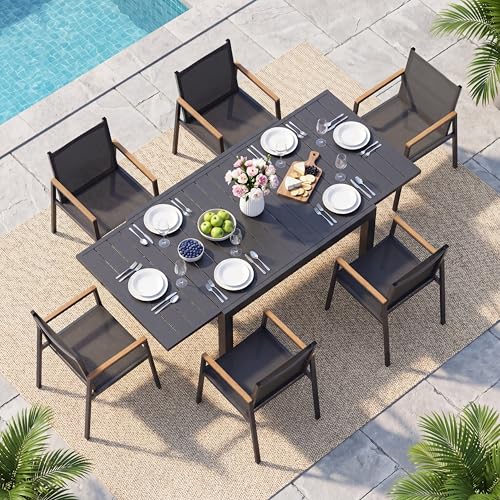
6 Person Outdoor Dining Table and Chairs
Everything you need to choose a six-seater patio dining set — sizing, table shapes, materials, chair styles, and the practical features that matter for daily outdoor use.
START THE BUYING GUIDEWhy a six-seat set is the outdoor sweet spot: A 6 person outdoor dining table and chairs configuration seats a typical family with room for guests, fits comfortably on most mid-size patios, and still leaves circulation space around the table. It is the most versatile capacity in outdoor dining — large enough for entertaining, compact enough to remain practical.
Why Choose a Six-Person Outdoor Dining Set
A six-person dining set bridges the gap between compact bistro arrangements and oversized eight-seat entertaining tables. For most households, it is the capacity that balances everyday usability with hosting flexibility. A six-seater gives each diner enough elbow room to eat comfortably without forcing you to dedicate half your patio to a single piece of furniture.
Dining outdoors introduces variables that indoor furniture never faces: sun exposure, rain, temperature swings, and seasonal storage. That makes the material choice and the construction quality of the table and chairs far more consequential than they would be indoors. A well-chosen six-seat set becomes a long-term investment in your outdoor living space; a poorly chosen one becomes a maintenance burden within a single season.
This guide walks through the dimensions that actually matter, the table shapes available at this capacity, the chair styles that pair with them, and the material and construction details that separate durable sets from short-lived ones. If you are still comparing capacities, you may also want to look at a slightly larger eight-person outdoor dining table and chairs arrangement to understand how much more footprint the next size up requires.
Key Buying Factors for a Six-Seater Patio Dining Set
1. Table Dimensions and Seating Geometry
The single most common mistake when buying a six-seat dining set is underestimating the table length required for comfortable seating. A rectangular table intended for six people generally needs to be at least 60 to 72 inches long so that three chairs fit along each long side without shoulders colliding. Shorter tables force diners to angle their chairs outward, which pushes them away from the table edge and creates an awkward dining posture.
Depth matters too. A table depth of around 36 to 40 inches allows place settings on both sides plus a serving area in the center. Narrower tables technically seat six but leave almost no room for shared dishes, which defeats the purpose of a family dining table. If your space is constrained, a round table is often the better geometry — a 60-inch round table seats six comfortably because the circular edge distributes seating evenly rather than concentrating it along two long sides.
2. Table Shape: Rectangular vs Round vs Oval
Rectangular tables maximize seating along a wall or in a defined dining zone and pair naturally with bench seating. Round tables improve conversation flow, eliminate corner collisions in tighter spaces, and suit patios where the table sits at the center of a circular furniture arrangement. Oval tables split the difference — they retain the convivial feel of a round table while offering slightly more usable surface area.
For a six-person configuration specifically, round and rectangular are the two dominant choices. If your patio is square or you entertain in small groups with lots of cross-table conversation, a six-person round outdoor dining table set is often the more natural fit. If you prefer defined place settings and the option of adding a bench later, a rectangular set is the more flexible foundation.
3. Chair Style and Comfort
Chairs determine how the set actually feels in daily use far more than the table does. At this capacity, the main chair categories are:
- Stackable armchairs: The most practical everyday option. Easy to move, easy to store, and typically lighter in construction.
- Swivel or rocking chairs: Add comfort and a relaxed feel, but require more clearance around the table and are heavier to reposition. A six-seat outdoor dining set with umbrella paired with swivel chairs is a popular comfort-focused configuration.
- Bench seating: Maximizes seating along one side and creates a built-in, communal look. A six-person dining table set with bench is a strong choice for families with children.
- Sling or mesh chairs: Breathable, quick-drying, and well suited to warm climates and uncovered patios.
Regardless of style, check seat height relative to table height. Standard dining height pairs a table around 28 to 30 inches with chairs around 17 to 19 inches at the seat. Counter-height and bar-height sets use a different ratio entirely, so never mix heights between the table and chairs.
4. Materials and Weather Resistance
Outdoor dining furniture lives outside year-round in most climates, so material selection is the deciding factor in longevity. The main frame families are:
- Powder-coated aluminum: Lightweight, rust-resistant, and the most common frame material for mid-range and premium sets. Powder coating is the key protective layer — a well-applied coating resists chipping and fading.
- Cast aluminum: Heavier and more substantial than tubular aluminum, with decorative detailing. Cast aluminum sets are typically positioned in the premium and luxury tiers and offer excellent stability in wind.
- Steel and wrought iron: Very sturdy and heavy-duty, but require a rust-proof finish and periodic inspection of welds and joints.
- Wicker and rattan (natural or synthetic resin): Warm, textured appearance. Synthetic resin wicker is the weather-resistant version and is far better suited to outdoor use than natural rattan. A six-piece wicker patio set with cushions shows how this material is typically packaged at this capacity.
- Wood (teak, acacia, eucalyptus): Naturally beautiful and repairable, but requires sealing or oiling and benefits from seasonal storage in harsh climates.
- Resin and plastic: The most weather-tolerant and lowest-maintenance option, well suited to entry-level sets and casual family use.
Tabletops follow a parallel logic. Glass tops are easy to wipe clean and visually lighten a space but show water spots; slatted aluminum and cast tops drain rainwater and tolerate heat well; solid surface and composite tops resist scratching but are heavier. For uncovered patios, drainage-friendly slatted tops are usually the most practical choice.
5. Umbrella Compatibility and Shade
If your patio is not covered by a pergola, gazebo, or awning, umbrella compatibility becomes a practical requirement rather than a bonus. There are two approaches: a table with a pre-cut umbrella hole and a stabilizing base, or a freestanding cantilever umbrella positioned beside the table. A six-person outdoor dining table with umbrella hole is the more common and generally more stable solution, because the umbrella is anchored through the table and weighted at the base.
Confirm two things before buying: the hole diameter matches your umbrella pole, and the table has a mechanism to secure the umbrella — either a built-in collar or room for a weighted base beneath the table. Without one, a gust of wind can tip the entire assembly.
6. Cushions, Fabric, and Maintenance
Cushioned chairs are more comfortable for long dinners but introduce a fabric component that must survive sun, rain, and mildew. Look for solution-dyed acrylic or olefin fabrics, which hold color and resist fading far better than untreated cotton blends. Quick-dry foam cores prevent cushions from staying waterlogged after rain. If your set will be exposed to the elements, plan for storage: either a deck box or a covered cart for cushions during the off-season.
Frame maintenance is straightforward for most materials. Rinse aluminum and resin frames periodically, touch up any chipped powder coating promptly, and inspect steel or iron sets for early signs of rust at joints and welds. Wood sets benefit from an annual oil or sealant application.
7. Assembly, Delivery, and Footprint Planning
Before ordering, measure your patio and account for the chairs pulled out from the table. A six-seat set needs roughly 36 inches of clearance on all sides for diners to get in and out comfortably — more if chairs swivel or rock. Mark the footprint on your patio with tape and walk around it; this simple step prevents the most common post-purchase regret.
Most six-seat sets ship flat-packed and require assembly, typically 45 to 90 minutes with basic tools. Check whether the retailer offers white-glove delivery if you would rather not assemble it yourself, and confirm the return policy on large furniture before ordering.
Comparing Six-Person Dining Set Configurations
The table below compares common configurations by category rather than by any numeric figure, so it stays useful regardless of market conditions.
| Configuration | Tier Positioning | Best For | Considerations |
|---|---|---|---|
| Rectangular aluminum table + six stackable chairs | Entry-level to mid-range | Everyday family dining, uncovered patios | Lightweight and easy to rearrange; confirm powder-coat quality |
| Round 60-inch table + six chairs | Mid-range | Conversation-focused entertaining, square patios | Even seating distribution; check chair clearance at the curve |
| Cast aluminum table + six chairs | Premium to luxury | Wind-exposed patios, long-term installation | Heavy-duty and stable; requires more effort to move |
| Table + bench + four chairs | Mid-tier | Families with children, space-efficient seating | Bench limits individual chair adjustment |
| Synthetic wicker set with cushions | Mid-range to high-end tier | Covered porches, styled outdoor rooms | Cushions need storage; resin wicker outperforms natural rattan |
| Resin or plastic set | Essential tier | Casual use, rental properties, harsh weather | Lowest maintenance; lighter visual presence |
If your priority is shade coverage for the whole table, compare how different sets handle umbrella anchoring in a six-person outdoor dining set with umbrella. If you want a more compact footprint with the same capacity, a six-person patio table with umbrella hole is worth reviewing alongside the standard rectangular options.
How to Choose the Right Six-Person Set for Your Patio
Work through these decisions in order — each one narrows the next.
Step 1: Measure the usable footprint
Mark the table footprint plus 36 inches of clearance on every side. If that does not fit, consider a round table or a bench configuration to reduce the effective depth of the seating zone.
Step 2: Decide on exposure
A fully uncovered patio argues for aluminum, resin, or synthetic wicker with quick-dry cushions. A covered porch opens up wood and cushioned wicker as realistic options.
Step 3: Choose the seating style
Stackable chairs for flexibility, benches for family seating density, swivel chairs for comfort. Be consistent about height category — standard, counter, or bar.
Step 4: Confirm shade strategy
Table-mounted umbrella, cantilever umbrella, or overhead structure. If table-mounted, verify the hole diameter and stabilization method.
Step 5: Plan storage and maintenance
Decide where cushions and the umbrella go in the off-season, and how much annual maintenance you are prepared to do for wood versus aluminum or resin.
Frequently Asked Questions
How long should a six-person outdoor dining table be?
A rectangular table for six should generally be at least 60 to 72 inches long to seat three people per side comfortably, with a depth of roughly 36 to 40 inches for place settings and serving space. A 60-inch round table is the equivalent circular option.
Is a round or rectangular table better for six people?
Round tables distribute seating evenly and suit conversation-focused patios and square spaces. Rectangular tables offer more defined place settings and pair well with bench seating. Both seat six comfortably at the right dimensions.
How much clearance do I need around the table?
Allow roughly 36 inches on all sides so diners can pull chairs out and move around the table. Swivel or rocking chairs may need additional clearance.
Which material lasts longest outdoors?
Powder-coated aluminum and cast aluminum offer the best combination of weather resistance and low maintenance. Resin is the most tolerant of harsh conditions. Steel and wrought iron are very durable but require vigilance against rust. Wood needs periodic sealing or oiling.
Do I need an umbrella hole in the table?
Only if you plan to use a table-mounted umbrella. If your patio is covered by a pergola or awning, or if you prefer a cantilever umbrella, an umbrella hole is optional.
Can a six-person set fit on a small patio?
Often yes, if you choose a round table and use a bench on one side to reduce the effective footprint. Measure the full clearance zone before ordering rather than just the table dimensions.
Ready to Compare Six-Seat Sets?
Review the recommended six-person outdoor dining table and chairs options below, then check dimensions, material, and umbrella compatibility against your measured patio footprint before you decide.
Explore Recommended Options