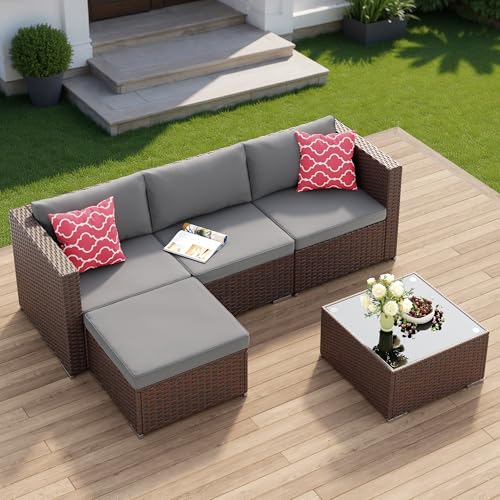
Sectional Patio Furniture for Small Spaces
Compact layouts, clever configurations, and practical buying advice for turning a tiny patio, balcony, or deck into a comfortable outdoor living room.
EXPLORE BUYING FACTORSWhy this guide matters: A sectional is one of the most efficient ways to seat several people in a compact outdoor area, but the wrong configuration can swallow up your entire patio. This guide explains how to match the shape, footprint, and materials of a sectional to a small space so that the furniture works with the layout instead of against it.
Why a Sectional Works Well in a Small Patio
A sectional consolidates seating into a single continuous footprint instead of scattering individual chairs around the patio. In a small space, that consolidation is a real advantage. An L-shaped or corner arrangement tucks seating into the edges of the patio, keeps the center open for a walkway, and creates a natural conversation zone without requiring a large open floor plan.
Sectionals also tend to offer more usable seating per square foot than a matching sofa-and-armchair set. Corner seats, chaise extensions, and ottomans that double as coffee tables all add function without adding separate pieces. If your patio is narrow, an L-shape that hugs two walls usually frees up more usable space than a straight sofa floating in the middle of the area.
The trade-off is that a sectional is less flexible than loose seating once it is assembled. That is why the configuration you choose matters more in a small space than in a large one. Modular designs address this by letting you rearrange, reduce, or extend the sectional as your needs change throughout the season.
Common Layout Configurations for Compact Patios
Small patios generally fall into one of a few layout shapes, and each one favors a different sectional arrangement. Before shopping, sketch your patio on paper and mark doors, steps, railings, and the path people use to move through the space. The sketch will quickly rule out configurations that look appealing but block circulation.
L-Shaped and Corner Sectionals
The L-shape is the most common choice for small patios because it uses a corner that would otherwise sit empty. A two-piece L can seat three to five people while leaving the opposite side of the patio open. Corner sectionals work especially well on square patios and on decks where two sides are bounded by railings.
Two-Piece and Three-Piece Modular Sectionals
Modular sectionals with two or three pieces are the most adaptable option for tight spaces. You can set them up as an L for entertaining, split them into a sofa and a standalone chair when guests leave, or store one piece away entirely. If your patio doubles as a passageway, a modular set lets you reclaim that passage in seconds.
Straight and Reversible Sectionals
A straight sectional with a reversible chaise is a practical middle ground. The chaise can sit on either end depending on where your patio wall or railing is, and the overall footprint stays narrow. These designs suit long, narrow balconies where an L-shape would block the walkway.
If your layout is defined by a round dining zone rather than a seating corner, it may be worth reading about round patio furniture as an alternative organizing principle before committing to a sectional.
Curved and U-Shaped Options
Curved sectionals soften the look of a small patio and avoid sharp corners that are easy to bump into. They require a slightly wider footprint than an L-shape, so they work best on patios that are square rather than narrow. Full U-shaped sectionals are rarely a good fit for a small space unless the patio is unusually deep, because the open side of the U tends to become the only walkway.
Key Buying Factors for Small-Space Sectionals
Once you know which layouts fit your patio, the decision narrows down to a handful of practical factors. The table below summarizes how each factor affects the fit in a compact space.
| Factor | What to Look For | Why It Matters in a Small Space |
|---|---|---|
| Footprint | Compact two- or three-piece sets with shallow seat depth | Leaves room for walkways and a coffee table |
| Configuration | Modular or reversible chaise designs | Adapts as the patio layout or your needs change |
| Frame material | Powder-coated aluminum, high-grade steel, or resin wicker over aluminum | Balances durability with weight that is easy to move |
| Cushions | High-density foam with solution-dyed acrylic covers | Resists moisture and fading in exposed conditions |
| Back height | Low-profile backs on at least one side | Keeps sightlines open and the space feeling larger |
| Storage | Ottomans with hidden storage or stackable modules | Reduces clutter in a compact area |
Measuring Before You Buy
Measure the patio in both directions and write down the usable area after subtracting door swings, steps, and grills. As a rule of thumb, leave at least 18 inches of clearance around the sectional for walkways and about 14 to 16 inches between the sectional and a coffee table. If the numbers do not leave room for both, a slimmer coffee table or a chaise that doubles as a table is a better choice than a full-size table.
Pay attention to vertical space as well. A low sectional under a window or railing looks proportioned and keeps the view open, while a tall back can make a small balcony feel walled in. You can apply the same measurement discipline used for a larger dining space; a round patio table and chairs for 4 layout guide illustrates how much clearance different furniture footprints actually require.
Frame Materials and Durability Tiers
Outdoor sectionals generally fall into a few quality tiers. Entry-level sets often use tubular aluminum with thinner walls and lighter cushions; they are a reasonable starting point for covered balconies and mild climates. Mid-range models typically step up to heavier aluminum or resin wicker over aluminum frames with denser foam cushions and better fabric treatments. Premium and luxury tiers use thicker gauge frames, welded joints, quick-dry cushion cores, and solution-dyed acrylic fabrics that hold color longer under direct sun.
For a small space, weight matters as much as durability. A heavy-duty steel frame is stable and long-lasting, but it is difficult to move when you want to reconfigure the patio. Aluminum is lighter and rust-resistant, which makes it the more practical choice for balconies and patios where furniture is rearranged often. Whichever frame you choose, a weather-resistant coating and rust-proof finish extend the life of the piece considerably.
Fabric quality is the other major variable. Solution-dyed acrylic resists fading and mildew better than printed polyester, and it is worth prioritizing if the sectional will sit in direct sun. Quick-dry foam cores help cushions recover after rain. Routine care, such as covering the sectional during storms and cleaning cushions seasonally, matters more than the tier label once the furniture is in place; the same principles covered in our weatherproofing guide apply directly to sectional cushions and frames.
Cushions, Fabrics, and Visual Weight
In a small space, the visual weight of the furniture matters as much as the physical footprint. Light neutral cushion colors, slim arms, and low backs make a sectional recede into the background and keep the patio feeling open. Dark, bulky sectionals can dominate a compact area even when their measurements are technically fine.
Consider a sectional with reversible or removable cushions so you can rotate them for even wear and wash the covers when needed. Seat cushions with zippered covers are easier to maintain than fixed upholstery. If the patio is partially covered, a lighter fabric tier is usually sufficient, but fully exposed patios benefit from a higher-grade outdoor fabric.
Smart Additions That Maximize a Small Sectional Setup
The right accessories make a compact sectional feel larger and more functional. Choose pieces that serve more than one purpose and avoid anything that duplicates a function you already have.
- Round coffee table: A round table reduces sharp corners and fits more naturally into tight walkways than a rectangular one. A round patio coffee table with umbrella hole can also anchor shade in the center of the seating zone.
- Ottoman as table and seat: A cushioned ottoman can serve as a footrest, an extra seat, or a surface for a tray, replacing a separate coffee table.
- Outdoor rug: A rug visually defines the seating area and can make a small patio feel like a finished room without adding physical bulk.
- Compact shade: A single umbrella positioned over the sectional is usually enough for a small patio. Read our guide to patio umbrellas for sizing options that suit compact layouts.
- Ambient lighting: String lights or low-voltage path lighting extend evening use of the patio without taking up floor space.
- Storage bench or deck box: Keeps cushions and throws out of the weather and doubles as extra seating when guests arrive.
If the patio also needs a dining zone, combining a seating and dining footprint is usually more space-efficient than two separate sets. Guides to round patio table and chairs arrangements show how a compact dining set can sit adjacent to a sectional without overwhelming the space.
Sectional vs. Other Seating for Small Patios
A sectional is not the only option, and it is worth confirming it is the right one before you commit. The comparison below outlines how a small sectional stacks up against common alternatives.
| Seating Option | Best For | Trade-Off |
|---|---|---|
| Two-piece modular sectional | Balconies and patios that need to flex between seating and open space | Fewer seats than a full-size sectional |
| L-shaped corner sectional | Square patios with two usable walls or railings | Less flexible once assembled |
| Sofa plus two chairs | Patios that host small gatherings and need flexible seating | Uses more total perimeter space for the same seat count |
| Bistro or dining set | Patios used mainly for meals | Less comfortable for long lounging sessions |
| Bench seating | Very narrow patios with wall space | Limited deep lounging comfort |
For patios under about 60 square feet, a two-piece modular sectional or a bench-based arrangement is usually the realistic maximum. For patios between roughly 60 and 120 square feet, an L-shaped sectional plus a compact coffee table is a comfortable fit. Larger patios can support a full sectional with a chaise and a separate dining or fire feature zone.
Practical Tips for Living With a Small Sectional
- Keep the walkway clear. Resist the urge to fill the center of the patio with tables; leave a clear path between the door and the seating.
- Choose low-profile backs on at least one side so the patio does not feel enclosed.
- Store or cover cushions during off-season weather to extend their life; covered storage also reduces clutter during the week.
- Reconfigure modular pieces seasonally. Pulling a module away from the wall in summer can open up the patio; tucking it back in winter keeps the seating cozy.
- Use vertical space for plants and lighting rather than floor space, since a sectional already claims much of the floor.
- Check that door swings and grill access remain unobstructed before finalizing the layout.
Quick Buying Checklist
- Measured the patio and confirmed at least 18 inches of walkway clearance
- Chosen a configuration (L-shape, modular, or reversible chaise) that fits the layout
- Selected a frame material appropriate for the climate and exposure
- Confirmed cushion fabric is suitable for sun and moisture exposure
- Checked that the sectional can be moved and reconfigured without heavy lifting
- Planned for storage of cushions, covers, or extra modules
- Left room for a coffee table, shade, or a small dining zone
Frequently Asked Questions
What size sectional patio furniture fits a small space?
For small spaces, look for modular sectionals with a footprint under roughly 90 inches wide and 60 inches deep, or two- to three-piece configurations that can be rearranged. Corner and L-shaped layouts usually use patio space more efficiently than full U-shapes.
Are modular or fixed sectionals better for small patios?
Modular sectionals are generally better for small patios because individual pieces can be separated, reconfigured, or stored away when not in use. Fixed L-shaped sectionals are a solid choice when the layout of the patio is already clearly defined.
Which materials work best for a compact outdoor sectional?
Powder-coated aluminum frames with high-density cushions and solution-dyed acrylic fabrics offer a strong balance of durability and light weight. Wicker and rattan wraps are popular for visual warmth, while high-grade steel is the most heavy-duty option when the space allows it.
How do I keep a small patio from feeling cramped around a sectional?
Keep at least 18 inches of walkway clearance around the sectional, choose low-profile backs, use light or neutral cushion colors, and avoid oversized coffee tables. A round coffee table often works better than a rectangular one in tight layouts.
Final Thoughts
Sectional patio furniture can be a strong fit for a small space, provided the configuration is chosen to match the patio rather than the other way around. Measure first, favor modular or L-shaped layouts that tuck into corners, choose lighter frames and weather-ready fabrics, and keep the center of the patio open for movement. With those choices in place, a compact patio can support comfortable seating for several people without feeling crowded.
If you are still comparing seating styles, our broader guide to sectional patio furniture covers full-size configurations and how they differ from compact models. For patios that also need a dining area, explore round patio table and chairs for 6 as a complementary layout option.