Indoor Hanging Chair Buying Guide: Styles, Materials & Setup
Everything you need to choose, install, and enjoy a hanging chair inside your home — from weight ratings and ceiling anchors to fabric care and styling.
Why an indoor hanging chair deserves a place in your home: A hanging chair is more than a statement piece — it creates a dedicated zone for reading, relaxing, and unwinding without occupying floor space. For homeowners researching before they buy, the key questions are always the same: which style fits my interior, what material will hold up, how much weight can it support, and how do I install it safely? This guide answers all of those questions in plain language so you can move from research to a confident purchase.
1. Indoor Hanging Chair Styles
The first decision is the silhouette. Each style changes how the chair feels in a room, how much clearance it needs, and how easy it is to get in and out of. The four dominant styles are the egg chair, the macramé hammock chair, the wicker basket chair, and the metal-frame swing chair.
Egg chairs
An egg chair has a rounded, enclosed shell that wraps around the sitter. It offers the most privacy and the most support for the head and shoulders, which makes it a strong choice for reading nooks and bedrooms. The enclosed design also means it works well in open-plan living rooms where you want a visually contained seat. If you prefer a chair that doubles as a design focal point, an egg swing chair with a smooth shell finish is the classic pick, while a rocking egg chair adds a gentle motion that many people find soothing.
Macramé hammock chairs
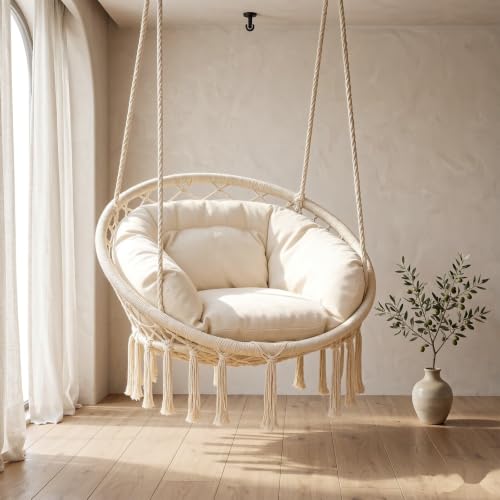
Macramé chairs are woven from cotton rope and have a soft, unstructured seat. They suit bohemian, coastal, and layered interiors and are usually the lightest option, which makes ceiling mounting simpler. The trade-off is less head and neck support, and the rope seat needs periodic inspection for fraying. They are a natural fit in bedrooms and sunrooms where a relaxed, casual feel is the goal.
Wicker and rattan basket chairs
Wicker and rattan chairs pair a woven basket shell with a cushioned seat. They bridge traditional and modern interiors and are typically sturdier than macramé because the shell is built over a rigid frame. If you like the woven look but want a chair that matches other rattan pieces in your home, a rattan chair in a matching finish creates a cohesive look across rooms. These chairs are also easier to wipe clean than rope seats.
Metal-frame swing chairs
Metal-frame chairs use a powder-coated steel or aluminum frame with a suspended fabric or upholstered seat. They are the most structured and the easiest to clean, and they tend to have the highest weight ratings. They suit modern, minimalist, and industrial interiors. A indoor swing chair with stand for adults is often the most practical version of this style because it removes the need for ceiling hardware entirely.
2. Materials and Construction
Material choice drives durability, maintenance, and how the chair ages. The table below compares the common options on the factors that matter most for an indoor chair.
| Material | Best For | Durability | Maintenance |
|---|---|---|---|
| Cotton macramé rope | Bedrooms, sunrooms, bohemian interiors | Moderate — inspect for fraying | Spot clean, keep away from direct sun |
| Wicker / rattan | Living rooms, layered traditional spaces | Good — rigid frame with woven shell | Dust regularly, wipe with damp cloth |
| Powder-coated steel | High-traffic rooms, family homes | Excellent — heavy-duty and rigid | Wipe clean; check hardware for wear |
| Aluminum frame | Apartments, lighter stands | Very good — rust-proof finish | Minimal; occasional wipe-down |
| Upholstered fabric seat | Modern and minimalist interiors | Good — depends on fabric grade | Vacuum and spot clean; covers help |
3. Weight Capacity and Safety Ratings
Weight capacity is the single most important specification, and it is also the one buyers most often overlook. The number that matters is not just the chair's rating — it is the lowest rating in the entire system: the chair frame, the suspension hardware, the ceiling anchor or stand, and the mounting surface.
- Entry-level tier: typically rated around 220 pounds. Suitable for lighter adults and older children, with a simpler suspension setup.
- Mid-range tier: commonly rated between 300 and 330 pounds. This is the sweet spot for most households and usually includes reinforced hardware.
- Premium and commercial-grade tiers: frequently exceed 400 pounds, with heavy-duty frames, welded anchors, and thicker suspension rope or chain.
Two practical rules follow from this. First, add a safety margin: if the chair is rated for 300 pounds, treat 250 pounds as the comfortable working limit. Second, never mix a high-rated chair with a low-rated anchor. The weakest link sets the real limit. If two people will occasionally share the chair, choose a model rated well above their combined weight and confirm the anchor is rated for the same load.
4. Installation: Ceiling Mount vs. Freestanding Stand
There are two safe ways to hang an indoor chair, and the right one depends on your home and whether you rent.
Ceiling-mounted chairs
A ceiling mount uses a heavy-duty anchor bolted into a structural beam or joist. It saves floor space and gives the cleanest look, but it requires locating a joist, drilling, and using hardware rated for the chair's load. Do not mount into drywall alone, and do not mount into a ceiling you cannot verify is structural. Ceiling mounts are best for homeowners who are comfortable with basic DIY or who will hire an installer.
Freestanding stands
A freestanding stand supports the chair from a curved or C-shaped metal base. It requires no drilling, can be moved between rooms, and is the correct choice for apartments and rentals. The trade-off is floor footprint: a stand occupies roughly a three-foot circle and needs a level surface. When comparing stands, check the base weight and the stand's own load rating — a lighter base can tip if the chair is pushed sideways. If you are weighing a stand-based setup against a ceiling mount, the indoor hanging chair overview page is a good starting point for model categories.
- Confirm the anchor or stand is rated at or above the chair's capacity.
- Mount only into a structural beam or joist; use a stud finder and verify.
- Leave 12–18 inches of swing clearance on all sides.
- Re-check hardware after the first week of use, then seasonally.
- Keep the chair away from heat sources, sharp edges, and door swing paths.
5. Measuring Your Space
Before ordering, measure three things: ceiling height, floor area, and the swing path.
- Ceiling height: allow at least 7 feet from the seat to the ceiling for a standard chair, and more for tall sitters. Low ceilings usually point toward a stand-based chair with a shorter suspension.
- Floor area: a ceiling-hung chair needs about a 3-foot circle of clear floor; a stand-based chair needs a similar footprint for the base itself.
- Swing path: leave 12–18 inches of clearance on all sides so the chair does not strike walls, furniture, or windows.
- Doorways and walkways: avoid placing the chair in a traffic path — a swinging chair is a trip hazard in a corridor.
Small rooms benefit from a corner placement with a ceiling mount, which frees floor space entirely. Larger rooms can use a stand-based chair as a freestanding reading nook. If you are furnishing a compact space generally, the principles in this guide overlap with small-space furniture planning: prioritize the seat you will actually use daily, and keep the swing path clear.
6. Cushions, Padding, and Comfort
Comfort comes down to three variables: seat depth, back support, and cushion quality.
- Seat depth: a deeper seat suits lounging; a shallower seat suits upright reading. Try to match the depth to how you plan to use the chair.
- Back support: egg chairs and basket chairs offer the most built-in support. Macramé chairs benefit from an added lumbar cushion.
- Cushion quality: look for removable, washable covers and a foam core that holds its shape. A thin seat pad on a rigid frame will feel firm after an hour; a layered foam cushion distributes weight better.
If you plan to add or replace cushions, check the fit against the seat dimensions before ordering, and choose fabrics that match the room's traffic level. The outdoor cushion guide explains foam density and fabric grades in more depth, and much of that guidance applies to indoor seats as well. For chairs with woven or sling seats, a fitted pad also protects the seat material from wear.
7. Care and Maintenance
An indoor hanging chair is exposed to less weather than an outdoor one, but it still needs periodic attention — especially the suspension hardware, which carries the full load.
- Monthly: inspect the suspension rope, chain, and anchor for fraying, stretching, or loosening. Re-tighten hardware as needed.
- Quarterly: clean the frame and seat. Wipe metal frames with a damp cloth; vacuum fabric and woven seats; spot clean macramé with mild soap and water.
- Seasonally: check the anchor bolts and stand base for movement. If the chair is near a window, rotate it occasionally so one side does not fade.
- Annually: replace worn suspension components. Rope and chain are inexpensive to replace relative to the chair, and fresh hardware is the simplest way to keep the setup safe.
If you use a stand, keep the base on a level, non-slip surface and avoid dragging the stand across hardwood floors. Felt pads under the base protect flooring and reduce noise.
8. Tier Comparison at a Glance
The table below uses universal quality tiers rather than numeric figures, so it stays useful over time. Use it to match a chair's position in the market to your household's needs.
| Tier | Typical Construction | Best For | What to Expect |
|---|---|---|---|
| Entry-level | Simple rope suspension, basic frame, thinner cushions | Light use, solo adults, occasional seating | Good value for its tier; verify anchor and capacity carefully |
| Mid-range | Reinforced hardware, thicker foam, better fabric | Daily use, most households, family rooms | Balanced tier with smoother suspension and better support |
| Premium | Heavy-duty frame, welded anchors, premium upholstery | Frequent use, shared seating, design-focused rooms | High-end tier with the most consistent build quality |
| Commercial-grade | Oversized hardware, commercial load ratings, robust stand | High-traffic homes, hospitality, shared spaces | Top-tier durability and the highest capacity ratings |
Why buyers choose a hanging chair
- Creates a relaxing reading nook without using floor space
- Adds a strong design focal point to a room
- Gentle motion is calming and encourages longer sitting
- Stand-based models need no drilling — renter-friendly
What to plan around
- Requires ceiling clearance and a clear swing path
- Ceiling mounts need a structural anchor and careful installation
- Fabric and rope seats need periodic cleaning and inspection
- Not ideal for households where the chair would sit in a walkway
9. Frequently Asked Questions
Can I install an indoor hanging chair in an apartment?
Yes — choose a model with a freestanding stand rather than a ceiling mount. Stands require no permanent modification to ceilings or walls, which makes them the right choice for renters and for rooms with concrete ceilings. Check the stand's weight rating and confirm the base sits on a level floor.
What weight can an indoor hanging chair support?
Entry-level models often support around 220 pounds, mid-range models typically reach 300 to 330 pounds, and premium or commercial-grade setups can exceed 400 pounds. Always confirm the rating of the full system — chair, suspension, and anchor or stand — and keep a safety margin below the stated limit.
How much ceiling space do I need?
Plan for at least 7 feet from the seat to the ceiling, plus 12 to 18 inches of swing clearance on all sides. Ceiling-mounted chairs must be anchored to a structural beam or joist; if you cannot verify the structure, use a freestanding stand instead.
Are indoor hanging chairs safe for children?
Many are, provided the chair is rated for the child's weight and the installation is correct. Choose models with enclosed or high-backed seats for younger children, anchor to a structural beam or use a certified stand, and inspect hardware regularly. Adult supervision is recommended.
What is the best material for an indoor hanging chair?
Wicker and rattan offer a classic look with good durability, macramé and cotton rope suit relaxed bohemian interiors but need more careful maintenance, and metal frames with upholstered cushions provide the most structured support and are the easiest to clean. Match the material to your interior style, traffic level, and whether pets or children will use the chair.
Ready to Choose Your Indoor Hanging Chair?
Browse recommended models, compare tiers, and check availability through our curated product selections below.
Explore Options