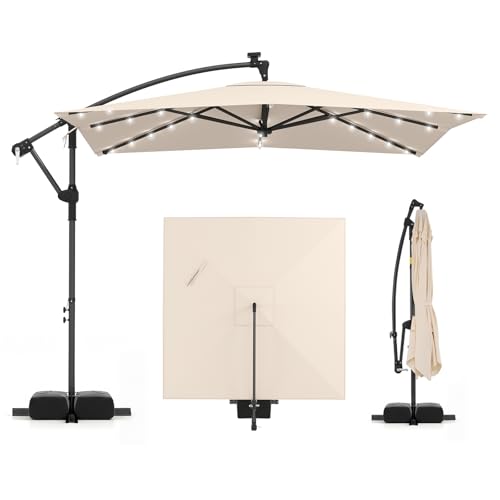
Offset Patio Umbrella With Lights and Base: The Complete Buying Guide
An offset patio umbrella with lights and base is one of the most practical upgrades you can make to an outdoor living space. Unlike a traditional center-pole umbrella, an offset design clears the area beneath the canopy so your dining table, lounge chairs, and conversation set can be arranged without a pole in the way. Add integrated lighting and a properly weighted base, and you get shade and ambiance from a single fixture that works from midday through the evening.
If you are researching this category, you already know you want a cantilever-style umbrella. What you likely need now is clarity on how these umbrellas work, what separates a sturdy model from a wobbly one, how the lighting is powered, and how much counterweight the base really needs. This guide walks through every decision point so you can buy with confidence.
What Is an Offset Patio Umbrella?
An offset patio umbrella — also called a cantilever umbrella — supports its canopy from a side arm that extends from a vertical mast. The mast sits at the edge of your seating area rather than in the middle, and the canopy hangs out over the furniture. Most models allow you to rotate the canopy a full 360 degrees and tilt it to block low-angle sun.
This design is especially valuable over dining tables, because no center pole interrupts legroom or table placement. It also pairs naturally with sectional sofas and deep lounge chairs where a center pole would be awkward. If you want to compare this shape against a related style, our overview of the off-set umbrella format explains the family of cantilever designs.
Offset vs. Center-Pole Umbrellas
- Clearance: Offset umbrellas free up the space beneath the canopy; center-pole umbrellas need a hole in the table or a freestanding base.
- Coverage: Cantilever canopies can be larger because the arm carries the load; center-pole models are limited by pole strength.
- Stability: Offset umbrellas rely on a heavy base and a robust arm; center-pole umbrellas are inherently more balanced but more intrusive.
- Flexibility: Most offset models rotate and tilt, making them easier to reposition as the sun moves.
Why Choose a Model With Integrated Lights?
Integrated lighting turns a shade structure into an evening focal point. Instead of stringing separate lights or dragging out a floor lamp, the umbrella itself provides ambient illumination. This is particularly useful for patios that lack nearby outlets or for homeowners who want a clean, uncluttered look.
Lighting also extends the usable hours of your outdoor space. A warm, diffused glow under the canopy is ideal for dinners, reading, and conversation. It pairs well with broader outdoor lighting strategies, but the umbrella lights alone can carry the evening ambiance.
Types of Umbrella Lighting
- Solar-powered LED strips: A small solar panel on the canopy top charges a battery during the day. No wiring is needed, and runtime depends on sun exposure. These are the most common option and are efficient in the long run for sunny locations.
- Rechargeable LED hubs: A removable light unit clips to the ribs and charges via USB. You can bring it inside to charge and reattach it when needed.
- Hardwired or plug-in LED: Some premium models include a low-voltage cable that runs down the mast. These offer consistent brightness but require an outdoor outlet nearby.
- Battery-operated puck lights: Small, removable lights that attach to the canopy ribs. They are simple and portable but require battery changes.
How the Cantilever Mechanism Works
The cantilever arm is the heart of an offset umbrella. It must support the canopy's weight while remaining smooth to operate. Look for these mechanism types:
- Crank and cable: A hand crank raises and lowers the canopy via an internal cable. Simple and common, but the cable should be high-grade steel with a protective coating.
- Pistol grip / trigger: A trigger releases the arm so you can slide it into position. Convenient but requires a sturdy locking collar.
- Foot pedal rotation: A pedal at the base lets you rotate the canopy hands-free. This is a premium convenience feature.
- Motorized operation: Top-tier models use a motor for opening, closing, tilting, and rotating. These are the easiest to use and often include a remote and wind sensor.
Whichever mechanism you choose, test the smoothness of the movement. A mid-range model with a well-machined collar often feels better than an entry-level model with a loose fit. If you want to see how offset designs compare with other cantilever formats, our guide to offset patio umbrellas covers the wider category, while offset umbrella breaks down the terminology.
Frame Materials and Build Quality
The frame determines how long the umbrella lasts and how stable it feels in a breeze. Common materials:
- Aluminum: Lightweight, rust-resistant, and the most common choice for cantilever arms. Powder-coated aluminum resists corrosion and holds color well.
- Steel: Stronger than aluminum but heavier and prone to rust unless it has a high-grade coating. Look for galvanized or powder-coated steel.
- Wood: Attractive for rustic and coastal styles, but requires more maintenance and is less common in cantilever designs.
For most homeowners, powder-coated aluminum is the sweet spot: light enough to reposition, durable enough for years of use. If you are matching the umbrella to other metal furniture, the material notes in our metal furniture guide are a useful reference.
Canopy Fabric and Venting
Canopy fabric should be solution-dyed for fade resistance and rated for UV protection. A single wind vent at the top reduces lift and lets hot air escape. Some premium canopies use double vents or a vented valance for better airflow. Reinforced stress points at the rib pockets and a sturdy valance hem are signs of a well-made canopy.
Base Weight and Anchoring: The Most Overlooked Decision
An offset umbrella is a lever. The longer the arm, the more counterweight the base needs. Manufacturers specify a minimum base weight, and you should treat that number as a floor, not a target. In exposed or windy locations, a heavier base or an anchored base is safer.
Base options include:
- Fillable plastic bases: Filled with sand or water. Sand is heavier and more stable; water is easier to drain for storage.
- Steel plate bases: Heavy, low-profile, and stable. They are harder to move but very secure.
- Wheeled bases: Convenient for repositioning but must be locked in place. Check that the wheels lock firmly.
- In-ground or deck-mounted bases: The most stable option, but require installation. See our guide on mounting a cantilever umbrella to a deck for installation considerations.
If you are comparing base styles for a different cantilever model, the notes on a weighted base are worth reviewing — the principles carry over.
Quality Tiers: What to Expect at Each Level
The offset umbrella market segments cleanly into tiers. Use this table to match your expectations to the category you are shopping in.
| Tier | Frame & Mechanism | Lighting | Best For |
|---|---|---|---|
| Entry-level | Aluminum frame, basic crank, limited tilt | Solar strip or battery puck lights | Occasional use, sheltered patios |
| Mid-range | Thicker aluminum, smooth crank, full 360° rotation | Solar LED with better battery, or rechargeable hub | Regular use, family dining areas |
| Premium | Reinforced arm, foot-pedal rotation, double vent | Rechargeable or plug-in LED with dimmer | Frequent entertaining, exposed patios |
| Luxury | Motorized open/close/tilt/rotate, wind sensor | Integrated dimmable LED, remote control | High-end outdoor rooms, commercial-grade use |
Across every tier, the same rule applies: a well-specified mid-range model is often a better long-term investment than an entry-level model that needs replacing after a couple of seasons. If you are furnishing a whole patio, the broader patio essentials checklist helps you sequence purchases.
Placement and Setup Tips
- Place the mast on the side of the table that receives the most direct sun, so the canopy swings over the seating area.
- Leave clearance for rotation — the canopy sweeps a circle as it turns.
- Set the base on a level surface. Uneven ground stresses the arm and makes rotation difficult.
- Position the solar panel toward the sun if the model uses solar charging.
- Close and secure the canopy when the umbrella is not in use, especially overnight.
Matching the Umbrella to Your Furniture
An offset umbrella works with nearly any seating arrangement, but it shines over dining tables and lounge sets. If you have a metal dining table, a cantilever canopy keeps the tabletop clear. Our guide to a metal outdoor dining table with umbrella hole explains why some homeowners still prefer a center-pole option over a table with a hole — and when the offset design is the better fit.
For smaller spaces, a cantilever umbrella can free up floor area that a center-pole base would occupy. If space is tight, the ideas in our modern outdoor furniture for small spaces guide pair well with a compact offset model.
Frequently Asked Questions
Do offset umbrellas with lights need an electrical outlet?
Not necessarily. Solar and rechargeable models operate without wiring. Plug-in models need an outdoor outlet, so check the light type before buying.
Can I use an offset umbrella on a windy balcony?
Only with a properly weighted base and in calm conditions. Balconies can funnel wind, so close the canopy when not in use and consider a model with a wind sensor.
How do I clean the canopy and lights?
Remove the canopy according to the manufacturer's instructions and clean it with mild soap and water. Wipe light housings with a damp cloth. Avoid pressure washing, which can damage fabric coatings and seals.
What size umbrella do I need for a six-seat dining table?
As a general rule, the canopy should extend at least two feet beyond the table edge on all sides. Measure your table and seating footprint before choosing a canopy diameter, and confirm the arm reach matches your layout.
Final Checklist Before You Buy
- Confirm the canopy diameter covers your seating area.
- Check the rotation and tilt range against your sun exposure.
- Verify the base meets the manufacturer's minimum weight and suits your surface.
- Choose a light type that matches your sun exposure and outlet availability.
- Review the warranty and replacement parts availability.
With these decisions settled, you are ready to compare specific models. The recommended products below are a good starting point for evaluating features side by side.