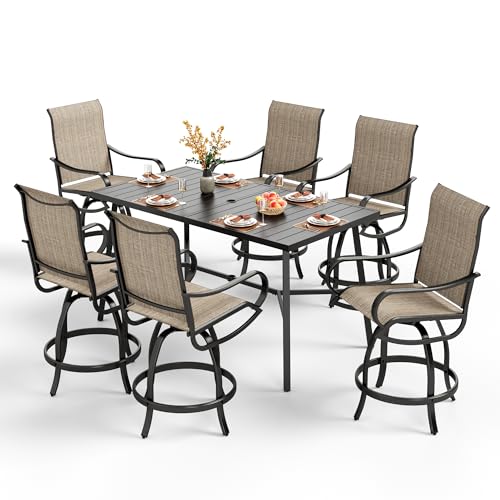
Bar Height Patio Dining Set with Swivel Chairs: The Complete Buying Guide
Understand frame construction, swivel mechanisms, table proportions, and layout planning so you can choose an elevated outdoor dining set that fits your space and lifestyle.
Why consider a bar height patio dining set with swivel chairs? Bar height outdoor dining sets raise the table surface so guests can stand, perch, or sit with a clear sightline across the yard. Adding swivel chairs turns that elevated surface into a flexible social hub: guests rotate toward the grill, the fire table, or the conversation without sliding furniture across the deck.
This guide walks through the practical details buyers research before committing — frame materials, swivel hardware, table height standards, chair ergonomics, and space planning. Use it as a research companion, then explore the recommended products at the end of the page.
What Defines a Bar Height Patio Dining Set with Swivel Chairs?
A bar height patio dining set with swivel chairs combines three elements that work together: an elevated table (typically around 40 to 42 inches from the ground), matching bar stool-height chairs with a swivel seat mechanism, and a coordinated frame finish that survives outdoor exposure. The elevated surface changes how the set functions compared with a standard dining table. Instead of a seated meal anchored to the floor, guests sit at a height that aligns with outdoor kitchen counters, balcony railings, and standing conversation.
The swivel function is the differentiator. A swivel chair rotates on a bearing or ring assembly mounted between the seat and the base. That rotation lets a guest pivot from the table toward a fire pit, a view, or a serving cart without pushing back from the table. On a compact balcony, this is a meaningful advantage because it reduces the clearance needed behind each chair.
If you are still deciding between elevation levels, the broader bar height patio dining set overview explains how bar height compares with counter height and standard dining height. Buyers who want the table itself without a full set can review the bar height patio table guide.
Why Choose an Elevated Set with Swivel Seating?
Elevated dining is not simply a style preference. It solves practical layout problems that standard-height sets struggle with.
- Better sightlines. At bar height, seated guests see over railings, planters, and low hedges. On a raised deck or balcony, this transforms the dining experience.
- Reduced footprint behind chairs. Swivel chairs rotate in place, so you need less push-back clearance than with fixed chairs. This matters on narrow patios and compact balconies.
- Social flexibility. A guest can face the table for a meal, then rotate toward a fire feature or grill for conversation. The set becomes a multi-purpose hub rather than a single-function table.
- Alignment with outdoor kitchens. Many outdoor kitchen counters and bar surfaces sit at bar height. A matching dining set creates a continuous line between cooking and eating zones.
- Casual entertaining energy. Perched seating reads as relaxed and social. It suits cocktail-style gatherings, weekend brunches, and evening conversations around a outdoor fire table.
If your primary goal is formal seated dining for a large group, a standard-height 6-piece outdoor dining set or a 7-piece patio dining set with cushions may serve better. Bar height shines in social, mixed-use, and view-oriented spaces.
Swivel Chair Mechanics: What to Examine Before You Commit
The swivel is the most important mechanical component on this type of set. A well-built swivel feels smooth, returns quietly, and stays level over seasons of use. A weak swivel develops wobble, grinding, or a tilt that makes the chair feel unstable.
Bearing type and rotation quality
Most outdoor swivel chairs use one of three mechanisms: a ball-bearing ring, a nylon or polymer glide ring, or a steel plate bearing. Ball-bearing rings deliver the smoothest continuous rotation and hold up well under repeated use. Polymer glide rings are common in entry-level and mid-range sets; they rotate adequately but can develop friction over time if grit accumulates. Steel plate bearings sit between the two in feel and durability.
When evaluating a set, look for a swivel base that is enclosed or sealed. Open bearings collect sand, pollen, and dust, which accelerate wear. A sealed or covered swivel assembly is a sign of better engineering.
Swivel return and locking
Some swivel chairs include a memory-return feature that rotates the seat back to a neutral position when the guest stands. Others offer a locking mechanism that fixes the chair in place for dining. Memory return is convenient for entertaining; a lock is useful if the chair sits on a slope or if children use the set. Not every set includes either feature, so confirm before purchasing if these matter to you.
Seat height and footrest geometry
Bar height chairs typically place the seat around 28 to 30 inches from the ground, paired with a table surface around 40 to 42 inches. The gap between seat and table should leave roughly 10 to 12 inches of clearance for legs and lap. A footrest ring or bar should sit at a height that lets the guest rest their feet without slouching. Poorly placed footrests are a common ergonomic flaw in lower-tier sets.
Table Construction: Frame, Top, and Stability
The table carries the visual weight of the set and determines how stable the whole arrangement feels. Three construction details deserve attention.
Frame material
Aluminum frames dominate the category because they resist rust and remain relatively light. Powder-coated aluminum adds a layer of UV and scratch protection. Steel frames are heavier and very stable, but require a rust-proof finish and periodic inspection at weld points. Wicker and rattan-wrapped frames over an aluminum core offer a warmer look; the wrap needs to be tight and UV-stabilized to avoid fading and cracking. For a deeper material comparison, see the high-quality wicker patio furniture guide.
Tabletop surface
Slatted aluminum, glass, and composite surfaces are the common options. Slatted tops shed rain and resist staining, making them a practical choice for uncovered patios. Glass tops look refined but show water spots and require careful handling. Composite tops balance durability and a solid feel. Whatever the surface, check that the top is secured to the frame with more than adhesive — mechanical fasteners are a sign of better construction.
Base and stability
A bar height table has a higher center of gravity than a standard table. Look for a wide base footprint, cross-bracing, or a pedestal design with a weighted foot. If the table includes an umbrella hole, the base must be rated to support an umbrella and a weighted base. Sets designed for shade often pair with a bar height patio set with umbrella hole; confirm compatibility before adding an umbrella.
Comparing Quality Tiers in the Category
Bar height patio dining sets with swivel chairs span several quality tiers. The descriptors below describe relative market position and construction expectations rather than any specific figure.
Starter Tier Sets
Typically use polymer glide swivels and lighter aluminum frames. Adequate for seasonal use on a covered porch. Expect simpler footrest geometry and fewer finish options. Good value for its tier if the set stays protected from harsh weather.
Balanced Tier Sets
Upgrade to sealed bearing swivels, powder-coated aluminum frames, and more refined tabletop finishes. Cushions, where included, use denser foam and solution-dyed fabric. A solid choice for year-round use on an exposed patio.
High-End Tier Sets
Feature heavy-duty sealed swivel mechanisms, reinforced weld joints, and premium materials such as high-grade aluminum or composite. Often include memory-return swivels and carefully engineered footrests. A long-term investment for buyers who entertain frequently.
| Tier | Swivel Mechanism | Frame Focus | Best For |
|---|---|---|---|
| Starter tier | Polymer glide ring | Lightweight aluminum, basic coating | Covered porches, seasonal use, first outdoor set |
| Balanced tier | Sealed bearing ring | Powder-coated aluminum, refined tops | Exposed patios, regular entertaining, mixed weather |
| High-end tier | Heavy-duty sealed bearing with return | Reinforced welds, premium materials | Frequent hosting, year-round exposure, long-term ownership |
Feature-rich tiers usually justify their position through smoother rotation, tighter tolerances, and better weather resistance. The differences show up over multiple seasons rather than on the first day.
Sizing and Layout: Making the Set Fit Your Space
Bar height sets feel larger than their footprint suggests because guests sit higher and chairs rotate. Plan the layout before you buy.
Table size and seating count
Round bar height tables commonly seat four comfortably, while rectangular tables accommodate six. A set designed for six is easier to place against a railing than an eight-seat arrangement. If you need a larger group, review a high top outdoor dining set for 6 before scaling up further.
Clearance behind swivel chairs
Because swivel chairs rotate in place, you need less push-back clearance than fixed chairs, but you still need room for the chair to swing. A common guideline is 24 to 30 inches from the table edge to the nearest wall, railing, or planter. On a compact balcony, a counter height outdoor dining set or a 3-piece outdoor bistro set may fit more comfortably.
Traffic flow and serving access
Leave a clear path between the set and the grill, the kitchen door, and any fire feature. An outdoor bar cart placed near the table reduces trips inside and keeps the serving zone compact. On a small deck, consider a minimalist deck layout that keeps the set as the single anchor.
Shade and weather exposure
If the set sits in direct sun, plan for shade. A cantilever patio umbrella with tilt and rotation can shade a bar height table without a center pole, which is important when the table top is elevated. For uncovered patios, prioritize powder-coated frames and sealed swivels.
Layout check: Measure the table footprint, add 24 to 30 inches on every side where a chair rotates, and confirm the total fits your patio with at least one clear walking path. A set that fits the table but not the chairs will feel cramped from day one.
Materials, Weather Resistance, and Care
Outdoor furniture lives with sun, rain, and temperature swings. The material choices on a bar height set determine how well it ages.
- Powder-coated aluminum: The most common frame choice. Resists rust, stays light, and holds color well. Inspect for chips at weld points and touch up promptly.
- Steel with rust-proof finish: Very stable and heavy. Requires periodic inspection for rust at joints and fasteners.
- Wicker and rattan over aluminum: Warm appearance. UV-stabilized wraps resist fading. Keep the weave clean to prevent grit from working into the swivel.
- Cushions: Solution-dyed acrylic or polyester fabrics resist fading and mildew. Removable covers simplify cleaning. Store cushions during prolonged wet periods to extend their life. For cushion sizing and replacement, see outdoor chair cushions set of 2.
- Swivel maintenance: Rinse the swivel area periodically to remove sand and pollen. Avoid pressure-washing directly into the bearing assembly.
Seasonal care extends the life of any set. A fire pit cover and a fitted furniture cover protect the table and chairs during off-season storage. If the set sits near a garden bed, the garden care guide covers irrigation and planting practices that reduce debris and moisture around furniture.
A Practical Buying Checklist
Use this checklist to evaluate any bar height patio dining set with swivel chairs before you commit.
- Measure the space including chair rotation clearance and one walking path.
- Confirm the table height and the seat-to-table gap for comfortable legroom.
- Inspect the swivel for sealed construction, smooth rotation, and any return or lock feature.
- Check the footrest position and stability underfoot.
- Verify the frame finish and rust resistance for your climate.
- Confirm umbrella compatibility if shade is part of the plan.
- Review the cushion fabric and whether covers are removable.
- Plan storage for the off-season to protect the swivel and finish.
If the set is intended for a balcony or narrow patio, compare it against a outdoor bar height table and chairs configuration that may fit tighter spaces. Buyers who want a more relaxed lounge orientation may prefer an outdoor conversation set with swivel chairs instead of a dining-focused arrangement.
Related Guides on PatioFocus
- Bar Height Patio Dining Set: Full Overview
- Bar Height Patio Table: Sizing and Base Options
- Bar Height Patio Set with Umbrella Hole
- Outdoor Bar Height Table and Chairs
- High Top Patio Table and Chairs
- High Top Outdoor Dining Set for 6
- Counter Height Outdoor Dining Set
- Outdoor Conversation Sets with Swivel Chairs
- High-Quality Wicker Patio Furniture
- Outdoor Bar Cart
Frequently Asked Questions
Is a bar height dining set comfortable for long meals?
Comfort depends on footrest placement and seat depth. A well-designed bar chair with a properly positioned footrest supports long meals. Chairs without a footrest or with a poorly placed one can cause leg fatigue. Test the seat-to-footrest distance if possible.
Do swivel chairs work on uneven patios?
Swivel chairs need a level surface to rotate smoothly. On slightly uneven pavers, choose chairs with adjustable feet or a base that compensates. A locking swivel can also help stabilize the chair on uneven ground.
Can I add an umbrella to a bar height set?
Only if the table includes an umbrella hole or the umbrella is a cantilever style. A center-pole umbrella on a bar height table requires a base rated for the higher center of gravity. Confirm compatibility with the set before adding shade.
How many chairs fit around a round bar height table?
Most round bar height tables seat four comfortably. Rectangular tables commonly seat six. Always account for swivel rotation clearance when counting seats — a table rated for six may feel crowded if the chairs cannot rotate freely.
What is the difference between bar height and counter height?
Bar height tables sit around 40 to 42 inches high, while counter height tables sit around 35 to 37 inches. Bar height aligns with outdoor kitchen counters and standing conversation; counter height sits closer to standard dining ergonomics. See the counter height outdoor dining set guide for the comparison.