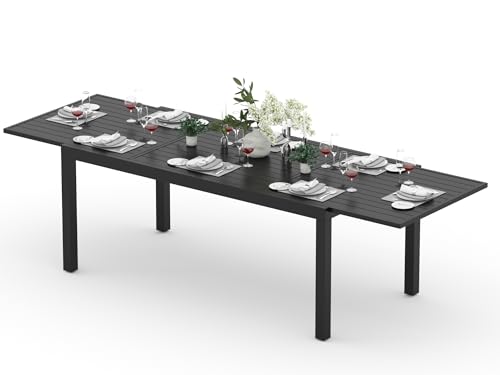
Extendable Patio Table Buying Guide
Everything you need to know about expandable outdoor dining tables — how extension mechanisms work, which sizes fit your space, the best materials for your climate, and how to care for a table that grows with your guest list.
Why an extendable patio table makes sense: Most households don't need a large dining table every day, but they do need one when family and friends visit. An extendable patio table solves that problem by staying compact for everyday use and expanding when the occasion calls for it. This guide walks you through the decisions that matter most so you can buy with confidence.
What Is an Extendable Patio Table?
An extendable patio table is an outdoor dining table designed with a built-in extension mechanism. Instead of a fixed tabletop, the table includes one or more removable or folding leaf sections, or a sliding frame that opens to reveal a stored leaf. When closed, the table seats a small group comfortably. When extended, it can accommodate several additional diners — often doubling its seating capacity.
Extension tables are distinct from fixed outdoor dining tables in one important way: flexibility. A fixed table locks you into one footprint and one seating count. An extendable table adapts to weeknight dinners for two just as easily as a weekend gathering for eight. For homeowners who entertain seasonally or who have limited patio space, that adaptability is the whole point.
If you are still comparing table formats, it helps to understand the broader category first. Our guide to expandable outdoor dining tables covers the full range of expanding formats, while this page focuses specifically on extension-style tables and the practical details of choosing one.
How Extension Mechanisms Work
The extension mechanism is the heart of an extendable table, and it is the feature most worth inspecting closely. There are three common designs:
- Butterfly leaf: A leaf folds in half and stores underneath the tabletop. To extend, you pull the table ends apart and flip the leaf up. This is the most common design for outdoor tables because it keeps the leaf protected when not in use.
- Removable leaf: A separate leaf panel is stored elsewhere and dropped into place when needed. This design is simple and robust, but it requires storage space for the leaf when the table is closed.
- Sliding or telescoping frame: The table frame slides outward on tracks to reveal a stored leaf or to create a gap that a leaf fills. This design feels the most premium and typically offers the smoothest operation.
Mechanism quality varies widely by tier. Entry-level tables often use simple hinges and lighter aluminum tracks. Mid-range and premium tables typically use reinforced steel or stainless hardware, smoother glides, and locking pins that hold the table rigid when extended. If you plan to extend and collapse the table frequently, mechanism smoothness is worth prioritizing over tabletop cosmetics.
Mechanism Check Before You Buy
Look for stainless steel or galvanized hardware, a locking mechanism that prevents accidental collapse, and a leaf that sits flush with the main tabletop. Gaps or uneven seams at the leaf joint are a sign of loose tolerances and will collect crumbs and water over time.
Sizing: Closed vs Extended Footprint
Sizing is where most buyers make mistakes. An extendable table has two footprints — closed and extended — and both matter. Measure your patio or deck, then subtract clearance for chairs and walking paths before deciding on a table size.
As a general guide, allow at least 24 inches of clearance on each side of the table for chairs, and 36 inches or more where people need to walk behind seated guests. A table that fits closed but blocks your walkway when extended is not actually a good fit for your space.
Seating counts also shift between configurations. A table that seats four closed may seat six or eight extended, depending on leaf width. Confirm the seating count in both states rather than assuming the extended number applies all the time.
| Table Format | Typical Closed Seating | Typical Extended Seating | Best For |
|---|---|---|---|
| Compact extension table | 2 to 4 | 4 to 6 | Balconies, small decks, couples who host occasionally |
| Standard extension table | 4 to 6 | 6 to 8 | Mid-size patios, families, regular entertaining |
| Large extension table | 6 to 8 | 8 to 10 | Large patios, frequent hosts, multi-generational homes |
If your priority is a table that stays compact most of the time, a smaller extension format pairs well with space-saving layouts. Our guide to small patio design explains how to arrange furniture around a table that changes size. If you already know you need a larger permanent footprint, a fixed eight-seat outdoor dining set with umbrella may be a better fit than an extension table that rarely closes.
Materials: What Works Outdoors
An extendable table lives outside year-round, so material choice determines how long it lasts and how much maintenance it demands. The tabletop and the frame are usually different materials, and both matter.
Tabletop materials
- Powder-coated aluminum: Lightweight, rust-resistant, and low-maintenance. A solid choice for humid or coastal climates. Entry-level and mid-range tables commonly use aluminum slats or panels.
- High-density polyethylene (HDPE): Weatherproof, fade-resistant, and heavy enough to stay put in wind. Often used in premium outdoor furniture and styled to resemble wood.
- Teak and hardwood: Naturally weather-resistant and repairable, but requires periodic oiling or sealing. Premium and luxury tiers dominate this category.
- Glass: Easy to wipe clean and visually light, but heavier and more fragile. Tempered glass is standard on outdoor tables; check that the leaf section is also tempered.
- Ceramic or porcelain tile: Scratch-resistant and heat-tolerant, common on high-end tier tables. Heavier than aluminum, so confirm the frame is rated for the weight.
Frame materials
Powder-coated steel is strong and common at mid-range. Aluminum frames are lighter and rust-proof, making them easier to move when you need to extend the table. Stainless steel hardware is the detail to look for on any table that will see rain. If you want a deeper dive into frame construction and finishes, our guide to aluminum outdoor dining tables covers the trade-offs in detail.
Umbrella Compatibility and Shade
Many extension tables include an umbrella hole, but the placement matters. On a table with a center leaf, the umbrella hole is usually in the main tabletop, which means the leaf must be installed around the pole or the hole is offset. Check whether the umbrella hole remains usable in both closed and extended configurations — some tables require the leaf to be removed before the umbrella can be inserted.
If shade is a priority, confirm the table's umbrella hole diameter matches standard pole sizes and that the table has a stable base or weighted stand. For tables without a hole, a cantilever umbrella is the practical alternative. Our guide to cantilever umbrellas with tilt and rotation explains how to shade a table without a center pole.
Care and Maintenance
An extendable table needs slightly more care than a fixed table because the mechanism adds moving parts. A simple routine keeps it working smoothly for years:
- Clean the mechanism seasonally. Wipe down tracks and hinges, remove grit, and apply a silicone-based lubricant to sliding parts. Avoid oil-based lubricants that attract dust.
- Store or secure the leaf. If your table uses a removable leaf, store it indoors or in a dry cover when not in use. Butterfly leaves should be folded down when the table is closed to protect the surface.
- Cover the table in off-season. A fitted cover protects both the tabletop and the mechanism from standing water and debris. Our guide to outdoor furniture covers explains what to look for in breathable, water-resistant fabrics.
- Inspect hardware annually. Tighten bolts, check locking pins, and replace any rusted screws before they seize.
For a broader seasonal maintenance routine that covers cushions, frames, and hardware, see our weatherproofing guide.
Matching Chairs and Seating
The table is only half the dining set. Chair choice affects comfort, storage, and how easily you can reconfigure the table. Stackable or folding chairs are practical for extension tables because you can store the extra chairs when the table is closed and bring them out when it expands.
If you want a coordinated look, a matching dining set is the simplest route. Our guides to six-piece outdoor dining sets and seven-piece patio dining sets with cushions show how table-and-chair combinations are typically configured. For a more flexible setup, pair the table with stackable folding outdoor chairs that can be stored in a shed or garage between gatherings.
Common Mistakes to Avoid
- Buying for the extended size only. If the closed table is too large for your everyday space, you will regret it. Measure both states.
- Ignoring the mechanism tier. A smooth, locking mechanism is worth more than a decorative tabletop. Test the extension action before buying if possible.
- Overlooking wind exposure. Lightweight tables need weight or anchoring in exposed areas. Check whether the table has leg levelers or anchor points.
- Forgetting chair clearance. Extra seating means extra chairs. Confirm there is room to pull chairs out on all sides when the table is extended.
- Skipping the cover. The extension mechanism is the most vulnerable part of the table. A cover is the simplest protection you can buy.
Frequently Asked Questions
What is an extendable patio table?
An extendable patio table is an outdoor dining table with a mechanism that lets you add or remove leaf sections, increasing or decreasing the tabletop length. This allows the same table to seat a small group day-to-day and a larger group when entertaining.
How much space does an extendable patio table need?
Measure the closed footprint first, then add the extended length plus clearance for chairs and walking paths. A practical rule is to leave at least 24 to 36 inches around the table on all sides for pulling out chairs and moving comfortably.
Are extendable patio tables weather-resistant?
Most outdoor extension tables are built with weather-resistant materials such as powder-coated aluminum, high-density polyethylene, or teak. The extension mechanism and hardware are the most sensitive parts, so choose stainless or galvanized components and keep the mechanism clean and lubricated.
Can an extendable patio table work on a small deck?
Yes. A compact table that expands is often the best solution for a small deck because it stays small most of the time and only grows when guests arrive. Choose a table that extends along one axis and check that the expanded length still fits your deck with chair clearance.
Ready to Choose Your Extendable Patio Table?
Browse our recommended outdoor dining products below, or explore related buying guides to compare formats, materials, and configurations before you decide.
Explore Recommended TablesRelated Buying Guides
- Expandable outdoor dining table with umbrella hole — shade-ready options for sunny patios.
- Expandable outdoor table with umbrella hole — how center-pole shade works with extension leaves.
- Outdoor patio table with umbrella — fixed-table alternatives if you do not need an extension mechanism.
- Six-seater round dining table and chairs — a round format that seats a crowd without corners.
- Outdoor dining set for eight — a fixed-table option for larger households.
- Large outdoor dining table with bench and chairs — bench seating for long tables.