
Folding Rocking Chairs: The Complete Buyer's Guide
Everything you need to know before choosing a portable rocking chair for your porch, patio, campsite, or tailgate. Compare frame materials, rocker mechanisms, weight capacity, and folding convenience — then pick the right tier for your outdoor lifestyle.
Explore Recommended ChairsWhy Choose a Folding Rocking Chair?
A folding rocking chair combines two features that outdoor owners value most: the gentle, soothing motion of a traditional rocker and the ability to collapse flat for storage or travel. For anyone who moves seating between a porch, a backyard, and a campsite, this dual capability is genuinely useful rather than a novelty.
The category has matured considerably. Earlier folding rockers relied on thin frames and stiff hinges, which produced a wobbly motion and short service life. Modern designs use reinforced aluminum or high-grade steel joints, tension-tested pivot points, and fabric seats that resist sagging. The result is a chair that rocks smoothly, folds compactly, and holds up across seasons of regular use.
Portability matters in practical ways. A folding rocker tucks into a closet during winter storms, fits in a car trunk for a weekend trip, and moves easily between a shaded deck and a sunny lawn. If you entertain often, having two or three foldable rockers on hand means flexible extra seating without permanent floor space.
For buyers who prefer a permanent porch fixture, a standard rocker may still be the better fit — our guide to front porch rocking chairs covers that category in depth. But when storage space, seasonal movement, or travel is part of your routine, a folding rocker earns its place.
Quick orientation: if you need a chair that stays put and you have room, buy a fixed rocker. If you need motion plus collapse-and-store capability, a folding rocker is the correct choice — and this guide explains exactly what separates a good one from a flimsy one.
Types of Folding Rocking Chairs
Not every folding rocker is built for the same setting. Manufacturers design around a primary use case, and that design choice affects frame geometry, fabric durability, and how much the chair weighs. Understanding the main categories prevents a mismatch between the chair and your intended use.
Patio and Porch Folders
These are the closest relatives of a traditional porch rocker. They usually feature a wider seat, a higher back, and curved armrests, with a folding frame that collapses front-to-back. Weight is less of a priority than stability, so you will find sturdier tubing and larger foot profiles. Many pair well with the seating arrangements described in our front porch rocking chair set with table guide.
Camping and Travel Rockers
Built for the trail and the tailgate, these prioritize compact folded dimensions and lower carry weight. Frames are typically aluminum, the seat is a tensioned fabric, and the rocker mechanism uses curved rail feet rather than a full arc. They pack into a carry bag and set up in seconds.
Lawn and Garden Rockers
A middle ground between the two categories above — light enough to move around the yard, sturdy enough to leave outside through a season. Models with webbing or mesh seats dry quickly after rain. If you rotate seating around the lawn, browse our folding lawn chairs collection for related options.
Specialty and Compact Folders
Smaller variants suit balconies, apartment patios, and tight corners. Some fold into a nearly flat profile for closet storage. A travel-friendly example is the folding rocking lawn chair in a bag, which illustrates how compact this category can get.
Frame Materials Compared
The frame determines durability, weight, and how smoothly the chair rocks. Folding rockers use a small set of materials, each with clear trade-offs.
| Material | Best For | Strengths | Watch Out For |
|---|---|---|---|
| Aluminum | Travel, camping, frequent folding | Light, rust-resistant, quick to fold | Lighter gauge tubing can flex; check joint quality |
| Powder-coated steel | Patio, porch, permanent seasonal placement | Strong, stable, holds a firm rock | Heavier; chipped coating can allow rust |
| Wood (folding designs) | Classic porch aesthetics | Warm look, traditional feel | Needs periodic sealing; heavier than metal |
| Resin / composite | All-weather, low-maintenance yards | Weather-proof, no rust, easy to clean | Can feel less rigid; limited repair options |
Aluminum dominates the travel segment because it strikes the best balance between low carry weight and rust resistance. Steel wins on stability and the quality of the rocking motion. If your chair lives outdoors year-round and you never move it, a heavier frame is a reasonable trade for a smoother rock.
Whichever material you choose, examine the coating finish. A powder-coated or rust-proof finish protects the metal at scratch points, which is where corrosion usually begins on a folding frame.
How the Rocking Mechanism Works
Folding rockers achieve motion in one of two ways, and the distinction affects both feel and floor safety.
Curved Rail Rockers
The classic approach: two curved rails beneath the seat contact the ground and roll the chair back and forth. It produces a natural, long-arc rock. The trade-off is that rails need a flat, hard surface to work well, and they can mark soft wood decks or sink into grass.
Spring-Loaded or Pivot Rockers
These use a hinge or spring system so the seat tilts rather than rolls. The motion is shorter and more controlled, and the chair sits on standard feet. That makes it safer on decks, patios, and uneven surfaces — a strong option for renters and multi-surface use.
Whichever mechanism a chair uses, the hinge is the single most important component. Look for reinforced pivot joints, welded or double-riveted connections, and locking hinges that prevent the chair from folding accidentally while in use. A chair with a premium hinge feels solid when you lean back; a chair with a weak hinge develops play within a season.
Portability & Folding Design
"Folding" covers a wide range. Some chairs collapse into a slim bundle that slips behind a door; others fold to a bulky footprint that still needs dedicated space. Measure before you commit.
- Folded dimensions: the most important spec if storage is your motivation. Check length, width, and thickness when collapsed.
- Carry weight: lighter frames travel better, but extremely light chairs often compromise stability. Match weight to how far you actually carry the chair.
- Fold mechanism: single-lever and quick-release hinges are convenient; check that they lock securely.
- Carry bag: a bag protects the frame in transit and keeps the chair clean between trips.
If the chair will mostly stay on one patio, portability is a secondary concern and you can prioritize stability. If it moves weekly, weight and folded size become the deciding factors. Buyers who only need occasional folding may find that a standard collapsible chair in our foldable outdoor chairs collection covers the need without the rocker mechanism.
Weight Capacity & Build Strength
Folding frames are engineered around a target load, and that target determines tube thickness, joint count, and seat fabric strength. A higher-capacity chair generally uses thicker gauge tubing, wider foot pads, and additional cross-bracing.
When comparing models, read the load rating rather than assuming all folding rockers are equivalent. A chair rated for a lighter load is fine for its intended user, but a taller or heavier adult should look at reinforced builds. Heavier-duty rockers also tend to rock more smoothly, because the extra frame rigidity prevents the flexing that makes cheap joints feel loose.
Build strength shows up in details: welded rather than crimped joints, reinforcement plates at the pivot, and feet that spread the load across a wider area. These are the features that separate a chair that lasts several seasons from one that loosens by the second summer.
Comfort, Fabric & Seating Position
Folding rockers are not all shaped the same. Seat height, back angle, and armrest design determine whether the chair feels supportive for long sits or tiring after an hour.
Seat Height and Depth
A taller seat height makes standing up easier, which matters for older users and anyone with knee concerns. A deeper seat suits taller users but can leave shorter users with pressure behind the knees. Test where possible, or compare published seat height against a chair you already own.
Back Angle and Lumbar Support
Rocker backs vary from upright to noticeably reclined. An upright back suits reading and conversation; a reclined back suits lounging. Some models include a padded lumbar panel or a tensioned fabric back that conforms to the spine.
Fabric and Upholstery
Outdoor fabric should be fade-resistant, quick-drying, and breathable. Mesh seats are cool in summer and dry fast after rain. Padded polyester or olefin cushions feel softer but retain moisture if left out. Removable, washable covers are a practical advantage.
Armrests
Curved wooden or padded armrests improve comfort and make it easier to push up out of the chair. On folding models, armrests often double as part of the frame locking mechanism, so check that they feel rigid.
Care & Weatherproofing
A folding rocker has more moving parts than a fixed chair, so maintenance focuses on joints and coating integrity.
- Clean the frame regularly. Wipe down tubing and hinges to remove grit that accelerates wear. A dedicated furniture cleaner handles most outdoor materials safely.
- Inspect the coating. Touch up chips on powder-coated steel promptly — exposed metal is where rust starts.
- Lubricate hinges sparingly. A light application of silicone-based lubricant at pivot points keeps folding smooth without attracting dust.
- Dry before folding. Folding a wet chair traps moisture in the hinge area and fabric creases.
- Store under cover in winter. Even rust-resistant frames last longer when protected from freeze-thaw cycles.
For broader seasonal maintenance guidance, see our weatherproofing guide. If your chair spends long stretches outdoors, a cover protects both fabric and mechanism.
Safety Tips for Using a Rocker
The rocking motion changes how a chair behaves compared with a static seat, and folding frames add a hinge to consider.
- Confirm the chair is fully open and all locking mechanisms are engaged before sitting.
- Place curved-rail rockers on a flat, hard surface. On grass or gravel, use a mat or choose a pivot-style rocker instead.
- Avoid standing on the chair or using the armrests as a step.
- Keep the rocker clear of the edge of a deck or steps.
- Check hinge tightness at the start of each season.
- Supervise children, and avoid letting them rock standing up.
Buying Checklist: Choosing the Right Tier
Product tiers in this category are defined by frame quality, hinge engineering, fabric durability, and finish. Use the table below to match a tier to your intended use. Tiers describe relative market positioning, not absolute specifications.
| Tier | Best For | Typical Characteristics |
|---|---|---|
| Entry-level | Occasional use, light travel | Thinner aluminum tubing, basic hinge, simple fabric seat |
| Mid-range | Regular patio and porch use | Reinforced joints, improved fabric, smoother rock, locking hinges |
| Premium | Frequent use, heavier users, multi-surface | Heavy-duty frame, padded seat, high-grade fabric, precision pivot |
| Luxury | Design-focused permanent porch placement | Wood or composite frame, upholstered cushions, refined finish |
Decision Points to Confirm Before Buying
- Where will the chair live most of the time — porch, patio, lawn, or campsite?
- How often will it be folded and moved?
- What is the required load rating for the primary user?
- Is the ground surface hard and flat, or soft and uneven?
- Will the chair be left outdoors through winter?
- Do you want a rail rocker for a longer arc or a pivot rocker for stability?
Answering these six questions narrows the field quickly. A chair that scores well on all six will feel right from the first sit and hold up over time.
Recommended Folding Rocking Chairs
⚠️ AFFILIATE DISCLOSURE: This website contains affiliate links. As an Amazon Associate, we earn from qualifying purchases. If you make a purchase through these links, we may receive a small commission at no additional cost to you. Read our full affiliate policy.

GCI Outdoor Freestyle Rocker Camping Chair Portable Folding Rocking Chair with Solid, Durable Armrests, Drink Holder & Comfortable Backrest — Indigo Blue
Check price on Amazon
GCI Outdoor Freestyle Rocker Camping Chair - Black | Patented Spring-Action Rocking, Fold-Flat Steel Frame w Carry Handle, Mesh Backrest, Cup Holder, 250 lb Capacity
Check price on Amazon
GCI Outdoor Freestyle Rocker XL with Side Table Camping Chair - Black | Spring-Action Rocking | Wide, Eazy-Fold Steel Frame w Carry Handle | Mesh Backrest | Phone & Cup Holder | 400 lb Capacity
Check price on Amazon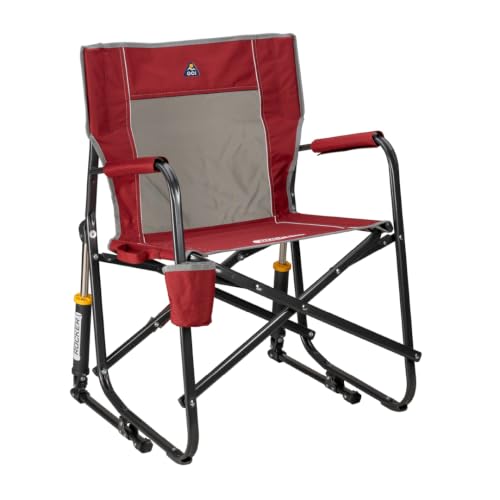
GCI Outdoor Freestyle Rocker Camping Chair - Cinnamon | Patented Spring-Action Rocking, Fold-Flat Steel Frame w Carry Handle, Mesh Backrest, Cup Holder, 250 lb Capacity
Check price on Amazon
GCI Outdoor Comfort Pro Rocker Camping Chair - Indigo Blue | Patented Spring-Action Rocking, Tall Angled Backrest, Mesh Back Panel, Phone Pocket, Cup Holder, 250 lb Capacity
Check price on Amazon
Amazon Basics Outdoor Portable Folding Rocking Chair with Headrest, Ergonomic Design, Weather-resistant Textilene Fabric for Porch, Blue
Check price on Amazon
Romswi 2 Pack Folding Rocking Camping Chair, Portable Outdoor Rocker Chair | with Cup Holder & Carry Strap, Durable Oxford Fabric Chair for Camping, Sports Events & Patio, Royal Blue
Check price on AmazonFinal Verdict
A folding rocking chair is worth buying when portability and storage are real requirements, not imagined ones. If the chair will move between rooms, vehicles, and outdoor spaces, the folding mechanism delivers clear value. If it will sit in one spot on a covered porch for years, a fixed rocker is usually the sturdier investment.
Within the folding category, prioritize the hinge and the frame over styling. A mid-range chair with reinforced joints and a rust-proof finish will outlast an entry-level chair with a decorative design. Check the load rating against the primary user, confirm the folded dimensions fit your storage, and match the rocker mechanism to your ground surface. Do those three things and you will end up with a chair that rocks smoothly for many seasons.
For buyers still exploring adjacent outdoor seating options, our foldable metal chairs and foldable chair and table guides cover complementary setups that work well alongside a rocking chair.
Frequently Asked Questions
Are folding rocking chairs stable enough for everyday use?
Yes, provided the chair is a mid-range or premium build. Stability comes from frame rigidity and hinge quality rather than the folding mechanism itself. A reinforced aluminum or steel frame with locking hinges stays firm through daily use, while a lightly built entry-level chair may develop play over time.
Can a folding rocking chair be left outside in the rain?
Weather-resistant models handle rain, but leaving any folding chair out long-term accelerates wear on hinges and fabric. Dry the chair before folding it, and store it under cover during extended wet or freezing periods to protect the mechanism.
What is the difference between a rail rocker and a pivot rocker?
A rail rocker rolls on curved rails and produces a longer, more traditional arc, but it needs a flat hard surface. A pivot or spring rocker tilts in place on standard feet, which makes it more stable on decks, patios, and uneven ground.
How much weight can a folding rocking chair hold?
Load ratings vary by model and tier. Entry-level chairs typically target lighter loads, while premium and heavy-duty builds use thicker tubing and wider foot pads to support more. Always compare the published load rating against the primary user's needs before buying.
Is a folding rocking chair suitable for camping?
Camping-specific folding rockers are excellent for that use because they use light aluminum frames, compact folding profiles, and carry bags. Avoid bringing a heavy porch-style folder to a campsite — choose a model designed for travel instead.
How do I stop a folding rocker from marking my deck?
Use felt pads or rubber caps on the rail or feet, and keep the chair on a flat surface. Pivot-style rockers are generally gentler on decking than rail rockers, which concentrate pressure along a curved contact line.