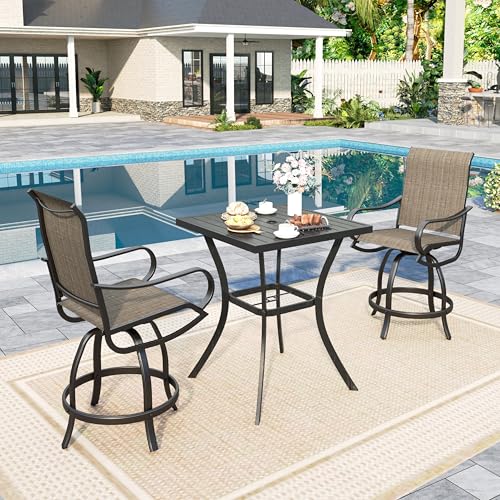
High Top Patio Table and Chairs with Umbrella: The Complete Guide
Everything you need to know before choosing an elevated outdoor dining set with built-in shade — sizing, materials, umbrella compatibility, stability, and setup for a patio that works as well as it looks.
Why Choose a High Top Patio Table and Chairs with Umbrella
A high top patio table and chairs with umbrella sits at bar or counter height, which changes the way an outdoor space feels and functions. The elevated surface puts food and drinks closer to standing eye level, makes conversation easier at gatherings, and visually lifts the dining area so it does not disappear against a large deck or wide lawn.
Pairing that height with an integrated umbrella solves the biggest practical problem of outdoor dining: sun exposure. Instead of moving the set around the yard, the shade moves with the table. For anyone researching outdoor furniture, this combination is one of the most functional configurations available, and it works especially well on compact patios where a full dining set plus a freestanding shade structure would not fit.
The format also pairs naturally with other elevated furniture. If you are building a cohesive bar-height zone, it is worth comparing this setup against a dedicated high top outdoor bar table and chairs arrangement, which leans more toward standing socializing than seated meals.
Who this setup suits best
- Small and mid-size patios where a single multi-purpose set needs to handle breakfast, drinks, and dinner.
- Households that entertain casually and want guests to mingle rather than sit through long formal meals.
- Sun-exposed decks where built-in shade is non-negotiable for afternoon use.
- Open-plan outdoor kitchens where bar-height seating bridges the cooking and dining zones.
It is less ideal for households with very young children or guests with limited mobility, since climbing onto bar-height stools requires more effort than sliding into a standard dining chair.
Anatomy of the Set: Table, Chairs, and Umbrella
Understanding the three components separately makes the buying decision much clearer, because each one has its own specification requirements and failure points.
The table
The table carries the load of the umbrella, the food, and sometimes leaning guests, so its construction matters more than it does on a low dining table. Look for a reinforced center hub around the umbrella hole, a tabletop thickness that resists flexing under an umbrella's torque, and a base or leg design that spreads weight outward. Square and round tops in the 32 to 36 inch range are the most common for two to four seats; rectangular tops in the 55 to 60 inch range handle four to six.
If you prefer a table where the umbrella is central to the design rather than an accessory, the dedicated high top outdoor table with umbrella hole format is worth a close look, since those models typically reinforce the hub more aggressively than general-purpose tables.
The chairs
Chair seat height must match the table height or the set will feel wrong no matter how good it looks. Bar-height tables generally pair with seats around 28 to 30 inches; counter-height tables pair with seats around 24 to 26 inches. Beyond height, look for footrests (essential at bar height), a stable stance that resists tipping when someone leans back, and cushioning that drains rather than holds water.
Swivel chairs are a popular upgrade for this format because they let guests turn toward or away from the table without pushing back. Models designed specifically for this pairing, like these high top patio table with swivel chairs configurations, solve the height-match problem out of the box.
The umbrella
The umbrella is where most buyers underestimate complexity. Canopy size, venting, tilt mechanism, pole diameter, and base weight all interact, and a mismatch in any one of them undermines the whole set. Section five below covers this in detail.
Quick rule of thumb: measure the distance from the ground to the tabletop before anything else. If it lands between 36 and 38 inches, you are looking at counter height. Above 39 inches, you are at bar height. Buy chairs and umbrella poles that match that number, not the marketing label.
Sizing and Space Planning
High top sets take up less floor area per seat than standard dining sets, but they still need clearance for chairs to pull back and for people to walk behind seated guests. A practical minimum is 30 to 36 inches of clear space behind each chair position, plus a comfortable aisle of at least 36 inches if the set sits between two traffic paths.
Matching table size to seat count
- Two seats: 32 to 36 inch square or round top. Compact and ideal for balconies and narrow patios.
- Four seats: 36 to 40 inch square, or a 55 inch rectangular top.
- Six seats: 60 to 72 inch rectangular top, or a 48 inch round top in a pinch.
If you already know the seat count you need, browsing by configuration helps narrow the field quickly. A high top patio table with 4 chairs covers the most common household size, while a high top patio table with 6 chairs suits families that regularly host.
Accounting for the umbrella footprint
Center-mount umbrellas do not add floor area, but the base does. A freestanding weighted base can extend 20 inches in every direction and sits directly under the table, so chair legs and guest feet need to clear it. Cantilever umbrellas shift that footprint to the side and require their own clearance zone, typically 24 to 36 inches from the table edge.
Height and sight lines
On a raised deck or a balcony with a solid railing, bar-height seating gives guests a view over the barrier rather than a face full of railing. That is often the single strongest argument for this format. On a ground-level patio with a low fence, the advantage is smaller but the visual lift still helps a compact space feel less crowded.
Frame and Tabletop Materials
Outdoor furniture lives under UV, rain, temperature swings, and in some climates salt air. The material choice determines how long the set stays structurally sound and how much maintenance it demands.
| Material | Weather Resistance | Maintenance Level | Best For |
|---|---|---|---|
| Powder-coated aluminum | High — rust-proof when coated | Low — wipe down occasionally | Most climates, including coastal |
| High-density polyethylene (HDPE) | Very high — impervious to moisture | Very low — rinse and go | Humid and rainy regions |
| Wrought iron | Moderate — needs ongoing rust management | Moderate to high | Sheltered patios with classic styling |
| Teak and other hardwoods | High with periodic sealing | Moderate — oil or seal annually | Natural-look designs and covered patios |
| Resin wicker over aluminum | High — frame protected, weave UV-stabilized | Low | Soft-looking sets that still shrug off weather |
| Glass or ceramic tabletop | High — but breakable | Low | Easy-clean dining surfaces |
| Slatted metal tabletop | High — drains well | Low | Rainy climates and low-maintenance setups |
Aluminum and HDPE are the safest general-purpose choices. Both handle moisture without swelling, cracking, or rusting, and both hold up under an umbrella's load without deflection. If the design language matters more than pure durability, wrought iron and hardwood deliver a look that coated metals cannot match, at the cost of more seasonal attention.
For buyers who want the structural integrity of engineered outdoor materials, exploring the broader category of high-density polyethylene (HDPE) outdoor furniture is a useful next step. Those sets tend to be heavier and more dimensionally stable than hollow plastic, which helps at bar height where wobble is more noticeable.
Fabric and cushion considerations
Seat cushions on high top chairs take more wear than low dining chairs because guests slide on and off repeatedly. Look for solution-dyed acrylic or similar UV-stable fabrics with open-weave backs that let water drain. Foam should be open-cell and quick-drying; closed-cell foam traps moisture and turns cushions into a mildew problem within a season.
Umbrella Options and Shade Coverage
The umbrella is the component most likely to disappoint if chosen casually. A canopy that is too small leaves shoulders and food in direct sun; one that is too large overwhelms a small table and catches wind like a sail.
Canopy size by table size
- 32 inch table, two chairs: 7.5 foot canopy is sufficient.
- 36 inch table, four chairs: 9 foot canopy covers the table and most of the seating.
- Rectangular table, six chairs: 10 foot canopy, or two smaller umbrellas spaced along the length.
The canopy should overhang the table by roughly 12 to 18 inches on each side to shade seated guests' shoulders and plates. Beyond that, marginal shade gain is small while wind load rises quickly.
Center-mount versus cantilever
Center-mount umbrellas pass through the table's hub and are the traditional choice for high top sets. They are simpler, stable when properly based, and keep the pole out of the walking path. Cantilever umbrellas place the pole to the side, freeing the tabletop and allowing tilt and rotation, but they need a heavier base and a dedicated clearance zone.
If the table you like lacks a hole, a cantilever is the workaround. Otherwise, a center-mount is usually the cleaner solution for a bar-height dining set. For tables specifically engineered around shade, the high top patio table with umbrella hole options are designed with the reinforced hub this setup needs.
Venting, tilt, and crank mechanisms
An air vent at the canopy's peak lets hot air escape and dramatically reduces lift in gusts. Tilt mechanisms help when the sun angle shifts toward evening, but push-button tilts tend to outlast crank tilts in heavy use. Crank-lift openings are easier on tall poles than push-up designs, especially for shorter users reaching above a bar-height table.
Pole diameter and fit
Most center-mount patio umbrellas use 1.5 inch poles, and most tables are drilled to match. Confirm both numbers before buying separately. A 1.5 inch pole in a 2 inch hole wobbles; a 2 inch pole in a 1.5 inch hole does not fit at all.
Stability, Wind, and Safety
A bar-height table with an umbrella has a high center of gravity. In a gust, the umbrella acts as a lever and the table becomes the pivot. This is the single most common failure mode for this furniture category, and it is almost entirely preventable.
Base weight and anchoring
Use a base rated for the umbrella's canopy size, not just its pole diameter. A common mistake is pairing a 9 foot canopy with a base sized for a 7.5 foot umbrella. Where the patio surface allows, add pavers under a freestanding base or choose a base that can be weighted with sand or water. On windy sites, an in-ground sleeve or a bolted base is the most reliable answer.
Table design and wobble
Four-leg tables with wide splayed bases resist tipping better than pedestal designs with a single central column. If you prefer a pedestal, look for a spread base with adjustable feet and a low center of mass. Test the table by leaning gently on one corner; a set that flexes noticeably at bar height will feel unstable in daily use.
Chair tipping and footrests
Bar-height stools without footrests encourage guests to shift their weight awkwardly. Footrests keep weight centered and reduce the instinct to lean back. Frames with slightly splayed legs also improve stability compared to straight-leg designs.
Wind protocol: close the umbrella whenever the set is unattended and whenever gusts pick up. No base weight substitutes for closing the canopy in a storm. If your patio is regularly exposed to strong wind, consider a table with a reinforced hub and a bolted or in-ground mount rather than a portable base.
Market Tiers and What They Mean
High top sets vary widely in construction quality, and the differences show up in welds, coating thickness, hardware, and how well the umbrella hub is engineered. Rather than tracking prices, it is more useful to understand what each tier typically delivers so you can match the set to how hard it will be used.
| Market Tier | Typical Construction | Umbrella Support | Best For |
|---|---|---|---|
| Entry-level | Thinner aluminum or steel tubing, basic powder coat, simpler welds | Standard 1.5 inch pole hole, lightweight base | Balconies, seasonal use, light daily wear |
| Mid-range | Heavier gauge aluminum, better coating adhesion, reinforced hub | Rated for 9 foot canopies, weighted base options | Year-round patios with regular family use |
| Premium | Architectural-grade aluminum or HDPE, commercial welds, quality hardware | Reinforced hub, vented canopies, heavy bases | Exposed sites and households that entertain often |
| Luxury / commercial-grade | Marine-grade materials, precision joinery, replaceable components | Engineered for large canopies and high wind ratings | Hospitality use and permanent high-traffic installations |
The jump from entry-level to mid-range is usually the most consequential one. Mid-range sets tend to fix the three things that most often fail on starter sets: hub reinforcement, coating durability, and base stability. Premium and luxury tiers add longevity and refinement, but the practical gap between mid-range and premium is smaller than the gap between entry-level and mid-range.
For buyers who want the set to last a decade or more without replacement, the logic here mirrors the broader case for high-quality outdoor furniture: better materials reduce the maintenance burden and avoid the cycle of replacing lightweight pieces every few seasons. If the surrounding patio is being built to a high standard, the case for a high-end outdoor furniture set becomes stronger still.
Setup and Placement Tips
Where the set sits determines how much you use it. A high top table with umbrella works best when it is placed deliberately rather than dropped into leftover space.
Position relative to the sun
Place the set so the umbrella shades the seating during the hours you actually use the patio. If afternoon sun hits from the west, the umbrella pole should sit toward the west side of the table, or a cantilever should be positioned so the canopy extends over the seats. Tilting umbrellas help, but correct placement helps more.
Traffic flow
Leave at least 36 inches between the table edge and doorways, steps, and grill zones. At bar height, guests tend to stand near the table while socializing, so the practical clearance needed is larger than the chair-pull-back measurement alone suggests.
Surface and leveling
High top sets are more sensitive to an uneven surface than low dining sets. A slight slope that is invisible at 30 inches becomes noticeable at 40. Adjustable feet solve small variations; larger slopes call for shims under the base or a different location entirely.
Companion pieces
A bar-height dining set reads as intentional when it is part of a consistent zone. Adding a matching high top outdoor table and 2 chairs nearby, or a small high top bistro table and 2 chairs for overflow seating, keeps the proportions coherent. If the space is primarily for drinks rather than meals, a high top outdoor bistro table and chairs format may be the better fit than a full dining layout.
For patios that also need warmth in the evening, consider how the set would look near a fire feature. A high top fire pit table and chairs arrangement replaces the umbrella with a heat source, which suits cooler climates or shoulder-season use better than shade does.
Care and Seasonal Maintenance
High top sets tolerate weather well when the materials are right, but a few routine habits extend their life significantly.
Routine cleaning
- Wipe the tabletop weekly during pollen season to prevent staining on porous surfaces.
- Rinse aluminum and HDPE frames monthly with mild soap and water; avoid abrasive pads that scratch coatings.
- Clean the umbrella canopy with a soft brush and mild detergent, then let it dry fully open before closing.
- Check the umbrella hub and pole collar seasonally for loosening hardware.
Seasonal tasks
- Inspect base weights and fasteners before the windy season.
- Apply sealant or oil to hardwood surfaces annually, before the rainy season rather than after.
- Touch up any chipped powder coat promptly; exposed metal is where rust starts.
- Store cushions and the canopy in a dry place during extended off-season periods.
Winter handling
Closing the umbrella and removing the canopy during heavy winter weather prevents the most common wind damage. If the set stays outdoors year-round, use a breathable cover rather than a sealed one so trapped moisture can escape. Detailed seasonal guidance is available in our high-quality resin wicker patio furniture care notes and the broader outdoor maintenance resources on the site.
Buyer's Checklist Before You Commit
- Measure the tabletop height: counter height (36–38 inches) or bar height (39–42 inches)?
- Confirm chair seat height matches the table height.
- Verify the umbrella hole diameter matches the pole diameter you plan to use.
- Check that the table hub is reinforced for the canopy size you want.
- Select a base rated for that canopy size, not just the pole.
- Measure clearance behind each chair position — at least 30 inches.
- Confirm the material suits your climate (coastal, humid, freeze-thaw).
- Check cushion fabric for UV stability and water drainage.
- Review the warranty on frame, finish, and umbrella components separately.
- Plan placement around sun angles and foot traffic before delivery day.
Frequently Asked Questions
What is the standard height of a high top patio table?
Most high top patio tables measure between 38 and 42 inches from the ground to the tabletop. Bar height usually sits around 40 to 42 inches, while counter height is closer to 36 inches. Matching chairs should have seat heights of roughly 28 to 30 inches so guests can sit comfortably with knees clear of the table apron.
Can any high top patio table hold an umbrella?
No. An umbrella needs a dedicated hole, a reinforced center hub, and a stable base or weighted stand. Tables without an umbrella hole can sometimes use an offset cantilever umbrella, but a center-mount umbrella requires the table itself to be designed for it.
What umbrella size suits a high top table with chairs?
For a typical 32 to 36 inch square or round high top table with two to four chairs, a 7.5 to 9 foot umbrella provides good coverage. For larger rectangular high top dining sets seating six, a 9 to 10 foot umbrella or a pair of smaller umbrellas works better.
How do I keep a high top table with umbrella from tipping in wind?
Use a weighted base rated for your umbrella size, keep the umbrella closed during high winds, and consider an air vent canopy that reduces lift. Placement matters too: avoid fully exposed corners and use a base plate or pavers under freestanding bases.
Is a high top set suitable for a small patio?
Yes. High top sets take up less floor area per seat than standard dining sets, and the built-in umbrella removes the need for a separate shade structure. The main requirement is enough clearance behind the chairs for people to get in and out comfortably.
Should I choose aluminum, HDPE, or wrought iron?
Aluminum is the most versatile choice for most climates — rust-proof when coated and relatively light. HDPE is the most weather-proof option and requires the least maintenance. Wrought iron offers a classic look but demands more rust management, so it suits sheltered patios better than exposed ones.
Final word: A high top patio table and chairs with umbrella is one of the most space-efficient and shade-smart outdoor dining setups available. The buying decision comes down to three measurements — table height, chair seat height, and umbrella pole diameter — plus one material choice that matches your climate. Get those right and the set will serve the patio for years.