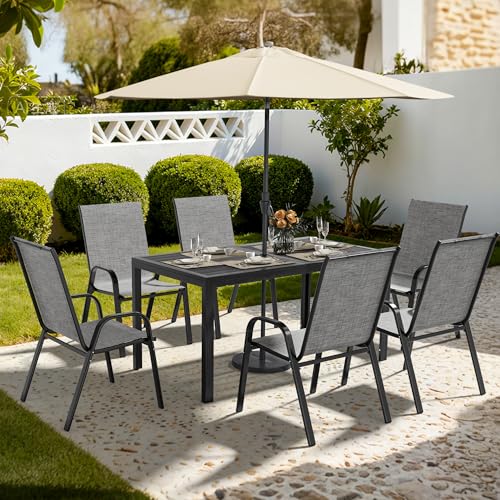
Outdoor Furniture Table and Chairs with Umbrella: The Complete Buying Guide
Everything you need to choose the right dining set with a built-in shade solution — from table sizing and umbrella mechanics to material durability and setup.
Start the GuideWhy this guide matters: An outdoor furniture table and chairs with umbrella is one of the most practical purchases for any patio, deck, or backyard. It combines dining space with instant shade, so you can enjoy meals, conversations, and quiet mornings without moving furniture around. But because tables, chairs, and umbrellas are sold in many configurations, buyers often struggle with size, material compatibility, and wind stability. This guide walks you through each decision so you can choose a set that fits your space and lasts for seasons.
What an Outdoor Table and Chairs with Umbrella Includes
A complete set usually combines three components that must work together: the dining table, the chairs, and the umbrella with its base. Some sets include the umbrella and base in the box, while others sell the table and chairs only, leaving shade as a separate purchase. Understanding this structure helps you compare listings fairly.
- The table: Provides the dining surface and, in market-umbrella configurations, a center hole and sometimes a stabilizer ring to hold the umbrella pole upright.
- The chairs: Match the table height and seating count. Stackable chairs are convenient for compact spaces, while swivel or armed chairs add comfort for longer meals.
- The umbrella: A canopy with a pole, ribs, and a crank or push-up mechanism. Market umbrellas pass through the table; offset umbrellas stand beside it.
- The base: A weighted plate or fillable base that keeps the umbrella stable. The base is often the most overlooked part of the set.
Sizing the Table, Chairs, and Umbrella to Your Space
The most common regret among patio dining buyers is choosing a set that is too large for the space or too small for the household. Measure twice and plan clearance before comparing styles.
Seating capacity and table footprint
| Seating Capacity | Typical Table Shape & Size | Best For |
|---|---|---|
| 4 people | 36–48 in round or square; 60 in rectangular | Small patios, balconies, couples, compact decks |
| 6 people | 48–60 in round; 60–72 in rectangular | Standard family patios, regular entertaining |
| 8 people | 72–84 in rectangular; 60 in round with extension | Large decks, extended family, frequent hosting |
| Bar height | High-top tables with matching tall chairs | Casual lounging, smaller footprints, fire pit pairing |
Leave at least 24 to 36 inches of clearance between the table edge and walls, railings, or other furniture so chairs can slide out and guests can walk behind them. If you are working with a tight area, consider smaller round tables or a high-top configuration that uses vertical space efficiently.
Umbrella canopy size relative to the table
A market umbrella canopy should generally extend slightly beyond the table footprint so shade reaches the seated guests. As a rule of thumb, a four-person round table pairs well with a canopy in the 7.5 to 9 foot range, while larger rectangular tables may need a 9 to 11 foot canopy or two smaller umbrellas. Offset umbrellas can be sized differently because they can be tilted and repositioned.
Quick shade tip
Measure the table's widest dimension and choose an umbrella canopy at least as wide. For long rectangular tables, a single large cantilever umbrella often shades more effectively than a center-pole umbrella that only covers the middle.
Market vs. Offset Umbrellas: Which Fits Your Table
The umbrella mechanism determines how the set functions day to day, how stable it is in wind, and how much flexibility you have in shading different seating positions.
Market umbrella (center pole through the table)
- Passes through a hole in the table center and is supported by the table or a base underneath.
- Simple to operate with crank or push-up lift mechanisms.
- Uses the table as part of its support, so the table must be stable and properly weighted.
- Best for round and square tables and symmetrical seating arrangements.
- Cannot be repositioned away from the table without moving the entire setup.
Offset (cantilever) umbrella
- Stands beside the table on a heavy base and hangs over the dining area.
- No table hole needed, which is helpful for tables without an umbrella opening.
- Can be rotated and tilted to follow the sun through the day.
- Requires a substantial base and careful placement so the canopy clears chairs and walking paths.
- Best for large rectangular tables, lounging areas, and spaces where flexibility matters.
| Feature | Market Umbrella | Offset Umbrella |
|---|---|---|
| Table requirement | Needs center hole and stable table | No table hole required |
| Adjustability | Fixed over table center | Rotates and tilts |
| Footprint | Compact; base under table | Larger; base beside table |
| Best for | Symmetrical round and square sets | Large or irregular layouts |
Materials That Hold Up Outdoors
Material choices affect weight, maintenance, comfort, and how well the set tolerates sun, rain, and seasonal storage. The table and chairs do not have to match the umbrella material, but all parts should be rated for outdoor use.
Table top and frame materials
- Aluminum: Lightweight, rust-resistant, and easy to move. Often paired with slat or glass tops. A popular mid-range choice for dining sets.
- Resin and high-density polyethylene: Moisture-proof and low-maintenance. Resin tables with umbrella holes are common for casual dining and family use.
- Wrought iron and steel: Heavy and stable, which helps with umbrella support, but requires rust protection and periodic touch-ups.
- Wood (teak, cedar, acacia): Warm appearance and solid feel. Requires sealing and seasonal care in wet climates.
- Glass and ceramic tops: Easy to wipe clean but heavier and more fragile during moves. Check that the umbrella hole has a protective rim.
Chair frame and fabric considerations
- Powder-coated metal frames resist chipping and fading better than bare finishes.
- Solution-dyed fabrics hold color in sunlight and dry quickly.
- Stackable chairs simplify storage when the umbrella is closed or the season changes.
- Swivel chairs add comfort but need more clearance around the table.
Umbrella canopy and frame quality
- Look for canopies rated for fade and water resistance, with reinforced stress points at the ribs.
- Aluminum or fiberglass ribs resist bending in wind better than thin steel.
- A crank lift with a collar tilt is easier to operate than a push-up mechanism.
- Ventilated canopies reduce wind uplift and keep the set steadier in breezy conditions.
| Tier | Typical Materials & Features | Best For |
|---|---|---|
| Entry-level tier | Resin or lightweight aluminum table, basic powder-coated chairs, manual umbrella | Occasional use, covered patios, starter setups |
| Mid-range tier | Aluminum or sealed wood table, solution-dyed cushions, crank-tilt umbrella | Regular family dining, mixed sun and shade |
| Premium tier | Teak or heavy-gauge metal, reinforced umbrella ribs, weighted base | Frequent entertaining, open patios, long-term use |
| Luxury tier | High-grade hardwood or powder-coated steel, commercial-grade canopy, precision tilt | Design-focused outdoor rooms, hospitality-style setups |
Buying Criteria: What to Check Before You Choose
Use this checklist to compare sets systematically rather than by appearance alone. It is designed for buyers who already know they want a table-and-chairs-with-umbrella setup and need confidence in the details.
- Confirm the table height and chair pairing. Standard dining height, counter height, and bar height are not interchangeable. Buy chairs that match the table's stated height class.
- Verify the umbrella hole diameter and rim. Most market umbrellas use a pole around 1.5 inches, but confirm the table hole size and that a protective ring is included to prevent water intrusion and chipping.
- Check the umbrella mechanism. Test crank smoothness, tilt range, and locking. A stiff mechanism becomes frustrating after a few seasons.
- Match the base to wind exposure. Open patios and coastal areas need heavier or fillable bases. A base that is too light is the most common cause of umbrella tip-overs.
- Review weather resistance ratings. Look for rust-proof finishes, UV-resistant fabric, and sealed or composite table tops.
- Plan storage and seasonal care. Confirm the umbrella closes fully, the canopy can be removed for cleaning, and chairs stack or nest if space is tight.
- Measure delivery access. Large tables and pre-assembled sets may not fit through narrow gates or stairwells. Check assembly requirements in advance.
Stability checklist for windy locations
Choose a table with a sturdy base or add weight under the table, use a base rated for the canopy size, keep the umbrella closed when unattended, and consider a vented canopy. For exposed decks, an offset umbrella with a heavy base can be repositioned to reduce wind load on the table itself.
Setup and Placement Tips
Placement affects both comfort and safety. Plan the set's position around sun direction, traffic flow, and the umbrella's opening arc.
- Place the table so the umbrella shade falls over the seating area during your main meal or relaxation hours.
- Leave room behind each chair for pulling out, and keep walking paths clear of the umbrella base.
- Set the base on a level surface. Uneven pavers or soft ground can cause the umbrella to lean or tip.
- Keep the umbrella away from low-hanging branches, pergola beams, and grill heat sources.
- Use a table cover with an umbrella hole when the set is not in use to protect the surface and the opening.
Care and Maintenance for Long-Term Use
A well-chosen set stays comfortable and stable for many seasons when it receives basic care. Focus on the umbrella mechanism, the table surface, and the chair frames.
- Close the umbrella during storms and high winds, and store or cover the canopy in winter.
- Clean the table top with mild soap and water; avoid abrasive pads on glass, resin, and coated metal.
- Lubricate the umbrella crank and tilt joints lightly as recommended by the manufacturer.
- Touch up chips on metal frames to prevent rust from spreading.
- Reapply sealant to wood tables according to the finish schedule.
- Inspect the base and umbrella pole collar periodically for looseness.
Related Reading on PatioFocus
Explore these guides to refine your setup or compare related configurations before you decide.
Frequently Asked Questions
What size outdoor table and chairs with umbrella should I choose?
A four-person set generally needs a table around 36 to 48 inches across or a rectangular table roughly 60 inches long. Six-person sets typically use tables around 60 to 72 inches long or 48 to 60 inches round. Always leave 24 to 36 inches of clearance around the table for chairs to pull out comfortably.
What is the difference between a market umbrella and an offset umbrella?
A market umbrella passes through a hole in the center of the table and is supported by the table base or a freestanding base. An offset umbrella hangs from a side arm and cantilever, so it does not need a table hole and can be repositioned independently of the table.
Which table material works best with an umbrella?
Aluminum, resin, and high-density polyethylene tables resist moisture and are easy to maintain. Wood such as teak and cedar is durable when sealed. Wrought iron and steel offer stability but need rust protection. Any table used with a market umbrella should have a properly sized umbrella hole with a smooth rim.
How heavy should the umbrella base be?
The base should be matched to the umbrella canopy size and wind exposure. Larger canopies and open, windy locations require heavier bases or bases that can be filled with water or sand. Always follow the umbrella manufacturer's base guidance for the specific canopy diameter.
Can an outdoor dining set with umbrella stay outside all year?
Many sets can stay outdoors year-round when the materials are weather-resistant, but the umbrella canopy should usually be closed and covered during storms and stored or covered during winter. Furniture covers and a protective base extend the life of the set in harsh seasons.
Final Takeaway
Choosing an outdoor furniture table and chairs with umbrella comes down to matching three things: the table size to your space and household, the umbrella type to your shade needs, and the materials to your climate and maintenance preferences. Start with measurements and clearance, confirm the umbrella hole and base requirements, then compare tiers based on durability and features. With those decisions settled, you can choose a set with confidence and enjoy shaded meals and gatherings for seasons to come.