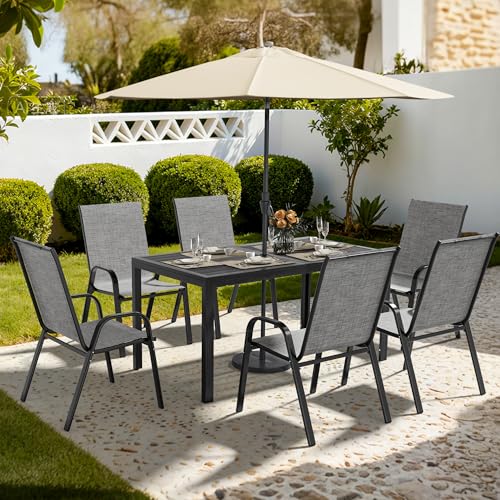
Patio Table and Chairs for Small Deck: The Complete Buying Guide
Everything you need to choose a compact dining set that fits your deck, seats your guests comfortably, and stands up to the elements — without crowding your outdoor space.
Start with SizingA small deck is one of the most rewarding outdoor spaces to furnish — and one of the easiest to get wrong. The difference between a deck that feels inviting and one that feels cramped usually comes down to a single decision: the patio table and chairs you choose. Get the scale right, and even a modest 8-by-10-foot deck can host weekend breakfasts, evening wine, and quiet reading afternoons. Get it wrong, and you lose walkway clearance, block your railing view, and end up with furniture that never quite fits.
This guide is written for homeowners who already know they want a patio table and chairs for a small deck but are unsure which configuration, size, and material will actually work. Rather than throwing a list of products at you, we walk through the decisions that matter most — footprint, shape, chair style, storage, and weather resistance — then connect each decision to the types of sets that perform well in that role. By the end, you will have a clear checklist for evaluating any set you find online or in a store.
Small decks come with constraints that larger patios do not. Railings limit how far chairs can slide back. Stairs and doors create traffic zones that furniture cannot block. Wind exposure is often higher on elevated decks, which affects umbrella stability and chair weight. Sun exposure can be brutal in the afternoon, making shade planning part of the table decision rather than an afterthought. And because small decks are often shared with grills, planters, and storage, every square foot has to earn its place. The recommendations below keep all of these realities in view.
1. How to Measure Your Small Deck Before You Shop
Before browsing any product page, measure your deck the way a furniture planner would. You need three numbers: the total usable floor area, the longest uninterrupted railing or wall span, and the width of your main traffic path (usually from the door to the stairs). These three measurements eliminate most of the guesswork.
Next, apply clearance rules. Chairs need room to pull out, and people need room to walk behind occupied chairs. A common planning standard is 24 inches of clearance between the table edge and any fixed obstacle so a chair can slide back, and 36 inches for a primary walkway. On a deck where the table sits against a railing on one side, you can reduce clearance on that side because no one needs to sit there. This is one of the most effective tricks for small decks: push the table toward the railing and open up the interior side for chairs and movement.
Quick sizing rule: For a deck under 100 square feet, a table with a footprint of roughly 30 to 36 inches across (round or square) paired with two to four chairs is the sweet spot. For decks between 100 and 150 square feet, a 36-to-48-inch round table or a compact rectangular table can work if you keep 24 inches of clearance on the seating sides.
Also measure the door swing and any grill or storage box you plan to keep on the deck. A set that fits the floor plan on paper can still fail in practice if a storm door needs three feet to open or if a grill lid needs clearance behind it. If your deck is elevated, check railing height and post spacing — these affect where an umbrella base can sit and whether a table with a center umbrella hole aligns with your shade needs.
If you are still deciding between a deck and a ground-level patio, our overview of patio styles and layouts is a useful companion read. For deck-specific planning, note that elevated decks usually need lighter furniture and stronger tie-downs than ground-level patios, since wind exposure and weight limits are more pressing concerns.
Pre-Shopping Measurement Checklist
- Usable floor area (length × width, minus stairs and fixed planters)
- Longest continuous railing or wall span
- Main traffic path width (door to stairs or grill)
- Door swing clearance
- Distance from railing to nearest obstacle
- Umbrella base location and available shade direction
- Weight limit for elevated decks (check with your building authority if unsure)
2. Round vs. Rectangular vs. Square: Which Shape Fits a Small Deck?
Shape is the single biggest lever for fitting a dining set onto a small deck. The right shape can free up several square feet of walkway without reducing seating. The wrong shape can make a set feel twice its actual size.
Round tables are usually the best choice for compact decks. A round table has no sharp corners to catch a hip or block a path, and because the perimeter is uniform, chairs can be arranged at any angle. On a small deck with an irregular usable area — say, a corner cut by a staircase — a round table uses the space more efficiently than a rectangle. A 30-to-36-inch round table seats two comfortably and four in a pinch. If you need a four-seat round set, look for tables in the 40-to-48-inch range and confirm that chairs tuck under the edge.
Square tables are the next most space-efficient option. They work well on symmetrical decks and can be pushed into a corner when not in use, with chairs on the two open sides. A square table also pairs naturally with four chairs and creates a compact, balanced footprint. If your deck has a clear rectangular zone where a table can sit without blocking circulation, a square table is often the most comfortable four-seat solution.
Rectangular tables make the most sense on narrow, elongated decks where furniture lines up along the railing. They are less efficient in irregular spaces and can create awkward dead zones in corners. If you go rectangular, choose a compact length — six seats will almost always overwhelm a small deck, so a four-seat rectangular set with chairs that tuck fully underneath is the practical limit for most balconies and small decks.
If you are furnishing a very tight space, a bistro-style setup with a small round table and two chairs is the classic solution. You can explore compact patio table and chairs for two to see how these sets are typically configured. For decks that need to flex between two and four seats, a table with a drop-leaf or extension mechanism is worth the extra complexity.
| Table Shape | Best For | Seating Capacity | Space Efficiency | Watch-Outs |
|---|---|---|---|---|
| Round (30–36 in.) | Irregular or corner decks, balconies | 2–4 | High | Confirm chairs tuck under the rim |
| Round (40–48 in.) | Square-ish decks with 24 in. clearance | 4 | High | Check walkway width behind chairs |
| Square (32–40 in.) | Symmetrical decks, corner placement | 2–4 | High | Corners can still catch traffic |
| Rectangular (compact) | Narrow decks along a railing | 4 | Medium | Avoid dead corners; check length |
| Bistro / drop-leaf | Very small decks, flex seating | 2 | Very high | Fewer seats; check folding hardware |
3. Chair Types That Save Space on a Small Deck
Chairs are often the hidden space hog in a small-deck dining set. A table's footprint is fixed, but chairs move, and the amount of room they need to pull out determines whether the set actually works day to day. The best chairs for small decks share three traits: they tuck fully or mostly under the table, they are light enough to move with one hand, and they stack or fold for storage.
Stackable chairs are the most practical choice for compact decks. When the meal is over, two chairs can stack in a corner, freeing the deck for other uses. Look for stackable designs with arms that clear the table apron so they can push in fully. Aluminum stackable chairs are common in the mid-tier and premium range and tend to be both lighter and more durable than entry-level resin versions.
Folding chairs offer the ultimate flexibility. They collapse flat and can be stored in a closet or under a bench. The trade-off is comfort and stability — folding chairs generally have less supportive seats and can feel less solid than fixed-frame chairs. For occasional seating on a small deck, though, they are hard to beat. Pair folding chairs with a compact table that has a center umbrella hole, and you have a set that can be fully cleared in minutes.
Armless dining chairs slide under the table more easily than armchairs and reduce the visual clutter of a small space. If comfort is a priority, look for armchairs with a low back that still clear the table edge. Swivel or rocking chairs are comfortable but need more clearance; they are usually a poor fit for a small deck dining set unless the table is generously sized relative to the deck.
Bench seating is another space-saving option worth considering. A bench along one side of a table can seat two or three people while allowing the bench to slide fully under the table when not in use. Benches also create a more built-in look and can double as storage if you choose a storage bench design. For decks with a railing on one side, a bench pushed against the railing can free up chair-pull space on the opposite side.
If your set will include a swing or lounge chair alongside the dining table, keep those pieces on the opposite side of the deck from the main traffic path. Our guide to patio swing chairs covers clearance and anchoring considerations that also apply to compact dining layouts.
4. Material Guide for Compact Patio Sets
Material choice affects weight, maintenance, and how long the set looks good on a deck that takes sun, rain, and wind. On a small deck, weight matters more than on a large patio because you may need to move furniture to clean, reconfigure, or clear space. Lightweight but sturdy materials are the ideal combination.
Powder-coated aluminum is the most versatile frame material for small-deck sets. It is light enough to rearrange alone, will not rust, and holds a finish well. Mid-range aluminum sets typically offer better weld quality and smoother mechanisms than entry-level versions. Look for reinforced joints and a finish described as weather-resistant or rust-proof.
High-grade steel is heavier and extremely stable, which is useful on windy elevated decks. The key is the coating: a rust-proof finish or galvanized treatment is essential, because bare steel will corrode. Steel sets are best treated as semi-permanent — move them rarely and use furniture pads to protect the deck surface.
Resin and plastic sets are the lightest and the easiest to maintain. They resist moisture, do not rust, and can be hosed down. Entry-level resin can fade and become brittle over years of UV exposure, while premium resin formulations hold color better and feel more substantial. Resin is an especially good fit for rental decks and for households that need to move furniture frequently.
Wood — teak, acacia, eucalyptus — brings warmth and a natural look that suits many deck styles. Teak is the most weather-resistant and ages gracefully; acacia is a solid mid-tier alternative but benefits from periodic sealing. Wood sets are heavier than aluminum and resin, so confirm you can move the pieces when needed. On small decks, a wood bistro set is often a better fit than a full wood dining set.
Wicker and rattan over an aluminum frame offer a woven look without excessive weight. All-weather synthetic wicker is the practical choice outdoors; natural rattan should be kept under cover. Wicker dining chairs tuck under tables reasonably well, but check that the weave does not snag on the table edge.
Deck-surface note: Composite and wood decks can be scratched by metal feet. Use furniture pads or choose chairs with nylon glides. On PVC decking, dark-colored furniture can transfer heat and leave marks over time — lighter finishes are a safer bet in full sun.
5. Shade and Umbrella Considerations
On a small deck, shade is not optional — it determines whether you can actually use the table at midday. The challenge is that umbrellas need a base, and bases need floor space. The good news is that compact decks can be shaded effectively with the right combination of table, umbrella, and base.
The simplest solution is a table with a center umbrella hole. A hole-aligned umbrella keeps the pole out of the walkway and uses the table itself for support. Check the hole diameter and the pole diameter before buying an umbrella — standard holes are around 1.5 to 2 inches, and mismatches are a common source of frustration. If you are shopping for a table specifically, our guide to patio tables with umbrella holes explains the sizing details.
On decks where the table is pushed against a railing, a cantilever or offset umbrella can provide shade without occupying floor space under the table. These umbrellas need a heavy base, and on elevated decks the base must be placed where it cannot tip or slide. For windy locations, a weighted base and a tie-down strap are essential. If wind is a recurring problem, our article on umbrellas that stay put in wind covers anchoring strategies in detail.
For very small decks, a market umbrella with a compact base may be the only workable option. Choose a base that is rated for the umbrella's canopy size, and position it so the canopy shades the table without overhanging the railing into a neighbor's space or a walkway below. A shade sail or a railing-mounted umbrella is another option when floor space is truly at a premium.
If your deck has partial overhead cover — an awning, pergola, or upper balcony — you may not need an umbrella at all. In that case, a table without a hole is fine, and you gain flexibility in table shape and size. Just confirm that the covered area actually shades the table during the hours you use it most.
6. Space-Saving Layout Strategies for Small Decks
Furniture placement can make or break a compact deck. The same table and chairs can feel cramped in one arrangement and comfortable in another. The following layouts are proven starting points; adapt them to your deck's door, stair, and railing positions.
Corner placement. Push the table into a corner where two railings meet, and arrange chairs on the two open sides. This frees the center of the deck for circulation and creates a cozy, defined dining nook. Corner placement works especially well with round tables, which can nestle into the corner without sharp edges catching traffic.
Railing-side placement. Place the table parallel to the longest railing, with one side of chairs facing the view. This preserves the interior for movement and makes the deck feel deeper. A rectangular table works well in this layout if the deck is narrow; a round table works if the deck is deeper.
Wall-side placement. If the deck has a solid wall or a section of privacy fencing, place the table against it and orient chairs outward. This creates a more enclosed, intimate feel and can double as a serving surface when the table is not in use.
Floating center layout. On a deck with enough room for a 24-inch clearance on all sides, a centered round table creates a balanced, symmetrical look. This is the most comfortable arrangement for four-seat dining but requires the most space. Reserve it for decks where the table will be the primary feature.
Flex layout. Use a compact table with folding or stacking chairs so the dining set can be cleared when the deck hosts a grill session or a yoga mat. The key is a table that can be moved by one person — aluminum and resin are the best materials for this strategy.
Whatever layout you choose, keep the main traffic path clear. A path from the door to the stairs should be at least 24 inches wide, ideally 30. If furniture blocks the path, people will walk around it, and the deck will feel smaller than it is. Also leave clearance for grill lids, storage box lids, and doors. These are the hidden space consumers that make a deck feel crowded.
For more ideas on compact outdoor living, see our guide to small patio ideas, which covers many of the same principles for ground-level spaces.
7. Storage and Off-Season Care
On a small deck, storage is not an accessory — it is part of the furniture plan. Cushions, folding chairs, and table leaves all need a home when not in use, and leaving them out can quickly make a tidy deck feel cluttered. The best compact sets are designed with storage in mind, or they pair well with a deck storage box.
Stacking and folding are the two most important storage features. Stackable chairs can be nested in a corner, and folding chairs can be stored upright in a closet. If your set includes cushions, look for cushions that can be stored in a deck box or a storage bench. A storage bench can also serve as seating, effectively combining two functions in one footprint. Our guide to patio storage benches covers sizing and weather protection.
For cushions and small accessories, a patio storage box placed against a railing or wall keeps items dry without taking up much floor space. Choose a box sized to your cushion dimensions, and confirm that the lid seals well enough to keep out rain. On windy decks, a box that doubles as a bench or side table is a practical two-in-one.
Off-season care depends on the material. Aluminum and resin can be cleaned and left out year-round in mild climates; steel benefits from a cover or indoor storage in freezing conditions. Wood should be cleaned and sealed before winter. Cushions should be brought inside or stored in a weatherproof box. Table and chair covers protect finishes and reduce spring cleaning; just make sure the cover is breathable so condensation can escape.
If your deck gets heavy snow or ice, consider a set that can be disassembled or folded and stored in a garage or shed. The lightest sets are the easiest to store, which is another argument for aluminum or resin on a small deck. For a broader seasonal care checklist, our weatherproofing guide covers furniture-specific maintenance steps.
8. Set Selection by Quality Tier
Patio sets on the market fall into broad quality tiers, and the tier you choose should match how often you use the deck and how much maintenance you are willing to do. This guide uses consistent tier descriptors rather than numbers, so you can compare sets on construction and materials instead of transient figures.
| Tier | Typical Construction | Best For | Lifespan Outlook | Maintenance |
|---|---|---|---|---|
| Entry-level | Resin or lightweight aluminum, basic welds | Occasional use, rentals, first deck | Several seasons with care | Low; store cushions |
| Mid-range | Powder-coated aluminum or steel, reinforced joints | Regular family use, four-season decks | Many seasons | Low to moderate |
| Premium | Heavy-duty aluminum or teak, high-grade hardware | Frequent entertaining, exposed decks | Long-term | Moderate; seal wood annually |
| Luxury | Solid teak, commercial-grade frames, precision joinery | Design-focused, permanent installations | Decades with care | Moderate; professional refinishing possible |
For a small deck, the mid-range tier is often the sweet spot: light enough to move, durable enough to leave out, and well-specified enough that chairs stack and tuck without wobbling. Entry-level sets are a reasonable choice if the deck is a rental or if the set will be stored for part of the year. Premium and luxury tiers make sense when the deck is a primary living space and the set will stay in place year-round.
When comparing sets within a tier, look at specifics: chair weight capacity, weld quality, whether the table has adjustable feet, whether cushions have ties or grip dots, and whether the finish is described as rust-proof or weather-resistant. These details matter more than broad marketing claims. Also check the return policy and warranty terms — a solid warranty is one of the clearest signals of build confidence.
Ready to Compare Sets?
Use the sizing, shape, and material guidance above to shortlist compact sets that fit your deck. Then browse recommended options selected for small-deck footprints and everyday durability.
View Recommended SetsFrequently Asked Questions
What size patio table and chairs fit on a small deck?
For a small deck under 100 square feet, a round table measuring 30 to 36 inches in diameter with two to four chairs is the most efficient choice. It preserves walkway clearance of at least 24 inches around the table. Bistro sets and drop-leaf tables are excellent solutions when the deck doubles as a passage area.
Is a round or rectangular table better for a small deck?
Round tables generally suit small decks better because they have no sharp corners, allow smoother traffic flow, and fit more naturally into compact or irregular spaces. Rectangular tables can work well on narrow, elongated decks where a linear arrangement along the railing makes sense.
How much clearance do I need around a patio table on a small deck?
Plan for at least 24 inches of clearance between the table edge and any railing, wall, or obstacle so chairs can pull out comfortably. For the main walking path, aim for 36 inches. On very tight decks, a table pushed against the railing on one side can free up space on the opposite side.
What materials work best for patio table and chairs on a small deck?
Aluminum and high-grade steel frames with powder-coated finishes offer the best balance of low maintenance, light weight, and weather resistance for small decks. Resin and plastic sets are the lightest and easiest to move. Teak and acacia bring warmth but require periodic sealing. Wicker and rattan over aluminum frames provide a woven look without excessive weight.
Can I use a full-size dining set on a small deck?
A full-size set with six to eight chairs usually overwhelms a small deck and blocks walkways. If you occasionally need extra seating, choose a compact four-seat set with stackable or folding chairs and add a small side table for serving. Modular and extendable tables offer flexibility without permanently consuming floor space.
Do I need an umbrella base if my table has an umbrella hole?
Yes, in most cases. A table hole supports the pole, but it does not anchor the umbrella against wind. A weighted base is especially important on elevated decks where wind exposure is higher. Check the umbrella manufacturer's recommended base weight and choose a base rated for your canopy size.
How can I make a small deck dining set feel less crowded?
Choose armless chairs that tuck under the table, use a round or square table instead of a rectangular one, keep the color palette light and consistent, and limit the number of pieces on the deck. A single compact set with two to four chairs plus one side table is usually enough. Clear the main traffic path and avoid stacking furniture in corners.
Choosing a patio table and chairs for a small deck is ultimately a problem of fit and function, not size. A compact round table with stackable chairs can transform a narrow balcony into a real dining space, while a poorly chosen rectangular set can make the same deck feel unusable. Measure first, apply clearance rules, choose chairs that tuck and stack, and treat shade and storage as part of the set rather than accessories.
If you are still exploring layout options, the product recommendations below are selected for small-deck footprints and everyday durability. Use the tier guide and material notes above to compare them on construction, not just appearance — and remember that the best set for your deck is the one that leaves room to move, sit, and enjoy the space without rearranging it every time you use it.