Portable Propane Fire Pits: The Complete Outdoor Buying Guide
Flame without the fuss. Learn how portable propane fire pits work, what separates entry-level units from top-tier models, and how to choose the right one for your patio, deck, or campsite — with clear, practical guidance for confident buyers.
Updated buying guide • No wood, no ash, no smoke — just controlled warmth on demand.
Why Portable Propane Fire Pits Are a Smart Outdoor Upgrade
Traditional wood-burning fire pits deliver atmosphere, but they also bring smoke, ash cleanup, spark concerns, and the need for a steady supply of seasoned wood. Portable propane fire pits solve those friction points. They ignite with a turn of a knob, produce a clean, controllable flame, and can be relocated from the patio to the deck or packed for a weekend trip. For homeowners who want warmth and ambiance without the maintenance ritual, that combination is hard to beat.
The portability factor matters more than many buyers realize. A freestanding propane unit can follow the shade in the afternoon, shift to the center of the conversation circle in the evening, and be tucked away when floor space is needed. If you are still weighing formats, our broader guide to portable outdoor fireplaces covers the full landscape of movable heating options, while the dedicated propane patio fire pit overview focuses specifically on patio-oriented models.
There is also a practical safety dimension. Because propane fire pits burn without flying embers or drifting sparks, they are a popular choice for decks and patios where wood-burning units require extra caution. The flame is instantly adjustable, and most models include a shut-off valve that lets you end the evening in seconds rather than waiting for coals to die down.
How Portable Propane Fire Pits Work
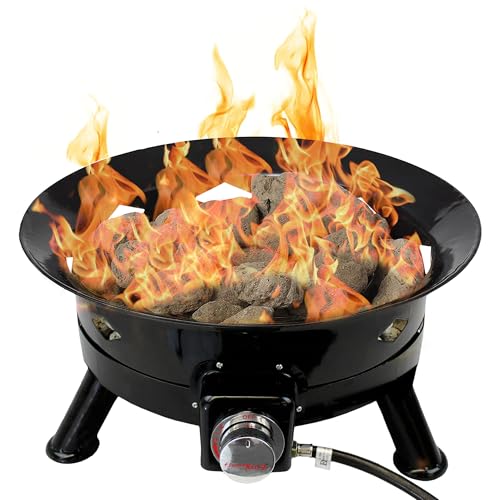
Every portable propane fire pit follows the same basic principle. A propane tank or canister feeds gas through a regulator and hose to a burner assembly concealed beneath a bed of lava rock, fire glass, or ceramic logs. When you open the valve and trigger the igniter, the gas ignites and the media above the burner radiates heat and creates the flame effect. The surrounding bowl or table body acts as a heat reflector and a safety barrier.
Understanding the burner system helps you evaluate quality. Entry-level units often use a single ring burner with a basic regulator. Mid-range and premium models typically use a wider, higher-output burner with better flame spread, a more precise regulator, and a sturdier ignition system. The difference shows up in heat distribution, flame consistency in light wind, and the smoothness of the flame adjustment across the full range.
The main components
- Burner assembly: The heart of the unit. Wider, heavier-gauge burners deliver more even flames and better wind tolerance.
- Regulator and hose: Controls gas flow from the tank. A quality regulator prevents sputtering and makes low-flame settings more stable.
- Ignition system: Push-button or rotary igniters are standard; premium models add electronic ignition for faster, more reliable starts.
- Media bed: Lava rock, fire glass, or ceramic logs. The media protects the burner and enhances heat radiation and visual appeal.
- Housing and bowl: Steel, aluminum, or composite construction. This determines durability, weight, and weather resistance.
Types and Formats of Portable Propane Fire Pits
Portable propane fire pits are not a single product category. The format you choose should match where you plan to use it and how often you expect to move it. The table below summarizes the main formats and their best-use scenarios.
| Format | Best For | Portability | Notes |
|---|---|---|---|
| Freestanding bowl fire pit | Patios, decks, small yards | Moderate | Classic look; often the most affordable tier entry point |
| Fire pit table | Patio lounging and entertaining | Low to moderate | Doubles as a table surface; ideal for conversation seating |
| Compact camping fire pit | Camping, tailgating, RV use | High | Lightweight, runs on 1 lb canisters or small tanks |
| Dual-purpose fire pit with grill | Patio and outdoor cooking | Moderate | Adds a cooking grate; best for buyers who want both functions |
| Tabletop propane fire pit | Balconies, small patios, ambient lighting | High | Small flame footprint; primarily ambiance rather than heavy heat |
If your priority is a permanent-feeling centerpiece that still allows some flexibility, a fire pit table is the strongest all-rounder. If you plan to move the unit frequently — between the yard, the deck, and the car — lean toward a compact camping model. Buyers who want a patio-first experience with a classic profile should compare a dedicated small propane fire pit for tighter spaces or a propane deck fire pit if the unit will live on a wooden surface.
Quality Tiers Explained: Entry-Level to Top-Tier
Portable propane fire pits range from simple starter units to premium models with refined construction. Rather than tracking shifting market figures, it helps to think in terms of quality tiers. The classification below is used consistently throughout this guide.
| Tier | Typical Characteristics | Best For |
|---|---|---|
| Entry-level | Single-ring burner, basic regulator, lighter steel body, simple push-button ignition, lava rock media | Occasional use, first-time buyers, casual patio evenings |
| Mid-range | Wider burner with better flame spread, sturdier housing, improved regulator, fire glass or ceramic media options | Regular patio use, homeowners who want reliability and a polished look |
| Premium | High-output burner, electronic ignition, heavy-duty construction, refined finish, integrated table surface or storage | Frequent entertaining, design-conscious patios, long-term investment |
| Top-tier | Professional-grade components, commercial-style burner, superior wind resistance, luxury materials and detailing | High-end outdoor living spaces, hospitality-style setups, buyers who want the best |
In practice, the jump from entry-level to mid-range delivers the most noticeable improvement in daily use: smoother flame control, more even heat, and better build quality. The premium and top-tier bands add refinement, stronger wind performance, and more sophisticated design — worthwhile for buyers who entertain often or treat the fire pit as a permanent design feature rather than a seasonal accessory.
Key Features That Separate Good Units From Great Ones
Burner output and heat distribution
Heat output matters, but distribution matters more. A wide burner paired with a well-designed bowl radiates warmth in a broader circle, so more people feel comfortable without crowding the unit. Look for descriptions that emphasize burner width and media depth rather than a single headline number.
Ignition reliability
Push-button igniters are standard and generally dependable. Electronic ignition, common in premium tiers, starts faster and holds up better in damp conditions. If you plan to use the fire pit year-round or in coastal environments, prioritize the more robust ignition system.
Construction materials
Steel is the most common housing material; aluminum and powder-coated finishes improve corrosion resistance. Stainless steel components and reinforced burners signal a higher-quality build. For buyers in humid or coastal areas, corrosion resistance deserves extra attention — the same principles covered in our powder-coated outdoor furniture guide apply here.
Wind resistance
Propane flames are vulnerable to gusts. Premium models use recessed burners, wind guards, or deeper media beds to keep the flame stable. A unit that stays lit in a light breeze is far more pleasant than one that flickers out repeatedly.
Portability features
Handles, caster wheels, and manageable weight all contribute to real-world portability. A fire pit that is technically movable but awkward to lift tends to stay in one place. If you plan to relocate it often, test the weight and grip in person or read owner feedback carefully.
Integrated storage and table surfaces
Fire pit tables with a built-in lid or side shelf add usable surface area when the flame is off. This is a genuine lifestyle benefit for small patios where every square foot counts. Models with concealed tank storage also look cleaner and reduce tripping hazards.
Safety and Placement: What Every Buyer Should Know
Propane fire pits are convenient, but they still involve an open flame and pressurized gas. A few disciplined habits keep them safe and enjoyable.
- Outdoor use only. Never operate a propane fire pit in an enclosed space, garage, tent, or under a low, sealed overhang. Carbon monoxide is invisible and odorless.
- Respect clearance distances. Keep the unit away from walls, furniture, and flammable decor. Follow the manufacturer's stated clearance guidelines.
- Use a stable, heat-resistant surface. On wooden decks, use a heat shield or fire-resistant mat beneath the unit. A dedicated propane deck fire pit is designed with these environments in mind.
- Check connections before every use. A soapy-water test on the hose and regulator connection quickly reveals leaks.
- Never leave a lit fire pit unattended. Turn off the gas and let the unit cool before moving or covering it.
- Keep children and pets at a safe distance. The housing and media can remain hot long after the flame is off.
- Store tanks properly. Keep spare propane tanks upright, outdoors, and away from direct heat sources.
Fuel and Runtime: What to Expect From Propane
Portable propane fire pits typically run on one of three fuel setups: standard 20 lb refillable tanks, smaller 5 lb or 10 lb tanks, and 1 lb disposable canisters. Each has a clear role.
| Fuel Setup | Best For | Runtime Character |
|---|---|---|
| 20 lb refillable tank | Home patios, frequent use | Long sessions across multiple evenings at moderate flame settings |
| 5–10 lb tank | Smaller patios, balcony use, portability | Balanced runtime with easier handling and storage |
| 1 lb canister | Camping, tailgating, short gatherings | Short, high-output bursts; best for compact units |
Runtime is influenced by burner output and flame setting. A low, ambient flame stretches usage considerably, while a high flame for warmth burns fuel faster. For patio use, most owners settle into a moderate setting that balances comfort and efficiency. If you entertain often, a spare tank removes the risk of an early end to the evening.
For buyers who want a larger, table-integrated format, comparing a propane fire pit table or a round propane fire table helps clarify how fuel storage and table design interact. Camping-focused buyers may find a compact propane firepit easier to pack and fuel with canisters.
Care and Maintenance for Long-Term Performance
Propane fire pits are low-maintenance, but a simple routine keeps them looking sharp and burning cleanly.
After each use
- Let the unit cool completely before covering it.
- Wipe down the housing with a damp cloth; avoid abrasive cleaners on painted or powder-coated surfaces.
- Check that the burner ports are free of debris or insect nests.
Seasonal checks
- Inspect the hose and regulator for cracks or wear.
- Refresh the media bed if lava rock or fire glass has become dull or clogged with soot.
- Store the unit under a fitted cover during long periods of disuse.
- For coastal environments, rinse and dry metal surfaces more frequently to limit corrosion.
If the flame becomes uneven or yellow, the burner ports may be partially blocked or the regulator may need attention. A clean burner and properly seated media usually restore a steady blue flame. The maintenance mindset is similar to caring for other outdoor metal pieces, as outlined in our powder-coated aluminum patio furniture care guide.
Which Portable Propane Fire Pit Fits Your Space?
The right choice depends less on specifications and more on how and where you will use the unit. The scenarios below map common buyer situations to sensible formats and tiers.
Small patio or balcony
Prioritize a compact footprint and a tabletop or small bowl format. A small propane fire pit keeps the flame contained and the space usable. Mid-range construction is a good balance for regular use.
Wooden deck
Choose a unit explicitly suited to deck placement, with a heat shield and stable base. A propane deck fire pit is engineered for this environment. Prioritize clean-burning performance and a sturdy housing.
Entertaining patio
A fire pit table creates a natural gathering point and doubles as a surface. A round propane fire table works well for circular seating, while a propane fire pit table comparison helps narrow the field. Premium tiers reward frequent hosts with smoother controls and better finish.
Camping and travel
Look for a lightweight unit that runs on 1 lb canisters, packs efficiently, and includes a carry handle. A compact propane firepit or a specialized travel model fits the bill. Prioritize ignition reliability and wind resistance over table features.
Year-round patio use
If the fire pit will be used in cooler months, emphasize heat output and wind performance. A premium or top-tier model with a wide burner and refined regulator is the more efficient long-term investment. Pair it with a propane gas fire pit overview to confirm fuel compatibility and placement rules.
Frequently Asked Questions
Are portable propane fire pits safe to use on a wooden deck?
Portable propane fire pits produce no embers or sparks and burn cleanly, which makes them generally safer on decks than wood-burning units. However, you must still follow clearance guidelines, keep the unit on a heat-resistant surface, and never place it under a low overhang or near flammable materials.
How long does a propane tank last in a portable fire pit?
Runtime depends on the burner output and the tank size. A standard 20 lb tank typically provides many hours of use at a moderate flame setting, while smaller 1 lb canisters deliver much shorter sessions. Always keep a spare tank or canister on hand for uninterrupted evenings.
Can portable propane fire pits be used indoors?
No. Propane fire pits are designed for outdoor use only. Even though they burn cleaner than wood, they still consume oxygen and produce carbon monoxide. Never operate one inside a home, garage, tent, or any enclosed space.
Do portable propane fire pits give off real heat?
Yes. Modern propane fire pits are engineered with burner systems and reflective elements that radiate meaningful warmth. High-end tier models with wider burners and lava rock or fire glass media tend to distribute heat more evenly than starter tier units.
What is the difference between a portable and a built-in propane fire pit?
A portable unit is freestanding and can be moved between the patio, deck, and campsite. A built-in propane fire pit is permanently installed into a hardscape or table and typically requires a dedicated gas line. Portability trades some heat output and permanence for flexibility.
Ready to Choose Your Portable Propane Fire Pit?
You now have a clear framework: match the format to your space, choose a quality tier that reflects how often you will use it, and prioritize safety and wind performance. Browse hand-selected options below to find the right fit for your patio, deck, or campsite.
Explore Top Portable Propane Fire Pit Picks