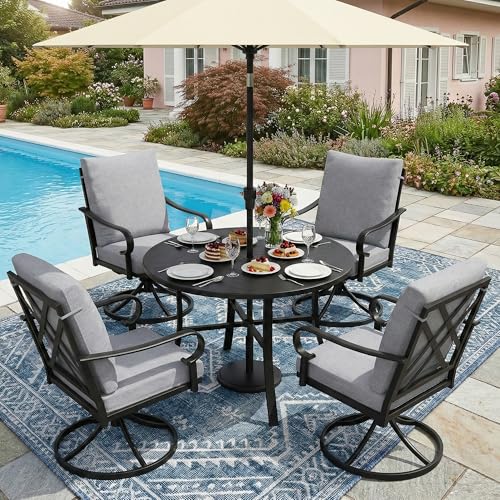
Round Outdoor Dining Set with Swivel Chairs
Everything you need to know before choosing a round patio dining set with swivel seating — table sizes, frame materials, chair mechanics, weather resistance, and layout planning for real backyards.
Explore Recommended SetsWhy Choose a Round Outdoor Dining Set with Swivel Chairs
A round dining table changes how a patio feels. There is no head of the table, no one stuck at a corner, and conversation flows naturally in a circle. Pair that table with swivel chairs and the space becomes far more flexible: guests can turn toward the table to eat, pivot toward the garden to talk, and swing outward to stand up without dragging a chair across the deck.
This combination is especially practical for outdoor rooms where the view matters. On a deck facing a lawn, a pool, or a sunset, swivel seating lets everyone enjoy the scenery without rearranging the furniture. It also helps on tight patios, because chairs rotate in place rather than requiring a wide pull-back zone behind them.
Key advantages of the round-plus-swivel combination
- Even conversation: everyone sits at a similar distance from the center of the table.
- Easier entry and exit: swivel bases reduce the need to slide heavy chairs backward.
- Better small-space behavior: rotation replaces the wide clearance that stationary chairs demand.
- Flexible orientation: diners can face the table, the view, or the grill without moving furniture.
- Visual balance: a circular table softens rectangular decks and awkward corners.
Worth knowing: a round table with swivel chairs is not automatically better than a rectangular set. If you regularly host eight or more people, a long rectangular or oval table usually seats a crowd more efficiently. Round sets shine for four to six diners who value flow, conversation, and a compact footprint.
Choosing the Right Table Size and Seating Count
Table diameter is the single most important specification to get right. Too small and place settings crowd each other; too large and the chairs no longer fit comfortably around the perimeter. As a practical rule, allow roughly 24 inches of table edge per diner and keep at least 24 to 30 inches between chair centers.
| Table Diameter | Typical Seating | Best For | Notes on Swivel Chairs |
|---|---|---|---|
| 36–42 in | 2–3 | Balconies, breakfast nooks, compact courtyards | Choose narrow swivel chairs; full-size chairs may crowd the table edge. |
| 42–48 in | 4 | Standard small patios and four-person households | The most common pairing; swivel motion works well with modest clearance. |
| 48–54 in | 4–5 | Mid-size decks with occasional extra guests | Leaves room for a centerpiece or lazy Susan without sacrificing place settings. |
| 54–60 in | 6 | Family patios and regular entertaining | Confirm chair width; six swivel chairs need a genuinely large deck. |
| 60 in and above | 6–8 | Large terraces and poolside dining areas | Consider a pedestal base so legroom is not blocked by table legs. |
Height matters as much as diameter
Standard outdoor dining height is around 28 to 30 inches at the table surface, paired with seat heights near 17 to 19 inches. Counter-height sets sit around 36 inches with seat heights near 24 to 26 inches, and bar-height sets reach roughly 40 to 42 inches. Swivel chairs are available in all three heights, so decide early whether you want a traditional dining posture or a taller, stool-like setup. If you are considering taller configurations, the same geometry rules apply — see our guidance on round bar height patio table and chairs for a closer look at clearance and chair proportions.
If four seats are your target, the dedicated guide to a round outdoor dining table set for 4 breaks down footprint and chair spacing in more detail. For larger households, the round outdoor dining table and chairs for 6 overview covers the jump in dimensions and what that means for deck space.
Round Table Construction and Top Materials
The table is the anchor of the set, and its top material determines how the surface ages, how much maintenance it needs, and how it handles heat, rain, and UV exposure.
Glass tops
Tempered glass gives a light, open look that keeps small patios from feeling heavy. It wipes clean easily and does not absorb stains. The trade-offs are weight, the potential for chipping at the edge, and visible smudges. If you choose glass, confirm the top is tempered and that the frame supports it fully rather than at a few points. Replacement options exist if a top is damaged — our page on replacement glass for a patio table with umbrella hole explains how to match thickness and hole placement.
Aluminum and metal tops
Powder-coated aluminum is the most common choice for round outdoor dining tables because it is light enough to move, resists rust, and holds a finish well. Slat or mesh tops drain rainwater quickly and stay cooler in direct sun than solid metal. Cast aluminum adds visual detail and weight, which helps on windy decks. Solid metal surfaces can become hot in strong sun, so consider a lighter finish or a shaded location.
Wood tops
Teak, acacia, and eucalyptus bring warmth and a natural look. Teak is the most weather-tolerant of the group thanks to its natural oils, while acacia and eucalyptus need more consistent sealing. Wood tops expand and contract with humidity, so expect minor seasonal movement. They pair especially well with swivel chairs that have wood or wicker frames.
Resin and composite tops
High-density resin and composite tops are engineered for outdoor exposure. They resist moisture, do not splinter, and are typically low-maintenance. The look is more uniform than natural wood, but the durability is excellent for households that prefer minimal upkeep.
Pedestal versus four-leg bases
A pedestal base keeps the area under the table clear, which matters when swivel chairs rotate inward. Four-leg tables are often more stable on uneven surfaces and easier to level, but the legs can interfere with footroom. On sloped or paver patios, look for adjustable feet.
If you want shade overhead, an umbrella hole is essential — confirm the hole diameter and whether a stabilizer ring is included. Our notes on the round outdoor dining table with umbrella hole cover what to verify before pairing a table with a canopy.
Swivel Chair Mechanics and Frame Options
The chair is where a set succeeds or fails in daily use. Swivel mechanisms vary considerably, and the difference shows up after a season of regular rotation.
How swivel mechanisms work
- Simple swivel base: a bearing ring under the seat allows continuous rotation. This is the most common design and the easiest to maintain.
- Swivel with memory return: the chair rotates and springs back to a forward-facing position. Useful when you want chairs to look tidy without adjusting them each time.
- Swivel rocker or glider: adds a gentle rocking or gliding motion on top of rotation. These are comfortable for lingering after meals but slightly heavier and more complex.
Whichever mechanism you choose, check that the bearing is rated for outdoor use. Sealed or stainless bearings resist grit and moisture far better than open assemblies. A chair that grinds or wobbles after one rainy season usually has an exposed bearing.
Frame materials for swivel chairs
Powder-coated aluminum frames are lightweight and rust-resistant, making them a strong default for humid climates. High-grade steel is heavier and very stable in wind, but requires a genuinely rust-proof finish. Resin wicker over a metal frame delivers a woven texture with less maintenance than natural rattan; the resin wicker patio furniture overview explains how the weave is constructed and what to inspect. For a more traditional silhouette, wrought-iron-style chairs are available with swivel bases — our replacement seats for wrought iron patio chairs guide is useful if you plan to refresh an older set rather than buy new.
Cushions and seat comfort
Swivel dining chairs are usually sold with seat cushions or as sling seats. Cushions add comfort but need storage during heavy rain; sling seats dry faster but offer less padding. Look for quick-dry foam and solution-dyed acrylic covers if cushions are part of the design. If you expect to replace cushions over time, confirm the seat dimensions are a standard size — our guide to replacement outdoor dining chair cushions covers how to measure correctly.
Armrests and weight capacity
Armrests help diners rise from the table, but they also add width. On a 48-inch round table with four swivel chairs, armrests can make the circle feel tighter. Check the published weight capacity and chair width before committing, especially if the set will host a range of guests.
Weather Resistance and Long-Term Care
Outdoor dining furniture lives through sun, rain, pollen, and temperature swings. The set that lasts is usually the one whose finishes were specified for exposure, not the one with the most features.
What to look for in finishes
- Powder coating: a baked-on finish that resists chipping and UV fading far better than paint.
- Rust-proof hardware: stainless or coated fasteners at every joint, especially on swivel bases.
- Marine-grade materials: relevant for coastal homes where salt air accelerates corrosion.
- UV-stabilized resin: prevents wicker and sling fabrics from becoming brittle.
Seasonal maintenance routine
- Rinse frames monthly during pollen season to prevent buildup in swivel bearings.
- Clean cushions with mild soap and water, then dry fully before storing.
- Inspect swivel mechanisms each season and apply a manufacturer-approved lubricant if specified.
- Cover or store cushions during off-season months to extend fabric life.
- Touch up any chips in powder coating promptly to prevent corrosion underneath.
For a deeper maintenance plan, our weatherproofing guide covers protective coatings and storage strategies in detail. If your set includes glass, review the replacement tempered glass for patio table page for safety considerations around chips and edge damage.
Practical tip: swivel chairs collect grit in the bearing ring faster than stationary chairs. A quick rinse and a dry cloth at the start of each season prevents the grinding sensation that signals premature wear.
Layout, Clearance, and Placement Tips
Even a well-built set can feel cramped if the layout ignores clearance. Measure your patio before you shop, and plan around these working numbers.
- Chair pull-out zone: allow 24 to 30 inches behind each chair for comfortable standing and walking.
- Wall and railing clearance: keep at least 18 inches between the chair back and any fixed surface when chairs are pushed in.
- Umbrella base clearance: a cantilever or weighted base needs its own footprint, often 20 inches or more on each side.
- Traffic paths: leave a clear route of 36 inches or more between the dining area and doors or stairs.
Placing a round set on a rectangular deck
A round table centered on a rectangular deck creates natural circulation around the perimeter. If the deck is narrow, offset the table toward one side and keep the wider clearance on the traffic side. On a square patio, a round set is almost always the most efficient choice because it avoids the dead corners that rectangular tables create.
Pairing with shade and heat
If the set will sit in full sun, an umbrella or a nearby structure makes the space usable at midday. Our guide to the round outdoor dining table with umbrella hole covers hole sizing and stabilizer options. For cooler evenings, a fire feature nearby extends the season — the round dining table with fire pit in the middle concept shows how a central heat source changes the layout.
When the set needs to seat a crowd
A six-seat round table with swivel chairs is a strong middle ground for families. If your guest list regularly grows, consider a lazy Susan or a slightly larger top rather than adding chairs beyond the recommended count. Our overview of the round outdoor dining table for 6 with swivel chairs discusses the balance between seating capacity and comfortable rotation.
Quality Tiers at a Glance
Instead of comparing listings by numbers, it helps to understand where a set sits in the market. These tier descriptors are relative and consistent across this guide.
Starter Tier Sets
Basic powder-coated frames, simpler swivel bearings, and lighter cushions. A reasonable starting point for renters or occasional use, with the expectation that finishes may need attention sooner.
Balanced Tier Sets
Better frame welds, sealed swivel mechanisms, and more durable sling or cushion fabrics. This is where most households find the best balance of longevity and daily comfort.
High-End Tier Sets
Heavier cast aluminum or solid wood construction, refined swivel return mechanisms, and solution-dyed fabrics rated for prolonged sun exposure. Built for year-round outdoor use.
Flagship Tier Sets
Marine-grade hardware, hand-finished frames, and commercial-grade bearing assemblies. A long-term investment for coastal homes and households that entertain frequently.
When comparing within a tier, focus on the swivel bearing, frame finish, and cushion fabric rather than decorative details. Those three components drive how the set feels and performs after several seasons.
Pre-Purchase Checklist
Run through this list before finalizing a set. Each item addresses a common source of regret after delivery.
- Measure the patio and map chair clearance, not just table footprint.
- Confirm seating count against how often you actually host guests.
- Check the swivel mechanism — sealed bearing, smooth rotation, no wobble.
- Verify frame finish — powder-coated aluminum or rust-proof steel.
- Decide on cushion versus sling seats based on storage and climate.
- Confirm umbrella compatibility if shade is part of the plan.
- Review the assembly process and whether tools are included.
- Check warranty terms for frame, finish, and fabric separately.
For the wider context of how this set fits into a complete outdoor space, browse our outdoor living section and the broader buying guides collection.
Frequently Asked Questions
What size round outdoor dining set fits a small patio?
A four-seat set with a table diameter around 42 to 48 inches works well for compact patios. It leaves enough clearance for chairs to swivel without hitting walls or railings.
Are swivel chairs better than stationary chairs for outdoor dining?
Swivel chairs make it easier to get in and out of the table and to turn toward conversation or a view. They are especially useful on a round table where guests sit close together.
What materials work best for a round outdoor dining set?
Powder-coated aluminum and high-grade steel resist rust, while teak and other dense woods age gracefully. Resin wicker over a metal frame offers a woven look with lower upkeep.
How many people can a round outdoor dining table seat?
A 48-inch round table typically seats four comfortably, a 54 to 60-inch table seats four to six, and larger 60-inch-plus tables can seat six with room for serving pieces.
Do swivel chairs need special maintenance?
Rinse the bearing ring periodically and keep it free of grit. If the manufacturer specifies a lubricant, apply it at the start of each season. Avoid pressure-washing directly into the swivel assembly.
Can a round set work on a rectangular deck?
Yes. A round set centered on a rectangular deck creates natural circulation, and offsetting it slightly keeps traffic paths clear. Measure clearance behind the chairs before finalizing placement.
Ready to Compare Options
Browse recommended round outdoor dining sets with swivel chairs and review the specifications that matter most for your patio.
View Recommended Sets