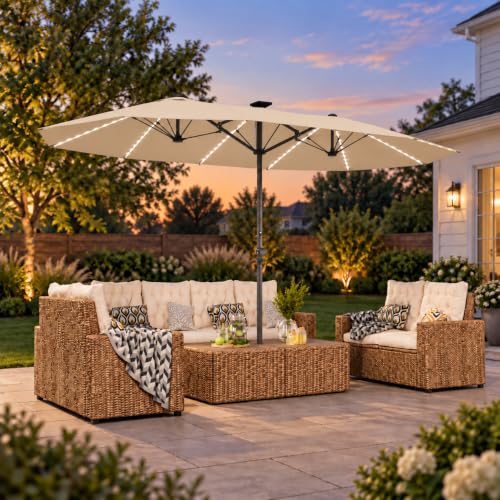
What Is a Solar Outdoor Umbrella?
A solar outdoor umbrella is a patio shade structure with a small photovoltaic panel mounted at the top of the canopy. That panel charges an integrated battery during daylight hours, and the stored energy powers a ring of LED lights built into the umbrella ribs or hub. The result is a single product that gives you sun protection in the afternoon and soft illumination after sunset — no extension cord, no outdoor outlet, no separate string lighting.
This design solves a very practical problem. Patios, decks, and poolside areas are often far from a power source, and running electricity outdoors is a construction project in itself. A solar umbrella sidesteps that entirely. For anyone comparing shade options, our broader guide to outdoor umbrella with solar lights and stand covers bundled configurations, while the dedicated solar lighting options page explains how photovoltaic patio lighting works in general.
It is worth distinguishing two categories early. A solar umbrella has the panel and LEDs built into the umbrella itself. A standard umbrella paired with a separate solar light kit or a sun shade for patio is a different setup with different trade-offs. This article focuses on the integrated type, because that is the form factor most shoppers are researching.
How Solar Umbrella Lighting Actually Works
The system is simple but the quality varies enormously between models. Understanding the chain helps you evaluate specifications.
- Solar panel: Mounted on the canopy's top vent or crown. Panel wattage typically ranges from a few watts on entry-level models to a higher-output panel on premium units. Larger panels charge faster and tolerate cloudy days better.
- Battery: Usually a rechargeable lithium or NiMH pack housed in the umbrella hub or pole. The critical question is whether the battery is user-replaceable. A sealed, non-replaceable battery effectively sets the product's lifespan, while a replaceable pack lets the umbrella keep working for years.
- LED ring: Bulbs set into the ribs or the hub, pointing downward. Count matters less than placement and diffusion — a well-diffused ring of fewer LEDs often looks better than a harsh ring of many.
- Switch: Usually a push-button on the pole or hub. Mid-range and top-tier models often add dimming or multiple brightness levels.
Light output is measured in lumens, but most manufacturers describe it loosely. As a practical rule, entry-level solar umbrellas produce enough glow to see your surroundings and eat comfortably; mid-range models brighten a dining table clearly; top-tier units with higher-output LEDs can genuinely light a seating area for evening conversation.
Key Features to Evaluate Before Buying
Canopy Fabric
Look for solution-dyed polyester or acrylic with a stated UV rating. These resist fading and mildew far better than thin commodity fabric. Breathable vented tops reduce wind lift.
Rib & Pole Material
Aluminum ribs and poles resist rust and keep weight down. Steel is heavier and needs a rust-proof finish. Fiberglass ribs flex in wind but can crack over time.
Panel & Battery
Prefer a model with a replaceable battery and a panel that sits above the canopy vent, not buried under fabric. Panel accessibility matters for cleaning.
Base & Stability
Many solar umbrellas ship without a base. Confirm whether you need a patio umbrella base, a standing umbrella base, or a wheeled option.
Tilt Mechanism
A crank-and-tilt or push-button tilt lets you angle shade as the sun moves. Cheap tilt joints are a common failure point — check reviews for wobble.
Table Compatibility
If you plan to run the pole through a table, verify pole diameter against your table's hole. Models with a umbrella extension pole for bar height table setups solve height mismatches.
Canopy Size: Matching the Umbrella to Your Space
Undersizing is the most common buying mistake. A canopy that is too small leaves shoulders and table edges in direct sun, which defeats the purpose. As a working guide:
- Around 7.5 to 8 feet: best for a small bistro table, a balcony, or a single lounge chair. Consider pairing with a compact setup like a round patio coffee table with umbrella hole.
- Around 9 feet: the workhorse size for a four-seat dining table. This is the most common canopy diameter on the market.
- Around 10 to 11 feet: suited to six- to eight-seat tables. Models like those used with a round patio dining table with umbrella hole pair naturally with this range.
- Beyond 11 feet: typically offset or cantilever designs that require a heavy base and more open floor space.
Always measure the footprint of the table plus the overhang of chairs. The canopy should extend past the seating edge, not stop at the table rim.
Solar Umbrella Tiers Compared
To avoid anchoring on any single figure, the table below groups solar umbrellas by market tier. Use it to decide which class of product matches your expectations for durability and lighting quality.
| Tier | Best For | Typical Characteristics |
|---|---|---|
| Essential tier | Casual shade, occasional evening use | Thinner polyester canopy, modest LED ring, sealed battery, no tilt or basic tilt. Adequate for a small balcony. |
| Balanced tier | Regular family use on a patio or deck | Solution-dyed fabric, aluminum ribs, brighter LEDs with two or three settings, crank-and-tilt, replaceable battery on better models. |
| Top-tier | Entertaining, large tables, long-term ownership | High-grade acrylic or reinforced fabric, heavy-duty aluminum frame, high-output LED ring, user-replaceable battery, refined tilt and crank mechanisms. |
| Flagship / commercial-grade | Hospitality settings, poolside, windy exposures | Oversized panels, wind-rated frames, reinforced hubs, serviceable electronics, and compatibility with heavy bases or in-ground mounts. |
In practice, the jump from essential tier to balanced tier delivers the biggest improvement in perceived quality — smoother cranks, better light diffusion, and fabric that survives multiple seasons. Moving from balanced to top-tier buys longer service life and a more pleasant evening glow rather than a dramatically different experience at noon.
Solar Panel and Battery: The Details That Decide Longevity
This is where solar umbrellas differ most from ordinary patio umbrellas, and where shoppers get caught out.
Panel placement and cleaning
The panel sits at the crown of the umbrella, often on a small raised platform above the vent. That placement is good for sun exposure but collects dust and pollen. A panel that is caked in debris may charge at a fraction of its rated output. Choose a model where the panel surface is easy to wipe, and plan to clean it every couple of weeks during the season. If your umbrella lives under a tree or near a bird feeder, clean it more often.
Battery life and replaceability
Rechargeable packs degrade over time regardless of quality. A replaceable battery is the single most important longevity feature on a solar umbrella — it turns a disposable product into a serviceable one. When a battery is sealed inside a glued hub, the umbrella's lighting function has a fixed lifespan even if the fabric and frame remain sound. Ask explicitly whether the pack can be swapped.
Realistic runtime
Expect roughly six to ten hours of light from a full charge on most models, with top-tier units reaching the upper end of that range. Cloudy days reduce charge, and cold weather reduces battery capacity. If you plan to host evening gatherings regularly, look for a model with a higher-capacity pack rather than the brightest LED ring alone.
Stability and Base Selection
Solar umbrellas are often sold as canopy-and-pole only, with the base as a separate purchase. This catches people off guard. A large canopy acts like a sail, and an undersized base is a genuine safety issue on a breezy day.
For a standard center-pole umbrella, a weighted base filled with sand or water is the usual answer. If you need to move the umbrella between sun and shade positions, a umbrella base with wheels is far more practical than dragging a static base. For very large canopies or exposed locations, a heavier umbrella bases option or a fixed mount is the safer route. Cantilever designs demand substantially more counterweight than center-pole umbrellas of the same canopy size.
Two other stability considerations: a vented canopy lets wind pass through rather than lifting the umbrella, and a tilt mechanism should lock firmly. If your umbrella will sit beside a pool, also look at models intended as umbrellas for pools, which typically emphasize corrosion resistance.
Where a Solar Umbrella Fits in Your Outdoor Setup
A solar umbrella rarely stands alone. It works best as the anchor of a complete shade-and-dining zone:
- Over a dining set: pair with a table that has a pre-cut hole. A round patio table and chairs set for eight or a round outdoor table and chairs for eight benefits enormously from a large canopy centered above.
- Beside a seating group: if your dining area is separate from your lounge area, a 5-piece conversation set with fire pit or a small outdoor patio set with fire pit can carry the evening ambiance while the umbrella shades the table.
- On a compact balcony: a smaller canopy over a 30-inch round patio table and chairs is a tidy solution for tight spaces.
- As a standalone shade station: if you prefer not to run a pole through a table, a heavy base and a freestanding umbrella over a pair of sun chairs or stackable outdoor chairs works well.
If you are also considering non-solar shade structures, the patio sun shade guide and the triangle sun shade overview cover fabric sails and fixed shade options that complement rather than replace an umbrella.
Buying Checklist: What to Confirm Before You Order
- Canopy diameter matches your table plus chair overhang — not just the table.
- Pole diameter fits your table's umbrella hole, or you have a compatible replacement table top with umbrella hole planned.
- Battery is replaceable — confirmed in the product description or by asking the seller.
- Panel is accessible for regular cleaning and sits above the vent, not under fabric.
- Frame material is aluminum or a rust-proof finished steel; check the warranty on ribs and hub.
- Base is included or budgeted — decide between static, wheeled, or fixed mount.
- Tilt mechanism matches your sun exposure; a cranking tilt is worth having if the umbrella stays in one spot all day.
- Light output suits your use — glow for ambiance versus clear task lighting over a dining table.
- Storage plan for winter — a cover or indoor storage preserves fabric and battery life.
- Weather resistance of the canopy fabric, stated as UV rating and mildew resistance.
Care and Maintenance for Long-Term Use
Solar umbrellas need slightly more attention than conventional ones because of the electronics, but the routine is simple:
- Wipe the solar panel every couple of weeks with a soft damp cloth. Do not use abrasive cleaners on the panel surface.
- Close the umbrella during storms. Wind damage to ribs and panels is the leading cause of premature failure.
- Remove the battery before long-term storage if the design allows it, and store it in a dry place.
- Clean the canopy with mild soap and water; avoid harsh detergents that strip UV coatings.
- Inspect the hub and tilt joints at the start of each season for looseness or corrosion.
- If rust appears on steel components, address it early using the methods in our rust removal guide before it spreads.
Treat the umbrella as a seasonal piece of outdoor furniture rather than a permanent fixture, and the frame, fabric, and electronics will all last considerably longer.
Frequently Asked Questions
How long do solar outdoor umbrella lights last on a full charge?
Most solar umbrellas with built-in LED lights run for six to ten hours on a full charge, depending on the number of LEDs, brightness setting, and how much direct sunlight the panel received during the day. Premium models with larger panels and efficient batteries tend to sit at the higher end of that range.
Can a solar umbrella stay outside in the rain?
Yes. The canopy fabric and solar panel housing on a well-built solar umbrella are designed to withstand normal rain. However, to protect the wiring and battery life, it is best to close the umbrella during storms and store it during off-season months.
What size solar umbrella do I need for a dining table?
For a standard four-seat dining table, a canopy around nine feet in diameter usually provides comfortable shade. For tables seating six to eight people, a ten to eleven-foot canopy is a better fit. Always confirm the umbrella pole diameter matches the hole in your table.
Do solar umbrellas require an electrical outlet?
No. The solar panel mounted on top of the canopy charges an integrated battery during daylight hours, so no outlet or extension cord is needed. This makes them ideal for decks and patios far from a power source.
How do I maintain the solar panel on my umbrella?
Wipe the panel with a soft damp cloth every couple of weeks to remove dust, pollen, and bird droppings. Clean panels charge more efficiently. Also check the battery compartment at the start of each season and remove the battery during long storage periods.