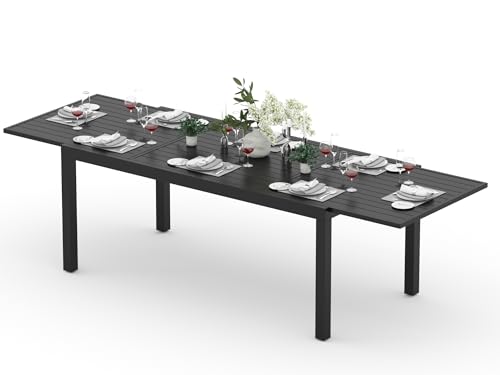
Extendable Outdoor Dining Table: The Complete Buying & Design Guide
One table that seats four for weeknight dinners and ten for holiday gatherings. This guide explains how extendable patio tables work, which mechanism fits your space, and how to plan seating, shade, and materials so you buy with confidence.
Explore Buying FactorsWhy this guide matters: An extendable outdoor dining table solves the most common patio dilemma — a footprint that feels generous on a quiet evening but crowded the moment guests arrive. Below you will find a practical breakdown of extension mechanisms, material tiers, real-world sizing, umbrella compatibility, and the seating combinations that work best together, so you can choose a configuration that stays useful for years.
What Is an Extendable Outdoor Dining Table?
An extendable outdoor dining table is a patio table engineered with a built-in expansion mechanism. Instead of owning two tables, you own one frame that shifts between a compact everyday size and a larger entertaining size. The extension is usually achieved with a leaf — a removable or folding panel of tabletop — or with a sliding frame that opens to accept that leaf.
This flexibility matters outdoors more than indoors. Patios are fixed footprints, and a table that is permanently large dominates the space even when it is empty. A table that opens only when needed keeps the deck navigable, preserves walking room to the grill, and still handles a full guest list. If your priority is a permanently generous layout rather than a convertible one, a fixed outdoor patio dining set may suit you better, but for mixed-use backyards the extendable format is usually the more practical choice.
Extension Mechanisms Explained
The mechanism is the single most important part of an extendable table, because it is the component that receives the most wear. There are three main systems, and each behaves differently outdoors where grit, moisture, and temperature swings accelerate wear.
Butterfly Leaf (Self-Storing Leaf)
A butterfly leaf folds in half and stores inside the table body when closed. To extend, you pull the two halves of the tabletop apart and the leaf unfolds into the gap. This is the most convenient system because the leaf never needs separate storage, which is a real advantage outdoors where loose panels can warp or collect moisture. Mid-range and premium models typically use smoother butterfly hardware with locking latches.
Drop-In Leaf (Separate Panel)
A drop-in leaf is a separate panel you lift into place after sliding the frame open. It is mechanically simple, which makes it dependable and easy to maintain, but the leaf must be stored somewhere dry when not in use. Entry-level tables often use this design. If you choose this type, plan a dry storage spot such as a deck box before you buy.
Sliding Frame Extension
In a sliding frame design, the tabletop sections slide along tracks to reveal a center gap, and the leaf fills that gap. The quality of the tracks determines how smoothly the table opens after a season outdoors. Look for sealed or covered tracks and a locking mechanism that prevents accidental sliding when the table is loaded with plates.
Materials: What Survives the Outdoors
An extendable table has more moving parts than a fixed one, so material choice affects both durability and how easily you can operate the extension. The table below compares the main options using market-position tiers rather than absolute figures.
| Material | Market Tier | Best For | Watch Out For |
|---|---|---|---|
| Powder-coated aluminum | mid-range | Rust resistance, lightweight handling, humid climates | Frame can feel light; check weight ratings on leaf supports |
| Teak or eucalyptus hardwood | premium | Natural warmth, long-term investment, covered patios | Requires periodic sealing; heavier to move and extend |
| High-density polyethylene (HDPE) | mid-tier | Wet climates, low-maintenance households, coastal areas | Heavier panels; color options are usually more limited |
| Resin or composite top with metal frame | entry-level | Occasional use, covered porches, starter setups | Verify UV stability and leaf alignment over time |
| Cast aluminum with decorative finish | high-end tier | Statement pieces, wind-prone decks, heavy-duty use | Substantial weight; moving it requires two people |
Whatever material you select, confirm that the extension hardware matches it. A rust-proof finish on the frame is only useful if the hinges and latches share the same protection. Stainless steel hardware is a strong signal of a well-specified table for its class, and it is worth prioritizing over cosmetic details.
Sizing: From Compact to Full Guest List
Sizing an extendable table is a two-step calculation: first measure the closed footprint your patio can spare every day, then measure the open footprint you can tolerate during gatherings. A table that opens beautifully but blocks the path to the door is not a good fit.
Seating Capacity by Configuration
- Compact (closed) configuration: usually seats four to six people. This is the everyday size and the one that dictates whether your patio feels open or crowded.
- Extended configuration: commonly seats six to ten, depending on leaf depth and table shape. Rectangular tables add seats along the long sides; oval tables improve circulation around the corners.
- With benches: a bench along one side frees floor space and lets you seat more people per side. Bench-and-chair combinations are covered in more detail below.
Clearance Rules That Prevent Regret
- Allow roughly 24 to 30 inches of clearance per seated person along the table edge.
- Leave at least 36 inches between the table edge and any wall, railing, or grill so chairs can pull out comfortably.
- Measure the extension travel as well as the final size. Some tables need extra room behind them while the frame slides open.
- If space is genuinely tight, review dining table with bench for small spaces layouts before choosing a full-size model.
Shade and Umbrella Compatibility
Outdoor dining without shade is a short-lived pleasure. Umbrella compatibility is where extendable tables vary most, and it deserves a direct check before purchase rather than an assumption.
- Confirm whether the umbrella hole is in the fixed frame or the leaf. A hole in the removable leaf means the umbrella must be repositioned whenever the table changes size.
- Check the hole diameter against your umbrella pole. Standard poles and thin market poles are not interchangeable.
- Consider a table with a duplicated hole or a centered fixed-frame hole, such as an extendable outdoor dining table with umbrella hole, so shade stays usable in both configurations.
- If you prefer a cantilever umbrella instead of a through-table pole, you gain flexibility but need a weighted base and clear floor space beside the table.
Seating Combinations That Work
An extendable table changes size, so your seating needs to change with it. The most practical approach is a mixed arrangement: chairs on the long sides and a bench on one end or one side, which scales gracefully as the table grows.
- A bench adds flexible seating and can be tucked under the table when closed. Start with a dining bench seat guide to match bench height to table height.
- Bench-and-chair sets suit family use because children can slide along the bench without chair-scraping. See dining table with bench and chairs for layout examples.
- For a coordinated look in one purchase, an extendable dining table with bench and chairs bundle removes the guesswork on proportions.
- Corner or banquette seating maximizes wall-adjacent patios. Review dining table with corner bench and chairs if your patio has two solid sides.
- Upholstered chairs raise the comfort level for long dinners; dining table with bench and upholstered chairs shows how to blend the two without visual clutter.
Whatever combination you choose, verify that chair seat height and bench seat height match the table apron. Mismatched heights are the most common cause of uncomfortable outdoor dining, and they are easy to avoid with a quick measurement.
Design and Placement Tips
An extendable table is a working piece of furniture, so design choices should support movement rather than fight it.
- Leave the extension path clear. Do not place planters, heaters, or serving carts directly behind the table where the frame needs to open.
- Anchor the table visually. An outdoor rug defines the dining zone and makes a table that changes size feel intentional rather than temporary. Coordinate with the material guide if you are building a broader layout.
- Plan lighting above, not on the table. Pendant lights or string lights hung above the table stay in place as the table grows, while centerpiece lighting has to be moved each time you extend.
- Choose oval or rounded-rectangle tops for tight circulation. Sharp corners waste walking space on compact patios.
- Think about storage before you buy. If you select a drop-in leaf, budget space for a weatherproof deck box. If the leaf self-stores, you gain that space back.
Care and Seasonal Maintenance
Extendable tables need slightly more attention than fixed ones because the mechanism has to keep working. A short seasonal routine prevents most problems.
- Clear tracks and hinges of grit before and after the entertaining season, using a soft brush rather than a hose blast.
- Lubricate moving parts with a product rated for outdoor hardware; household oils attract dust and gum up tracks.
- Cover the table during off-season months, but let the mechanism dry fully first to avoid trapped moisture.
- Re-seal wooden tops on the schedule the manufacturer recommends, paying attention to the cut edges of leaves.
- Inspect latches and locking pins annually. A table that unlocks unexpectedly while loaded is a safety issue, not just an inconvenience.
If you are coordinating delivery and setup with other outdoor purchases, review delivery and assembly guidance so the table is assembled on a level surface and the extension is tested before the return window closes.
Pre-Purchase Checklist
- Measure the closed and open footprints against your patio clearance.
- Confirm the extension mechanism type and where the leaf stores.
- Check umbrella hole placement and pole diameter.
- Verify chair and bench seat heights against the table apron.
- Match material to your climate: aluminum for humidity, hardwood for covered patios, HDPE for wet coastal areas.
- Confirm hardware is rust-resistant and the frame finish is rated for outdoor use.
- Plan storage for a drop-in leaf, or choose a self-storing butterfly leaf.
Frequently Asked Questions
What is an extendable outdoor dining table?
An extendable outdoor dining table is a patio table with a built-in mechanism that increases or reduces its seating surface. Most models use a butterfly leaf, a drop-in leaf, or a sliding frame so the table can shift between a compact everyday footprint and a larger layout for guests.
How many people can an extendable patio table seat?
A compact configuration typically seats four to six people, while an extended configuration often seats six to ten, depending on the leaf size and the table shape. Always check the manufacturer's stated seating capacity for both open and closed positions.
Does an extendable outdoor dining table work with a patio umbrella?
Many models include a pre-drilled umbrella hole, but the hole must remain accessible after extension. Look for tables where the umbrella hole is centered in the fixed frame or duplicated in the leaf, and confirm the hole diameter matches your umbrella pole.
Which material is best for an extendable outdoor table?
Powder-coated aluminum frames resist rust and stay lighter for handling leaves, while teak and eucalyptus offer natural warmth with proper sealing. High-density polyethylene and resin tops are low-maintenance options for wet climates. The best choice depends on your climate, storage habits, and how often you extend the table.
Should I choose a bench or chairs for an extendable table?
A mixed arrangement usually works best. Chairs on the long sides offer back support for everyday meals, while a bench on one side or end adds flexible seating that scales as the table extends. Verify that bench and chair seat heights match the table apron before committing.