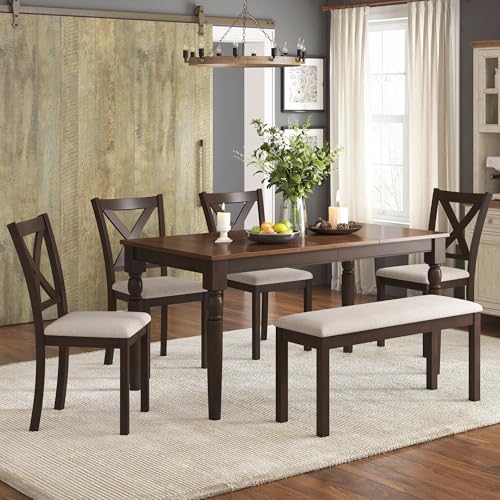
Dining Table with Bench and Chairs: The Complete Buyer's Guide
Everything you need to know about bench-and-chair dining sets — seating layouts, table shapes, materials, comfort factors, and how to match a set to your room before you buy.
Start the GuideWhy bench-and-chair sets are so popular: A dining table with bench and chairs blends the sociability of bench seating with the support of traditional chairs. The bench tucks fully under the table to save floor space, while chairs on the opposite side give guests back support. For families, small apartments, and farmhouse-style kitchens alike, this hybrid layout is one of the most practical dining arrangements available — and this guide explains exactly how to choose the right one.
What Is a Dining Table with Bench and Chairs?
A dining table with bench and chairs is a coordinated dining set in which one long side of the table is paired with a backless or backed bench, and the opposite side is paired with individual chairs. Instead of four identical chairs, you get mixed seating: the bench typically accommodates two to three people on one side, while two to three chairs face it. This asymmetric layout is the defining feature of a dining table with bench and chairs set, and it changes how the table fits a room far more than most buyers expect.
Bench seating is not new — it has long been used in farmhouse kitchens, breakfast nooks, and banquettes. What has changed is the range of ready-made configurations. Buyers can now choose a dining table and bench set that includes matching chairs, or a complete coordinated set with table, bench, and chairs designed together. The hybrid format also adapts well to small spaces, where every centimeter of floor area matters.
Why Choose Bench Seating Alongside Chairs?
Bench-and-chair sets solve several common dining room problems at once. Before you compare individual products, it helps to understand what each seating type contributes.
Space efficiency
A bench has no back legs pushing out behind it, so it slides completely under the tabletop. In a narrow room, that reclaimed floor area is the difference between a cramped walkway and a comfortable one. This is why a dining table with bench for small spaces is such a common recommendation for apartments and compact breakfast areas.
More seating per table length
Because benches allow people to sit shoulder to shoulder without armrests between them, a bench side usually seats one more person than the same length of chairs. A six-seat dining table set with bench typically pairs a three-person bench with three chairs, rather than three chairs facing three chairs.
Informal, sociable feel
Bench seating encourages a relaxed, communal atmosphere — children can slide in easily, and adults can shift positions without the restriction of armrests. A farmhouse dining set with bench and chairs is the clearest expression of this style, but the effect works in modern and coastal rooms too.
Design flexibility
The mixed seating format gives you a natural focal point. A bench on one side and chairs on the other creates visual rhythm, and you can swap the chairs later without replacing the entire set. If you prefer the bench against a wall, a dining table with bench on one side layout keeps the chair side open to the room.
The Anatomy of a Bench-and-Chair Dining Set
Before comparing styles, it helps to know what components make up a typical set and what each one contributes to daily use.
| Component | Best For | Key Consideration |
|---|---|---|
| Backless bench | Tucking under the table; tight walkways | Saves the most floor space; less back support for long meals |
| Bench with back | Long dinners and older guests | Comfortable but requires clearance behind it |
| Side chairs | Back support on the chair side | Check seat height matches the bench and table |
| Corner bench | Breakfast nooks and banquettes | Requires a defined corner; see dining room corner bench options |
| Storage bench | Small rooms needing hidden storage | Lift-up or drawer access must clear the table edge |
The component mix determines how the set behaves in your room. A bench with a back is more comfortable for long gatherings, while a backless bench is the better choice when the bench side faces a walkway. If you want hidden storage for linens or tableware, a dining table with storage bench and chairs keeps the set functional without adding extra furniture.
Seating Layouts: Which Configuration Fits Your Room?
The same table-and-bench combination can be arranged several ways. Choosing the right layout early prevents awkward walkways and chair conflicts later.
Bench against a wall
This is the classic banquette arrangement: the bench sits flush against a wall or window, chairs face it from the open side. It works best when the table runs parallel to a wall and the room has a clear path along the chair side. A dining set with bench arranged this way feels built-in and maximizes usable floor space.
Bench free-standing
When the table sits in the middle of an open-plan room, the bench can float on one side. Guests can enter from either end, which makes a dining table with bench and chairs feel less enclosed. This layout needs at least 24 inches of clearance behind the chairs for pull-out.
Corner or L-shaped banquette
A corner bench wraps two sides of the table, with chairs completing the remaining sides. This is the most space-efficient option for breakfast nooks. A dining set with corner bench and chairs is the natural choice for a dedicated corner, and a dining table with corner bench and chairs often includes a bench that fits exactly into the room's geometry.
Bench plus chairs on both ends
For larger rooms, the bench occupies one long side while chairs sit on the opposite side and at both ends. This layout, common in a dining table set for 8 with bench, uses the table ends for additional diners without crowding the long sides.
Quick layout rule
Measure the wall or open floor length available for the bench first, then the clearance needed behind the chairs. If the chair side has less than 24 inches of pull-out space, choose a backless bench and move the chairs to the ends of the table instead.
Table Shapes and Sizes for Bench Seating
Not every table shape works equally well with a bench. Rectangular tables are the most natural fit because the bench spans the long edge; round and oval tables require curved benches or shorter benches that sit on a chord of the circle.
A rectangular dining table set with bench and chairs is the most common and most flexible configuration. For smaller rooms, a dining table set for 4 with bench pairs a compact two-person bench with two chairs — ideal for a couple or a small family. As the household grows, a dining table and 4 chairs and bench configuration adds seating without requiring a much longer table.
For larger gatherings, an extendable dining table with bench and chairs lets you expand from a four-seat everyday setup to eight or more for holidays. If you need to seat ten regularly, consider a dining table for 10 seats paired with two benches, one per long side.
Typical seating capacity by table length
| Table Length | Bench Side | Chair Side | Total Seats |
|---|---|---|---|
| Compact (up to 48 in) | 1 bench, 2 people | 2 chairs | 4 |
| Standard (48–60 in) | 1 bench, 2–3 people | 2–3 chairs | 4–6 |
| Large (60–72 in) | 1 bench, 3 people | 3 chairs | 6 |
| Extra-large (72–84 in+) | 1–2 benches, 3–4 people | 3–4 chairs | 8–10 |
These figures assume standard 24-inch seating widths. Allow more room per person if your household includes larger adults or if the bench will often seat children alongside adults.
Popular Styles for Bench-and-Chair Sets
The style of the set determines how it integrates with the rest of your home. Below are the main options, each with a distinct visual character and practical trade-offs.
Farmhouse
Farmhouse sets typically feature a solid wood table with turned or tapered legs, a matching wood bench, and Windsor-style or slat-back chairs. A farmhouse dining table with bench and chairs is warm, forgiving of wear, and fits both rustic and transitional interiors. For a softer look, a farmhouse dining table with bench seating may use a bench with a low back and upholstered seat. Families who need to seat six will find a farmhouse dining table set for 6 with bench covers most everyday needs; larger households can step up to a farmhouse dining table set for 8 with bench.
Modern and minimalist
Modern sets use clean lines, slim metal or angled wood legs, and backless benches with simple upholstery. A modern dining room table set with bench and chairs in this style looks best in open-plan rooms where the table is visible from the living area. The backless bench in these sets is especially useful in narrow dining zones because it disappears under the table.
Industrial
Industrial sets combine high-grade steel frames with reclaimed-look wood tops and benches. They are a natural fit for loft apartments and homes with exposed brick or concrete. Look for heavy-duty construction and a rust-proof finish on the metal components if the set sits near a patio door or in a high-humidity room.
Transitional and upholstered
If you want the bench to match your chairs more closely, an upholstered bench and chair combination softens the look. A dining table with bench and upholstered chairs works well in formal dining rooms where a wooden bench alone would feel too casual. Upholstery adds comfort but requires more care with children and pets — choose a tight-weave fabric with a stain-resistant finish.
Materials: What to Look For
The material of the table, bench, and chairs determines durability, maintenance, and how the set ages. This is the single most important specification to compare after the seating layout.
Solid wood
Solid wood — oak, acacia, rubberwood, or pine — is the most common material for farmhouse and transitional sets. It can be refinished if scratched, and a sealed finish protects against everyday spills. Look for kiln-dried wood to reduce the risk of warping. A solid wood dining table with bench and two chairs is a long-term investment that can be handed down.
Engineered wood and veneer
Engineered wood with a veneer top offers a more stable surface at a lower position in the market. Entry-level and mid-range sets often use this construction. Check that the edges are well-sealed, because moisture is the main failure point on veneered furniture.
Metal frames
High-grade steel or powder-coated aluminum frames are used in industrial and modern sets. A rust-proof finish is essential for long-term durability, especially in humid climates or near kitchen areas.
Upholstery and padding
Bench pads and upholstered chair seats add comfort but need to match your household. For homes with young children, choose removable, washable covers or a wipe-clean fabric. For formal rooms, a tailored upholstered bench elevates the whole set.
Quality tiers at a glance
Bench-and-chair dining sets generally fall into three market positions:
- Entry-level / essential tier: engineered wood or lighter solid wood, basic finishes, simpler joinery. Suitable for first apartments and occasional use.
- Mid-range / balanced tier: solid wood or wood-and-metal construction, sealed finishes, more comfortable padding, and better weight capacity. The most common choice for family homes.
- Premium / high-end tier: kiln-dried hardwood, reinforced joinery, upholstered benches, and refined finishes. Built for daily use over many years.
Within each tier, compare construction details rather than surface styling: a mid-range set with reinforced joinery will usually outlast an entry-level set with decorative detailing.
Comfort and Ergonomics: What Many Buyers Overlook
Bench seating is comfortable for short and medium meals, but the ergonomics differ from a chair. Before buying, check these three measurements.
Seat height consistency
The bench seat and the chair seats should sit at the same height relative to the tabletop — typically 17 to 19 inches from the floor for a standard 30-inch table. A mismatch makes one side of the table feel noticeably lower or higher, which becomes obvious at family dinners.
Knee clearance
Check the clearance between the bench seat and the table apron. Benches with thick cushions reduce knee clearance, so confirm the total seated height still fits under the table edge.
Back support on long meals
A backless bench is fine for 30–45 minute meals but becomes tiring for long gatherings. If your household regularly hosts extended dinners, choose a dining table with bench with back and chairs, which pairs a backed bench with matching chairs for balanced support.
For households that want maximum chair-side comfort, a dining room table with bench and 4 chairs configuration gives four guests full back support while the bench handles overflow seating and children.
Matching the Set to Your Household
The best bench-and-chair set depends on who will use it every day. Use the table below as a starting point.
| Household Type | Recommended Configuration | Why It Works |
|---|---|---|
| Couple or small family | 4-seat set with a 2-person bench and 2 chairs | Compact footprint, easy to move, fits breakfast nooks |
| Family with young children | 6-seat set with a backless bench and 3 chairs | Bench lets children slide in easily; wipe-clean finishes matter more than padding |
| Frequent entertainers | Extendable table with bench and 3–4 chairs | Expands for holidays without replacing the set |
| Small apartment | Compact set with bench against the wall | Bench tucks away; chairs face the open room |
| Formal dining room | Upholstered bench with matching upholstered chairs | Softer look, consistent comfort across the table |
For homes that alternate between casual weeknight meals and formal occasions, a dining room table set with bench and chairs in a transitional style offers the most flexibility. If space is the overriding constraint, start with a dining table with 2 chairs and a bench and expand later with matching pieces.
Before You Buy: A Practical Checklist
Bench-and-chair sets are difficult to return once assembled, so verify these points before ordering.
- Measure the room twice. Record the table length, the bench length, and the clearance behind the chairs. Add 24 inches of pull-out space on the chair side.
- Confirm the seating count. A set listed as six seats should specify whether that means three on the bench and three chairs, or two on the bench and four chairs.
- Check seat height compatibility. The bench and chairs should match each other and fit comfortably under the table apron.
- Review the construction. Look for reinforced joinery, sealed finishes, and weight capacity ratings. See our delivery and assembly guide for what to expect on arrival.
- Plan the layout. Decide whether the bench will sit against a wall or free-standing before you buy, because it affects the table orientation.
- Consider future needs. An extendable table with a bench is more adaptable than a fixed set if your household size may change.
Ready to Compare Bench-and-Chair Sets?
Browse our recommended dining table with bench and chairs options below, selected for construction quality and practical seating layouts.
See Recommended SetsFrequently Asked Questions
- Is a dining table with bench and chairs good for small spaces?
- Yes. A bench tucks completely under the table when not in use, freeing up floor space. Models designed specifically for compact rooms, such as a dining table with bench for small spaces, work well in apartments and breakfast nooks.
- How many people can sit at a dining table with a bench and chairs?
- A standard bench seats two to three people, and two to three chairs usually sit on the opposite side. A six-seat configuration typically uses a bench for three and three chairs. Larger extendable tables can seat eight or more.
- Should the bench go against a wall or in the middle of the room?
- A wall-side bench creates a banquette feel and saves walkway space, which suits a dining room corner bench or a table with a bench on one side. A free-standing bench allows access from both ends and works better in open-plan rooms.
- What materials work best for a family dining set with a bench?
- Solid wood, high-grade steel frames, and easy-clean upholstery are the most practical choices. A mid-range farmhouse set in sealed wood offers a good balance of durability and classic styling.
- Do I need a bench with a back?
- A backless bench is more space-efficient and easier to tuck under the table. If your household hosts long dinners, a dining table with bench with back and chairs is more comfortable for extended sitting.