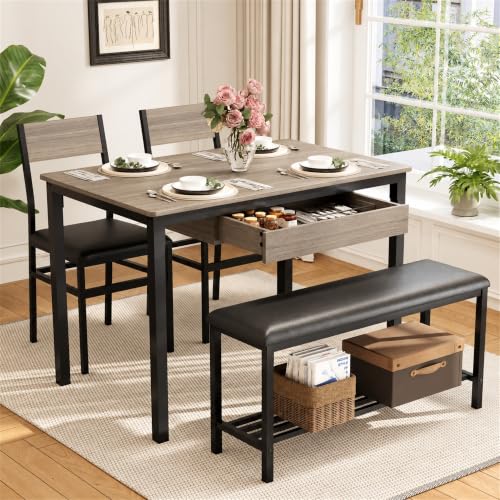
Dining Table with Storage Bench and Chairs: The Complete Buying Guide
Thinking about a dining set that seats the family and hides the clutter? A dining table with a storage bench and chairs gives you seating, surface area, and clever organization in one package. This guide walks you through sizes, materials, storage types, and layout planning so you can choose with confidence.
Jump to Buying ChecklistQuick answer: A dining table with a storage bench and chairs is best for households that need flexible seating and hidden storage in the same footprint. Look for a bench with a lift-top or drawer compartment, chairs that tuck under the table, and a frame material that matches your room's humidity and traffic. Mid-range and premium sets generally offer smoother hardware and more consistent finishes, while entry-level sets suit light use and starter homes.
Why Choose a Dining Table with a Storage Bench and Chairs?
A dining set with a bench and chairs solves several everyday problems at once. The bench seats more people than an equivalent number of chairs, the storage compartment absorbs items that would otherwise clutter counters or sideboards, and the overall footprint stays compact because benches tuck neatly under the table when not in use.
This configuration is especially practical for open-plan homes, breakfast nooks, and apartments where every square foot matters. It also works well for families with children, since a bench keeps younger diners close to the table and removes the tipping risk of loose chairs. If you are designing a dining area from scratch, our dining room set with bench and chairs overview covers complementary pieces and room-flow considerations.
Key benefits at a glance
- Space efficiency: benches slide completely under the table, freeing walkway space.
- Hidden organization: lift-top or drawer storage holds linens, board games, or seasonal items.
- Flexible seating: a bench can seat two or three people, while chairs can be moved to other rooms when guests arrive.
- Cohesive look: matched sets create a unified visual line that loose furniture rarely achieves.
- Family-friendly: benches are stable and easy for children to use.
Anatomy of a Storage Bench Dining Set
Before comparing models, it helps to understand the three core components and how they interact. Each part affects comfort, durability, and how well the set fits your room.
1. The dining table
The table is the anchor. Look at the top thickness, apron height, and leg placement. A table with a pedestal or central trestle base gives more legroom for bench seating, while four-corner legs can interfere with a long bench. Rectangular tables in the 60–72 inch range are the most common pairing for a bench-and-chairs layout. If you need more seats, an extendable dining table with bench and chairs lets you expand for holidays without committing to a larger table year-round.
2. The storage bench
The bench does double duty as seating and storage. The storage mechanism is the single most important quality indicator: lift-top hinges should be smooth and self-supporting, drawers should glide without wobble, and side-opening compartments should have secure latches. Bench depth typically ranges from 14 to 18 inches; deeper benches are more comfortable but consume more under-table clearance.
3. The chairs
Chairs balance the bench and provide back support for longer meals. Check seat height against table height: most dining tables sit at 28–30 inches, so chairs with an 18–19 inch seat height are the standard match. Upholstered chairs add comfort but need more care; solid wood or metal chairs are easier to wipe down. Our guide to dining tables with bench and upholstered chairs explains how to mix materials without breaking visual harmony.
Sizes and Seating Capacity
Seating capacity depends on table length, bench length, and how tightly diners are willing to sit. The table below gives practical ranges for common configurations. Use it as a starting point, then measure your room before committing.
| Configuration | Typical Table Length | Seats | Best For |
|---|---|---|---|
| 1 bench + 2 chairs | 48–54 inches | 4 people | Apartments, breakfast nooks, small dining rooms |
| 1 bench + 4 chairs | 60–66 inches | 6 people | Family homes, open-plan kitchens |
| 1 long bench + 6 chairs | 72–84 inches | 8 people | Larger dining rooms, entertaining households |
| Corner bench + chairs | 48–60 inches (L-shape) | 5–6 people | Corners, bay windows, built-in looks |
Measuring for fit
Allow 24–30 inches of table width per diner for comfortable elbow room, and leave at least 36 inches of clearance between the table edge and nearby walls or counters so chairs and benches can slide out. For a compact room, a dining table with bench for small spaces keeps circulation open. If your room is generous, a dining table set for 8 with bench provides room for extended family without adding a second table.
Storage Bench Types: Which Mechanism Suits You?
Storage benches are not all built the same. The opening mechanism determines how easy the bench is to use day to day and how much you can realistically store inside.
Lift-top storage bench
The entire seat lifts on hinges to reveal a large compartment. This design offers the most storage volume and is ideal for bulky items like throws, serving platters, or seasonal decor. Look for gas-strut or soft-close hinges so the lid does not slam. The trade-off is that you must clear the seat before opening it.
Drawer storage bench
One or two drawers slide out from the front or side. Drawers are easier to access for everyday items such as napkins, cutlery, or homework supplies, but they hold less than a lift-top compartment. Check that drawers have metal glides rather than plastic tracks, which wear out faster.
Side-opening bench
A side panel opens like a cabinet door. This is a good compromise for narrow spaces where a front drawer would block a walkway. Side-opening benches usually have fixed shelves inside, which helps organize smaller items.
Open-shelf bench
Some benches pair a solid seat with open shelving below. This is not enclosed storage, but it works well for baskets or shoes in entry-adjacent dining areas. An entryway mud bench shares this design language and can inspire a coordinated look if your dining area sits near a hallway.
Materials and Finishes
The material determines durability, maintenance, and how the set ages. Here is how the main options compare for a dining table with storage bench and chairs.
| Material | Tier | Durability | Maintenance | Best For |
|---|---|---|---|---|
| Solid hardwood (oak, acacia, rubberwood) | Mid-range to premium | High; can be refinished | Occasional oil or wax | Long-term family use |
| Engineered wood with veneer | Entry-level to mid-range | Moderate; sensitive to moisture | Wipe dry promptly | Climate-controlled dining rooms |
| Metal frame with wood top | Mid-range to premium | High; frames are very stable | Minimal; check for rust | Modern and industrial interiors |
| Resin or composite | Entry-level | Moderate; UV-resistant versions available | Soap and water | Outdoor-adjacent or humid rooms |
Finish considerations
Matte and satin finishes hide fingerprints better than high-gloss surfaces, which is helpful on a bench that sees daily use. Distressed or wire-brushed finishes camouflage minor scratches. If the set will sit near a patio door with strong sunlight, choose a UV-stabilized finish to prevent fading. For outdoor-adjacent spaces, our durable outdoor furniture guide covers weather-resistant construction in more detail.
Chair compatibility
Chairs should match the table's finish family but do not need to be identical. A common approach is a wood bench with wood chairs in the same stain, or a metal-frame bench with metal chairs. Mixing a painted bench with natural wood chairs can work if the table ties both tones together. The dining table with bench and chairs overview explains how to balance mixed materials without visual clutter.
Layout and Space Planning
Where you place the set matters as much as which set you choose. Benches need clearance on the side where diners enter, and chairs need room to pull out. Plan the layout before you order.
Bench placement
Place the bench on the side of the table that faces the wall or a window, so diners slide in from the open side. This keeps traffic flow unobstructed and makes the bench feel like a built-in banquette. A dining table with bench on one side is the most common and space-efficient arrangement.
Corner and banquette layouts
If your dining area sits in a corner, an L-shaped bench uses the corner efficiently and seats more people than a straight bench of the same length. A dining room corner bench can be paired with a rectangular table and two chairs to create a cozy breakfast nook. For a more built-in look, consider a dining room table with banquette seating.
Clearance rules of thumb
- Leave 36 inches between the table edge and any wall or counter.
- Allow 24 inches of bench length per seated diner.
- Keep at least 18 inches between the bench back and the wall if the bench has a backrest.
- Confirm doorways and stairwells can accommodate the table's longest dimension during delivery.
Delivery and assembly logistics are easy to overlook. Our delivery and assembly guide covers what to check when the set arrives.
Style and Decor Matching
A storage bench dining set can anchor a range of interior styles. The table shape, bench profile, and chair back style do most of the styling work.
Farmhouse and rustic
Heavy table legs, a thick top, and a bench with a slatted back suit farmhouse interiors. A farmhouse dining set with bench and chairs pairs naturally with woven rugs, iron accents, and warm wood tones. If you prefer a lighter farmhouse look, a farmhouse dining table with bench seating in a whitewashed finish keeps the room airy.
Modern and minimal
Clean lines, a slim tabletop, and a bench without a backrest create a modern silhouette. Metal-frame benches with wood tops work well in industrial and contemporary spaces. Pair with simple chairs and a neutral palette to keep the focus on the table.
Traditional
Turned legs, a darker stain, and upholstered chairs give a traditional set presence. A storage bench with a cushioned seat adds comfort without losing the storage function. Upholstered bench tops are easier to clean if the fabric is removable and washable.
Buying Checklist: What to Verify Before You Order
Use this checklist to compare sets on equal terms. It focuses on the details that affect daily use and long-term satisfaction.
Measurements
- Room dimensions, including doorway widths and ceiling height.
- Table length, width, and height; bench length and depth; chair seat height.
- Clearance for chairs to pull out and for the bench lid or drawer to open.
Construction
- Bench storage mechanism: lift-top, drawer, or side-opening.
- Hinge and drawer glide quality: metal hardware lasts longer than plastic.
- Weight capacity of the bench and chairs.
- Table leg style and whether it interferes with bench seating.
- Finish type and whether it is UV-stabilized if near windows.
Comfort and use
- Seat depth and back height of chairs.
- Bench cushioning, if included.
- Ease of cleaning for the chosen materials.
- Assembly requirements and included tools.
Value and support
- Warranty length and what it covers.
- Return policy and whether the set ships in multiple boxes.
- Whether replacement parts are available.
- Relative position in the market: entry-level sets suit light use, mid-range sets balance hardware and finish quality, and premium sets focus on solid construction and smooth mechanisms.
Frequently Asked Questions
What are the benefits of a dining table with a storage bench?
A storage bench combines seating with hidden compartments for table linens, serving pieces, or everyday items, helping keep the dining area organized and clutter-free while maximizing floor space.
How much seating does a dining table with a bench and chairs provide?
Most sets seat between four and eight people. A typical arrangement pairs one bench with two to four chairs, while larger tables with a long storage bench and six chairs can accommodate eight or more diners.
What materials are best for a storage bench dining set?
Solid wood and high-grade engineered wood offer durability and a classic look. Metal frames with wood tops are sturdy and modern, while resin or composite options suit outdoor and humid environments.
Can a dining table with a storage bench fit in a small space?
Yes. Benches tuck fully under the table, freeing up walkway space. Compact sets with a single bench and two chairs are especially well suited to apartments, breakfast nooks, and small dining rooms.
What should I check before buying a dining set with a storage bench?
Measure your room and doorways, confirm the bench storage mechanism (lift-top, drawer, or side-opening), verify weight capacity, check the chair back height relative to the table, and review the warranty and assembly requirements.
Ready to Choose Your Set?
A dining table with a storage bench and chairs is a practical investment that pays off every day. Focus on the bench storage mechanism, confirm the measurements fit your room, and choose a material that matches how you live. Once those three boxes are checked, the style details fall into place.
Browse the recommended options below to compare features side by side and find the set that fits your space.
View Recommended Sets