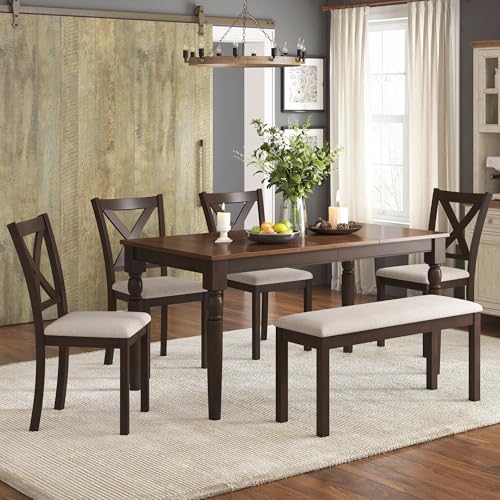
What Is a Dining Table with Bench and Upholstered Chairs?
A dining table with bench and upholstered chairs is a coordinated dining set built around three components: a table, a long bench for one side, and two or more upholstered chairs for the opposite side or the ends. This configuration is sometimes called a bench-and-chair dining set or a mixed-seating dining table, and it appears in farmhouse, transitional, contemporary, and even compact apartment interiors.
The appeal is simple. Bench seating lets you seat more people in less footprint because the bench slides fully under the table when not in use. Upholstered chairs add cushioned comfort and a more formal counterpoint, making the set feel intentional rather than purely utilitarian. The result is a dining area that works for quick weekday breakfasts, homework sessions, and weekend dinners with guests.
If you are still exploring the broader category, our guide to a dining table with bench and chairs covers the fundamentals of how these sets are configured and what to look for before you narrow down to upholstered seating.
Why Choose a Bench and Upholstered Chair Combination?
Homeowners usually arrive at this layout for a handful of practical reasons. Understanding them helps you judge whether the format suits your room and lifestyle.
- Space efficiency: A bench has no back clearance requirement, so it can sit closer to a wall than chairs. In tight dining nooks, this frees up walking space behind the table.
- Flexible capacity: Benches seat more people per linear foot than individual chairs. A bench plus four chairs can comfortably handle six diners, and kids often prefer the bench side.
- Visual contrast: Mixing a solid wood or metal bench with upholstered chairs creates texture and depth. The upholstery draws the eye and softens an otherwise hard-edged set.
- Comfort where it counts: Upholstered chairs give back support and cushioning for adults and guests, while the bench provides a casual, communal seat for children or quick meals.
- Design cohesion: Because the bench and chairs are sold as a coordinated set, finishes and proportions already match, reducing the risk of a mismatched look.
That said, mixed seating is not automatically the right answer for every room. If every diner needs full back support or the table sits in the middle of an open floor plan, an all-chair configuration may serve better. Our overview of a dining table with a bench and chairs discusses when the bench side makes sense and when it does not.
Key Components of the Set
The Dining Table
The table is the anchor. Standard heights range from about 28 to 30 inches for a dining table, with bench seat heights typically between 17 and 19 inches so diners can slide in comfortably. Table lengths vary from compact four-seat models to long farmhouse tables that seat eight or more. Materials include solid wood (oak, acacia, rubberwood, pine), engineered wood with veneer, metal, and glass tops.
Consider an extendable model if you occasionally host larger groups. Our guide to an extendable dining table with bench and chairs explains how leaf mechanisms work and what to check before you commit.
The Bench
Benches come in three broad styles: backless, back-supported, and storage benches. Backless benches tuck fully under the table and are the most space-efficient. Back-supported benches are more comfortable for longer meals but require clearance behind them. Storage benches add a practical bonus for table linens, board games, or seasonal items.
Bench construction matters. Solid wood benches with sturdy aprons and legs hold up better than hollow or folding designs. Upholstered bench tops add comfort but need removable, washable covers if young children or pets use the set daily. For a deeper comparison, see our article on dining bench seats.
The Upholstered Chairs
Upholstered dining chairs typically feature a padded seat, a padded or partially padded back, and a frame in wood or metal. Fabric choices range from performance polyester and linen blends to velvet and faux leather. Performance fabrics resist stains and fading and are the safer choice for family dining rooms. Faux leather wipes clean easily and suits modern and industrial interiors.
Pay attention to seat depth and back height. A seat depth of about 18 to 20 inches and a back height that reaches mid-shoulder tend to suit the widest range of diners. If you plan to mix chair styles, our discussion of dining table with bench and upholstered chairs covers how to keep upholstery tones harmonized across mismatched frames.
Seating Layouts That Work
How you arrange the bench and chairs changes how the set feels in the room. Here are the most common configurations and what each is best for.
| Layout | Best For | Notes |
|---|---|---|
| Bench on one long side, chairs opposite | Rectangular tables in family dining rooms | Classic mixed-seating arrangement; bench side suits children and casual diners |
| Bench on one side, chairs on the other, plus end chairs | Seating six to eight at a farmhouse-style table | End chairs add formality; keep upholstery coordinated with the side chairs |
| Corner bench with chairs on the open sides | Nooks, breakfast corners, and small dining areas | Maximizes corner space; see our guide to a dining table with corner bench and chairs |
| Bench on the wall side, upholstered chairs facing outward | Open-plan kitchens where the table sits against a wall | Keeps walkways clear and gives the room a banquette feel |
| Bench with back on one side, standard chairs opposite | Dining rooms where long meals are common | More back support than a backless bench but needs rear clearance |
If the table sits in the middle of a room rather than against a wall, a bench on only one side can still work, but you will need clearance behind the bench for people to slide in. A dining table with bench on one side is a good compromise when you want bench seating without committing the entire set to a banquette layout.
Matching the Set to Your Space
Measure before you shop. The single most common mistake is buying a set that technically fits but leaves no room to walk, pull out chairs, or open a nearby cabinet.
- Table clearance: Allow about 30 to 36 inches of open floor around the table on chair sides so diners can push back and stand.
- Bench side: Backless benches need far less clearance because they slide under the table. Leave roughly 12 to 18 inches behind the bench for access.
- Walkways: Keep at least 36 inches between the table edge and any wall, counter, or doorway used as a path.
- Ceiling height: If you plan a pendant light or chandelier, check that the fixture clears the tabletop by roughly 30 to 36 inches.
For compact rooms, a dining table with bench for small spaces is a strong choice because the bench footprint disappears under the table between meals. If you are working with a very tight nook, a dining table corner set can unlock seating that would otherwise be unusable.
Materials and Durability
Longevity in a dining set comes down to frame construction, joinery, and finish quality. Use the tier system below to compare options by market position rather than by any specific figure.
| Tier | Typical Construction | Best For |
|---|---|---|
| Entry-level | Engineered wood with veneer, basic hardware, folding or knock-down bench | First apartments, occasional dining, temporary setups |
| Mid-range | Solid rubberwood or acacia frame, reinforced aprons, performance fabric chairs | Everyday family dining, busy households, long-term daily use |
| Premium | Hardwood frames, mortise-and-tenon joinery, high-density foam, stain-resistant upholstery | Formal dining rooms, households that entertain often |
| Luxury / high-end tier | Hardwood with hand-finished details, top-grain leather or designer textiles, custom sizing | Design-led interiors, long-term investment pieces |
Whatever tier you choose, check the bench weight rating, the chair frame material, and whether the upholstery is removable. A mid-range set with solid joinery and performance fabric usually outperforms an entry-level set with decorative but fragile details. For a broader comparison of durable options, see our guide to durable outdoor furniture—many of the same construction principles apply indoors as well.
Comfort and Upholstery Considerations
Upholstered chairs are the comfort anchor of the set, so treat the fabric and foam as seriously as the frame.
- Foam density: Higher-density foam holds its shape longer. Low-density foam feels soft in the showroom but flattens within a year or two of daily use.
- Fabric type: Performance polyester and solution-dyed acrylic resist stains and fading. Linen blends look refined but need more care. Faux leather is wipe-clean and suits households with young children.
- Removable covers: Zip-off covers make deep cleaning possible. If covers are fixed, plan on professional cleaning or spot treatment only.
- Seat height: The chair seat should sit roughly 10 to 12 inches below the tabletop for comfortable arm and leg positioning.
- Bench cushioning: If the bench is upholstered, choose a firm cushion that does not compress to the frame. Removable bench cushions are easier to replace than fixed upholstery.
If you are matching new chairs to an existing set, our article on dining table set with bench and chairs covers how to coordinate upholstery colors and wood tones without everything looking identical.
Style Directions
The bench-and-upholstered-chair format adapts to several interior styles. Choose the direction that fits your home rather than chasing a single trend.
- Farmhouse: A solid wood trestle or turned-leg table, a simple wooden bench, and upholstered chairs in a neutral linen blend. See our farmhouse dining table with bench and chairs guide for material and finish suggestions.
- Transitional: A clean-lined table with a subtly tapered leg, a backless bench with a cushioned top, and upholstered chairs with a gently curved back.
- Contemporary: A metal or glass-topped table, a slim metal bench, and upholstered chairs in a performance fabric with a low back.
- Small-space modern: A compact extendable table, a storage bench, and two upholstered chairs that double as desk seating during the day.
If you are furnishing a larger dining room, consider scaling up with an eight-seat configuration; our guide to a dining table set for 8 with bench covers proportions and layout for bigger tables.
Practical Buying Checklist
Before you finalize a purchase, run through this checklist. It catches the issues that are hardest to fix after delivery.
- Measure the room and mark the table footprint on the floor with tape.
- Confirm the bench slides fully under the table on the side facing the wall.
- Check that chair seat height and table height are compatible.
- Verify the bench weight rating if adults will sit on it regularly.
- Confirm the upholstery is removable or treated for stain resistance.
- Ask whether assembly is required and whether the set ships in one or multiple boxes.
- Review the warranty on frame, upholstery, and hardware separately.
- Plan delivery access—long tables and wide benches sometimes cannot fit through narrow stairwells. Our guide to delivery and assembly covers what to prepare.
Care and Maintenance
A mixed-seating set needs slightly different care for each component.
- Wood surfaces: Dust weekly and wipe with a slightly damp cloth. Avoid harsh solvents that strip the finish. Re-oil or re-wax solid wood once or twice a year depending on climate.
- Upholstery: Vacuum chair seats and backs monthly. Blot spills immediately rather than rubbing. Rotate cushions if the set allows to even out wear.
- Bench: Check leg bolts and apron screws every few months, especially on benches that get heavy daily use. Tighten as needed.
- Fabric protection: Reapply fabric protector after deep cleaning if the manufacturer recommends it.
For seasonal deep-cleaning routines that apply to both indoor and covered outdoor dining sets, see our article on weatherproofing—it covers fabric care, wood sealing, and hardware checks in one place.
Common Mistakes to Avoid
- Buying before measuring: A set that fits the wall but leaves no chair clearance will feel cramped every day.
- Ignoring bench clearance: A back-supported bench against a wall can be uncomfortable to slide into. Backless benches solve this.
- Mismatched heights: A bench that is too low or too high relative to the table makes meals awkward. Aim for a bench seat about 10 to 12 inches below the tabletop.
- Choosing delicate fabric for a family table: Velvet and light linen look beautiful but need careful handling. Performance fabric is the safer choice for daily use.
- Overlooking delivery logistics: Long tables and wide benches can be difficult to move through doorways. Confirm dimensions and access before ordering.
If you are building the set gradually rather than buying a coordinated package, our guide to a dining table and bench set explains how to keep proportions consistent when the pieces come from different sources.
Frequently Asked Questions
Is a bench more comfortable than upholstered chairs?
Upholstered chairs generally offer more back support and cushioning for long meals. A bench is comfortable for shorter sittings and casual dining, especially if it has a cushioned top. Many households use the bench side for children and quick meals and reserve the upholstered chairs for adults and guests.
How many people can a bench-and-chair set seat?
It depends on table length. A typical bench on one side plus four chairs can seat six. A longer table with a bench on one side and chairs on the other plus end chairs can seat eight or more. Always check the manufacturer's recommended seating count and account for shoulder room between diners.
Can I use a bench with an upholstered chair set I already own?
Yes, provided the bench height matches the existing table. Measure the seat height of your current chairs and look for a bench within about an inch of that height. Coordinate the wood finish or metal tone with the chair frames so the mix looks intentional.
What fabric is best for upholstered dining chairs?
Performance polyester, solution-dyed acrylic blends, and faux leather are the most practical choices for family dining rooms. They resist stains, clean up easily, and hold color well. Linen and velvet look refined but require more careful maintenance.
Do I need a back on the bench?
Not necessarily. Backless benches tuck under the table and save space, which makes them ideal for small rooms and wall-side placement. Back-supported benches are more comfortable for long meals but need clearance behind them so diners can slide in and out.
How do I keep the bench and chairs looking coordinated?
Pick one shared element—wood tone, metal finish, or upholstery color—and let the other elements vary. For example, match the bench frame to the chair legs and use a single upholstery fabric across all chairs. This keeps the set cohesive without requiring identical pieces.