
Kitchen Table Set with Bench and Chairs: The Complete Buying Guide
Everything you need to know about choosing a kitchen table with bench seating and chairs — from layout and materials to seating capacity, style matching, and long-term durability.
Explore Recommended SetsWhy this guide matters: A kitchen table set with bench and chairs is one of the most space-efficient and family-friendly dining solutions available. But the wrong mix of table size, bench depth, and chair style can turn a cozy breakfast nook into a cramped, frustrating corner. This guide walks you through every decision point so you can buy with confidence.
Why Choose a Kitchen Table Set with Bench and Chairs?
A bench-and-chair combination solves a problem that a standard four-chair set cannot: it balances high seating density with individual comfort. The bench side tucks completely under the table when not in use, freeing up floor space in compact kitchens, while the chair side gives guests a backrest and easier entry and exit.
This hybrid layout has become the default choice for breakfast nooks, open-plan kitchens, and small dining rooms for several practical reasons:
- More seating per foot of table: A 48-inch bench comfortably seats two adults, and a 60-inch bench seats three — more people than the same length of individual chairs would allow.
- Better clearance in tight rooms: Benches slide fully under the table, so you can walk past without sidestepping.
- Family-friendly practicality: Benches are easier for children to climb onto and create a natural gathering spot for casual meals.
- Visual calm: Fewer chair backs create a cleaner sightline across an open kitchen, which matters in smaller homes.
- Storage potential: Many benches include lift-up lids or built-in storage, adding function without extra furniture.
If you are still deciding between a pure bench setup and a mixed configuration, our guide to kitchen table bench seating breaks down the trade-offs in more detail.
Seating Configurations: Choosing the Right Mix
The phrase "bench and chairs" covers several distinct layouts. Matching the configuration to your household size and room shape is the single most important decision you will make.
| Configuration | Best For | Typical Seating | Space Profile |
|---|---|---|---|
| Table + 1 bench + 2 chairs | Small breakfast nooks, couples, apartments | 4 people | Compact; bench tucks fully under |
| Table + 1 bench + 4 chairs | Family kitchens, daily use with children | 6 people | Moderate; needs clear walkway on chair side |
| Table + 2 benches (corner layout) | L-shaped nooks, bay windows | 5–6 people | Very space-efficient in corners |
| Table + bench + 2 chairs + 1 armchair | Open-plan kitchens with an end-cap | 5 people | Flexible; armchair can be repositioned |
Table + Bench + Two Chairs
This is the classic starter configuration and the best fit for rooms under roughly 8 by 8 feet. The bench sits against a wall or window, and two chairs face it. It works especially well in apartment kitchens and for households of two to four people. If this matches your space, see our dedicated guide to kitchen table with bench and 2 chairs.
Table + Bench + Four Chairs
Once your household grows past four, the four-chair version becomes the more practical choice. It seats six comfortably and gives every guest on the chair side a proper backrest. The trade-off is a wider footprint — you need at least 36 inches of clearance behind the chairs for safe pull-out. Our breakdown of kitchen table with bench and 4 chairs covers the measurements in detail.
Two-Bench Corner Layouts
An L-shaped arrangement with two benches is the most space-efficient option for bay windows and corner nooks. It sacrifices individual back support on the bench sides, but it maximizes seating in awkward corners. Explore L-shaped breakfast nook benches if your room has an unused corner.
How to Measure Your Space Correctly
Measurement errors are the leading cause of returns on kitchen dining sets. Follow this sequence before you shop:
- Measure the room's usable footprint — wall to wall, excluding base cabinets and appliances.
- Subtract clearance zones. Leave at least 30 inches between the table edge and any wall on the bench side, and at least 36 inches behind chairs so they can slide out without hitting anything.
- Check the walkway. If the set sits between a kitchen counter and a wall, keep a minimum 36-inch walking path.
- Measure doorways and stairwells. A table that cannot fit through your entry is a problem no layout can solve.
- Confirm bench height against table apron. The bench seat should sit roughly 10 to 12 inches below the tabletop so knees clear the apron comfortably.
For a structured walkthrough of clearance rules across all furniture types, our measurement guide is a useful companion reference.
Materials and Build Quality by Tier
Material choice determines how a set holds up to daily spills, heavy use, and humid kitchen air. Rather than comparing on any single metric, it helps to think in terms of market tiers. The descriptors below reflect relative positioning within the category.
Engineered Wood & Laminate
Lightweight, easy to assemble, and well-specified for casual use. Best suited to apartments and low-traffic kitchens. Look for high-pressure laminate tops and sealed edges to extend service life.
Rubberwood & Veneered Hardwood
A solid step up in durability. Rubberwood and veneered hardwoods resist warping better than particle board and take refinishing well. This tier offers the best balance of longevity and design variety for family kitchens.
Solid Oak, Maple & Walnut
Heavy-duty construction with joinery designed to last decades. Solid hardwood tables can be sanded and refinished repeatedly, making them a long-term investment. Expect heavier weight and more careful assembly.
Two additional material notes apply specifically to benches:
- Bench frames: Solid wood frames outlast metal-and-wood hybrids in kitchens where benches are dragged in and out. Reinforced corner blocks are a reliable indicator of solid build quality.
- Upholstered bench seats: Cushioned bench tops add comfort but require wipe-clean or removable covers in a kitchen environment. Choose tight-weave fabrics with a stain-resistant finish.
If you are weighing a metal accent against an all-wood look, our comparison of metal versus aluminum furniture covers the durability trade-offs, and the wood furniture care guide explains how to maintain a solid top through seasonal humidity shifts.
Style Matching: Making the Set Fit Your Kitchen
A kitchen table is a focal point, and style mismatches are hard to disguise. Three approaches work reliably:
Farmhouse and Rustic
Wide-plank tops, turned legs, and X-back chairs pair naturally with a bench. This style hides everyday wear well and suits open shelving and apron-front sinks. Browse our rustic farmhouse ideas for coordinating tones.
Modern and Minimalist
Clean-lined tables with slim legs and backless benches keep sightlines open in compact kitchens. A backless bench is the most space-efficient option because it disappears entirely under the table. See modern design approaches for palette guidance.
Coastal and Light-Filled
Whitewashed wood, painted benches, and natural fiber accents work in bright kitchens with large windows. Keep upholstery light but specify a performance fabric to handle kitchen traffic.
Whatever style you choose, the bench should visually relate to the table's leg profile. A heavy turned leg next to a slim metal bench frame reads as an accidental mismatch rather than an intentional mix.
Bench Features Worth Prioritizing
- Storage lids: Lift-up bench seats add a place for placemats, board games, or seasonal linens. Explore kitchen table bench seating with storage if this matters to you.
- Tapered depth: A bench that is slightly shallower at the base tucks further under the table.
- Backless versus backed: Backless benches are more space-efficient; backed benches are more comfortable for long meals. Many households choose a backed bench against a wall and leave the aisle side open.
- Foot glides: Felt or rubber glides protect hard floors and reduce noise — a small detail that makes a big difference in daily use.
- Corner joinery: Look for screwed and glued corner blocks rather than stapled joints on any bench rated for adult seating.
Common Buying Mistakes to Avoid
- Buying the table first and the bench last. Bench depth and height must be matched to the table apron, not chosen independently.
- Ignoring chair pull-out space. A set that fits the room on paper can still be unusable if chairs cannot slide back.
- Overlooking bench weight limits. Check the rated load per seat, especially on storage benches with hinged lids.
- Choosing upholstery without a cleaning plan. Kitchen benches see food spills; specify removable covers or performance fabric.
- Skipping the delivery check. Confirm that the assembled or boxed set will fit through your entry and stairwell. Our delivery and assembly guide explains what to verify before ordering.
- Forgetting the warranty. Frame warranties vary widely across tiers. Review our warranty and returns guide before committing.
Small-Space and Nook-Specific Advice
If your kitchen dining area is genuinely tight, a few adjustments make the bench-and-chair format work where a four-chair set would not:
- Choose a pedestal table over a four-leg design — it removes leg conflicts at the corners and lets the bench slide in further.
- Specify a backless bench on the aisle side and keep the backed bench against the wall.
- Consider a drop-leaf or extendable top so the table can shrink for daily use and expand for guests.
- Keep the chair count at two rather than four in rooms narrower than 9 feet.
Our guide to kitchen tables with benches for small spaces goes deeper on compact layouts, and small-space design principles offers transferable ideas for tight footprints.
Care and Longevity
A kitchen set faces more daily abuse than almost any other furniture in the home. Extend its life with a simple routine:
- Wipe spills promptly — especially on veneered and laminate surfaces where moisture can creep into seams.
- Re-tighten hardware every few months on benches with hinged storage lids.
- Use coasters and trivets on solid wood tops to prevent heat rings.
- Re-oil or re-seal solid wood annually in dry climates or during winter heating season.
- Check glides seasonally and replace worn felt pads before they scratch the floor.
For a full seasonal maintenance schedule, see our weatherproofing and care guide.
Related Kitchen and Dining Guides
Once you have settled on a bench-and-chair configuration, these related guides help you refine the rest of the room:
Frequently Asked Questions
Is a bench or chairs better for a kitchen table?
A bench is ideal for tight spaces because it tucks fully under the table and seats more people per linear foot. Chairs offer individual back support and are easier for guests with mobility needs. Most households do best with a combination: a bench on one long side and chairs on the other.
What size kitchen table set fits a small dining nook?
For a nook under about 8 by 8 feet, a table around 30 to 36 inches wide and 48 inches long with one bench and two chairs is a practical fit. Always leave at least 30 inches of clearance between the table edge and the nearest wall or counter so the bench can slide out.
What materials work best for a kitchen table with bench seating?
Solid hardwood and high-pressure laminate are the most durable choices for daily family use. Engineered wood with a quality veneer sits in the mid-range tier, while solid oak, maple, and walnut belong to the premium tier. Avoid unfinished softwoods in busy kitchens unless you plan to seal them.
How many people can a bench and chair set seat?
A 48-inch bench typically seats two adults comfortably, while a 60-inch bench seats three. Paired with two or four chairs on the opposite side, a standard set seats four to six people. Allow roughly 24 inches of bench width per person.
Recommended Kitchen Table Sets with Bench and Chairs
⚠️ AFFILIATE DISCLOSURE: This website contains affiliate links. As an Amazon Associate, we earn from qualifying purchases. If you make a purchase through these links, we may receive a small commission at no additional cost to you. Read our full affiliate policy.

Feonase 5-Piece Dining Table Set for 4-8 People, 63" Large Extendable Kitchen Table Set with 2 Benches and 2 Square Stools, Dining Room Table with MDF Wood Board, Easy Assembly, Black
Check price on Amazon
COSTWAY Dining Table Set for 4 w/Bench & 2 Chairs, Storage Racks, Brown | 4-Piece Kitchen Table Set, Metal Frame, Anti-Slip Foot Pads, Industrial Dinette Set for Small Space, Apartment, Home Office
Check price on Amazon
VECELO Kitchen Dining Room Table with 2 Chairs & Bench, Compact Space-Saving Design, Easy Assembly Steel Frame, Perfect for Small Apartments & Breakfast Nooks,Classic Black
Check price on Amazon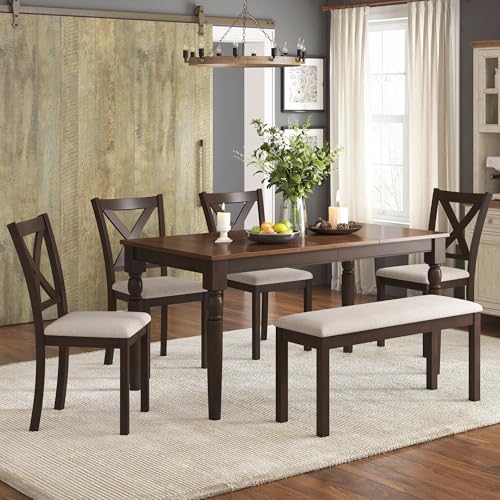
AMERLIFE 6 Piece Farmhouse Dining Set with 60" Solid Wood Table, Brown | Solid Wood Table, Upholstered Chairs, Bench Included, Seating for 6 to 7, Brown Finish
Check price on Amazon
Signature Design by Ashley 6-Piece Dining Table Set with Bench, Gray | Plush Gray Polyester Seats, Wood, Veneer and Engineered Wood Build, Space-Saving Tuck-Under Bench, Bridson Series
Check price on Amazon
LUXOAK 3-Piece Wood Corner Dining Table Set for 4, Black & Walnut | Breakfast Nook, L-Shaped Corner Bench, Hidden Storage, Space-Saving Design for Small Spaces, Farmhouse Kitchen & Dining
Check price on Amazon
Zevemomo 6-Piece Solid Wood Dining Table Set, Wooden Legs Table Set, Brown | Including 1 Dining Table, 4 Upholstered Chairs and 1 Bench, Dining Table Sets for 6, Table Set for Dining Room, Kitchen
Check price on Amazon