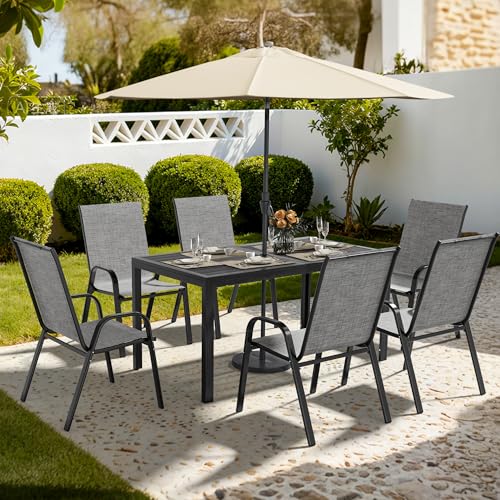
Outdoor Dining Sets: The Complete Buying Guide
Everything you need to choose a patio dining set that fits your space, your guests, and your climate. Compare sizes, shapes, materials, and shade options.
Why an outdoor dining set deserves careful planning: A patio dining set is one of the largest furniture purchases most homeowners make for their outdoor space, and it is also one of the most used. Get the size right and the set becomes the center of warm-weather living. Get it wrong and you end up with a table that crowds the patio, chairs that block the walkway, or a shade solution that does not cover where people actually sit. This guide walks through sizing, shapes, materials, and shade so you can choose with confidence.
What to Decide Before You Shop
Most buying mistakes on outdoor dining sets happen before the shopping starts. Three decisions determine what type of set actually fits your life.
How many people will you host on a regular basis? The set size should match your typical gathering, not your largest party. A 4-person set with umbrella is ideal for couples and small families, while a 6-person set suits regular entertaining. Sets for eight or more are best for larger patios where you consistently host bigger groups.
How much shade do you need? If the table will be used at midday, plan shade from the start. A set with umbrella hole keeps the umbrella anchored to the table, while a separate umbrella stand offers more flexibility in placement.
What material fits your climate and maintenance style? A covered patio tolerates more material variety than an exposed deck. In coastal or humid regions, metal and resin outperform timber on maintenance. If you want the look of timber without ongoing sealing, a set with umbrella in a metal finish is a practical choice.
Sizing: Match the Set to Your Patio
Outdoor dining sets are usually sold by seat count, but the physical table size matters just as much. Below is a practical reference for matching sizes to common patio layouts.
| Seat Count | Typical Table Size | Best For |
|---|---|---|
| 2 seats | Small bistro or round table | Balconies, morning coffee, couples |
| 4 seats | Medium round or square table | Small patios, families, everyday dining |
| 6 seats | Large round or rectangular table | Regular entertaining, larger families |
| 8+ seats | Long rectangular or extension tables | Large patios, parties, holiday hosting |
Beyond seat count, allow at least 60 cm of clearance around the table so chairs can slide in and out comfortably, and at least 90 cm for a walkway. On a compact patio, a 4-person round table is often the most space-efficient choice because it has no sharp corners to navigate around.
Table Shapes and Their Trade-offs
Round Tables
Round tables are the most social shape because everyone can see everyone else. They fit naturally into square or corner patios and are easy to walk around. A 6-person round table is a good balance between capacity and conversation, though a very large round table can make conversation across the span more difficult. Round tables pair naturally with a single central umbrella.
Rectangular Tables
Rectangular tables maximize seating along a long axis and are the most efficient in narrow patios or against a wall. A long dining table for 8 is ideal for larger gatherings, and the linear format suits a table runner, candles, and serving platters more naturally than a round table. Rectangular tables typically accommodate an umbrella hole in the center or an offset umbrella at one end.
Square Tables
Square tables are the most compact option for a given seat count, which makes them useful on smaller patios. A 4-person square table fits neatly into a corner and works well with a single central umbrella. Square tables also pair well with bench seating on one or two sides, which we cover in more detail below.
Benches and Mixed Seating
Bench seating is a smart way to extend capacity without increasing table size. A set with bench and chairs seats more people in the same footprint, and the bench can be tucked under the table when not in use. This configuration works especially well against a wall or under a pergola where a bench can sit permanently on one side.
Materials: What Holds Up Outdoors
Material choice affects weight, appearance, and maintenance. The table below maps the common builds to their use cases.
| Tier | Typical Build | Best For |
|---|---|---|
| Essential tier | Powder-coated steel or resin with basic chairs | Seasonal patios, sheltered decks, compact spaces |
| Balanced tier | Aluminium frame with slatted tabletop and sturdy chairs | Year-round patios, regular dining, mixed weather |
| Top-tier | Heavy-duty aluminium or stainless hardware with reinforced frame | Coastal patios, larger families, long-term use |
Metal is the most popular outdoor dining material because it is durable, weather-resistant, and available in a wide range of styles. Aluminium is lighter and resists rust; powder-coated steel is heavier and more rigid. A metal dining furniture set is a practical default for most patios.
Resin and plastic are the most weather-resistant option. They wipe clean, do not fade quickly when UV-stabilized, and are often stackable for storage. A stackable chair set is useful when the space needs to be cleared between uses.
Wood (teak, acacia, eucalyptus) offers warmth and elegance but requires periodic sealing. If the patio is covered or the set will be under a pergola, wood is a strong aesthetic choice. In exposed or coastal settings, metal or resin is more practical.
Chairs matter as much as the table. Look for reinforced welds, non-slip feet, and comfortable seat depth. If the set includes cushions, check that they are solution-dyed acrylic and removable for cleaning. A set with higher weight capacity chairs is worth considering for guests who need extra support.
Umbrella and Shade Options
Shade is a functional requirement, not a luxury. There are three main approaches to shading an outdoor dining set:
Central Umbrella Through the Table
The most common configuration. A dining set with umbrella hole keeps the umbrella centered on the table, providing even shade. The umbrella base sits under the table, and the pole passes through the hole. This arrangement looks clean and saves space.
Offset or Cantilever Umbrella
An offset umbrella keeps the pole out of the table, providing unobstructed surface area. A set with umbrella that uses an offset design is especially good for larger tables where a central pole would be inconvenient. These require a weighted base and slightly more clearance.
Permanent Shade Structures
On a covered patio, pergola, or under an awning, the dining set does not need an umbrella. A covered patio is the ideal setup for a wood dining set or any table that benefits from being out of direct sun. If the patio has partial cover, a small umbrella can supplement when the sun moves.
Bistro and Bar Height Dining
Bar-height dining is a popular alternative to standard dining height for smaller patios. A bar height table and chairs set provides a dining surface with a smaller footprint and pairs naturally with a tall umbrella. For balconies and small patios, a bistro table and chairs with umbrella offers a dining option without taking up much space.
Fire Pit Dining Sets
An increasingly popular option is an outdoor dining set with an integrated fire pit. The fire pit replaces the center of the table, providing warmth in the evenings. A set with a fire pit table is a strong choice for cool-climate patios because it extends the usable season well into autumn and even winter.
Fire pit dining sets require careful planning. Confirm the fuel type (propane, natural gas, or wood) and whether a cover is available to convert the fire pit into a flat table when it is not in use. A gas fire pit dining set is the most convenient if the patio has a gas line, while propane is more flexible for patios without one.
Fire pit dining sets are larger and heavier than standard sets. They work best on patios with generous space and good ventilation. Keep the fire pit away from low-hanging trees or overhead fabric.
Chair Choices and Swivel Options
Chairs are what guests actually sit in, so comfort matters as much as table design.
Swivel Chairs
Swivel chairs make conversation easier because guests can rotate to face different parts of the table. A swivel chair set for 4 or a 6-seat swivel set is a good choice for larger gatherings where people want to talk across the table. Swivel mechanisms add a moving part, so choose a set with a solid base and reinforced pivot.
Stackable Chairs
Stackable chairs are ideal when the space needs to be cleared between uses. A stackable chair set stores chairs in a compact stack, freeing up patio space in off-peak use. Check stackability is properly designed — chairs that stack unevenly can scratch each other.
Bench Seating
Benches are an efficient way to add seating without adding chairs. They work well against a wall or under a pergola, and can be moved under the table when not in use. A bench-style set for 4 is compact and easy to manage. If the set includes a bench, check that the bench height is comfortable with the table height — a common issue with poorly designed sets.
Layout and Placement
Placement determines whether the set feels natural or cramped. A few practical guidelines help:
- Allow clearance: at least 60 cm of space around the table for chairs to pull out, and 90 cm for walkways.
- Place against a wall or railing if space is tight: a rectangular set against a wall frees up the walkway side.
- Plan umbrella clearance: an umbrella needs vertical clearance above the table and enough room around the table for the base if it is not under the table.
- Match set size to patio width: a rectangular table set is more visually balanced in a long, narrow patio; a round set feels better in a square or corner space.
For patios with a fire pit table, place the set away from structures and trees. For shaded patios, the set can sit directly under a pergola or awning, which opens up options for wood furniture that would need more maintenance in full sun.
Care and Seasonal Maintenance
Outdoor dining sets are exposed to sun, rain, and food, so a simple maintenance routine keeps them looking good. Wipe the table after meals, rinse metal frames with fresh water after chlorinated or salt exposure, and check bolts and joints once a season. Remove cushions before storms or store them indoors. If the set includes an umbrella, close it during windy periods and store the fabric dry.
Timber sets should be resealed annually. Powder-coated metal frames benefit from prompt touch-ups at chips to prevent corrosion. Our broader weatherproofing guide and the detailed dining set buying guide cover seasonal care in more depth.
Frequently Asked Questions
What size outdoor dining set do I need?
Match the set to your typical gathering size rather than your largest party. A 4-person set works for couples and small families, while 6-person sets suit regular entertaining. Allow 60 cm of clearance around the table for chairs and 90 cm for walkways.
Should I choose a round or rectangular dining set?
Round tables feel more social and suit square or corner patios. Rectangular tables are more efficient in narrow patios and better for larger groups. Square tables are the most compact option for a given seat count.
Do I need an umbrella hole in my outdoor dining table?
Only if you plan to use a central umbrella. If you prefer an offset umbrella or the patio is already shaded, a table without a hole is fine. An umbrella hole is a practical feature for sunny patios that host midday meals.
What is the most durable material for an outdoor dining set?
Powder-coated aluminium is the most practical combination of durability and light weight. Resin is highly weatherproof, while timber requires sealing. Coastal patios benefit most from aluminium with stainless hardware.
Can I use an outdoor dining set with a fire pit in winter?
Yes. A gas fire pit dining set is particularly useful in cooler months and can extend the usable season. Store the chairs and cover the table during heavy weather, and follow the manufacturer's guidance for the fire pit's use in cold temperatures.