Outdoor Dining Set for 4 with Bench: The Complete Buying Guide
Everything you need to know before choosing a four-person patio dining set with a bench — from table dimensions and bench styles to frame materials, cushion care, and long-term durability.
VIEW RECOMMENDED SETSWhy a bench? A bench seat makes a four-person outdoor dining set feel more communal, seats more people along one side of the table, and often blends naturally into rustic, cottage, and farmhouse patios. But benches come with real trade-offs in comfort and access that are worth understanding before you commit.
If you have landed on this page, chances are you already know you want an outdoor dining set for 4 with bench. You are not browsing generic patio furniture anymore — you have a specific configuration in mind, and you want to confirm that it is the right fit for your space, your household, and the way you actually use your yard.
That is exactly what this guide is for. Below, we break down how a bench-and-table set differs from a conventional four-chair set, which table dimensions pair best with a bench, how to evaluate frame materials, and how to keep the whole setup looking sharp season after season. By the end, you should be able to walk into any store or product page and judge a set on its real merits rather than its styling alone.
What Makes a Bench Dining Set Different?
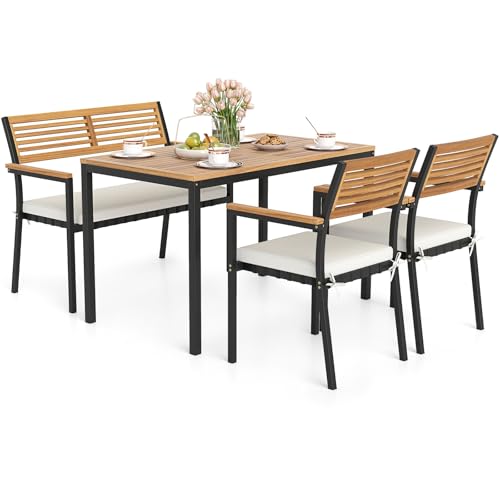
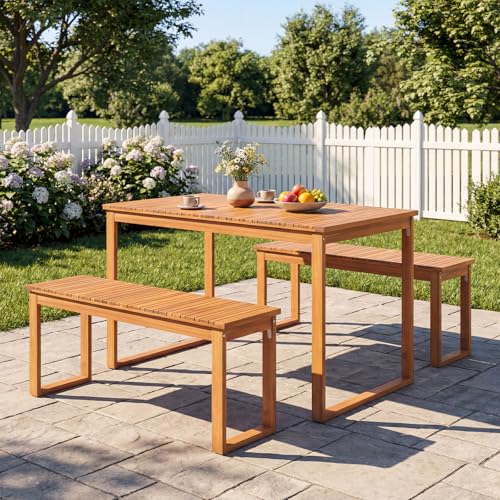
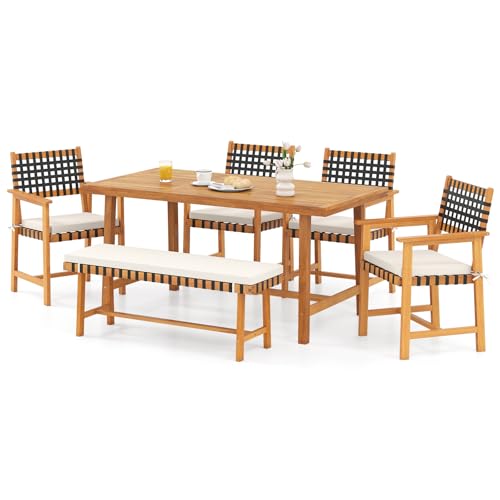
A standard four-person patio dining set pairs a table with four individual chairs. A bench configuration replaces one or both long sides of seating with a continuous bench. The most common arrangement is a bench on one side and two chairs on the other, but you will also find sets with a bench on both long sides — often called picnic-style — and sets that include a bench plus four chairs for six-person flexibility.
The practical differences are significant:
- Seating density: A bench lets you seat three people (or two adults plus children) on one side without the bulk of separate chair frames. This is why bench sets are popular for families and casual entertaining.
- Visual footprint: Benches tuck neatly under the table, which reduces the apparent visual mass of the set. On a compact deck, that matters.
- Access: Chairs let individuals pull in and out freely. A bench requires everyone on that side to slide in together — a detail that becomes annoying if you host guests who need frequent trips for drinks or the restroom.
- Comfort profile: Benches are typically firmer and less contoured than dining chairs. Some people love that; others find it tiring during long meals.
If your priority is maximum seating with minimum visual clutter, a bench set is a strong choice. If your priority is individual comfort and easy access, a traditional four-chair configuration may serve you better. Many buyers land somewhere in the middle with a bench-plus-two-chairs setup, which you can explore further in our guide to outdoor dining sets with bench and chairs.
Sizing: How Much Table Do You Actually Need for Four?
This is the question most buyers underestimate. A four-person set sounds simple, but the table dimensions determine whether the bench is comfortable, whether plates fit without crowding, and whether the set will realistically fit on your patio.
As a working rule, allow roughly 24 inches of table edge per person on a long side. For a rectangular table seating two on the bench side, that means a table at least 48 inches long — but 55 to 60 inches is far more comfortable once you account for serving dishes in the center. A bench that seats three comfortably typically wants a table closer to 60 inches or more.
| Table Shape | Typical Dimensions | Best For | Bench Suitability |
|---|---|---|---|
| Square | 40–44 in square | Compact decks, two-per-side seating | Good — one bench on one side, two chairs opposite |
| Rectangular | 55–60 in × 32–36 in | Families, everyday meals | Excellent — the classic bench configuration |
| Round | 42–48 in diameter | Conversation-focused dining, tight corners | Limited — round tables pair awkwardly with straight benches |
| Oval | 60–66 in × 36 in | Soft-edged layouts, transitional styling | Fair — bench works but curved aprons reduce knee room |
Also measure the clearance around the table. You want at least 36 inches of walking space between the table edge and any wall, railing, or planter so people can slide along the bench without scraping. If your space is tighter than that, look at sets designed for compact areas — our roundup of outdoor dining sets for four covers several layouts that work in narrow footprints.
Bench Styles: Backless vs. Backed vs. Storage Benches
Not all benches are interchangeable. The bench you choose affects comfort, storage, and even how easy it is to get in and out of the set.
Backless Bench
The most common pairing with a dining table. It slides fully under the table when not in use, which saves space and keeps the patio looking tidy. Best for casual meals and households that prioritize a clean visual line.
Bench with Back
Offers support during longer meals and feels more like a dining chair. The trade-off is depth — a backed bench needs more clearance behind it and may not tuck under the table, so confirm the fit before buying.
Storage Bench
Lifts on a hinged lid to reveal space for cushions, table linens, or grill tools. A practical pick for patios without nearby storage. Look for a water-shedding lid gasket and a reinforced hinge assembly on mid-range and premium models.
Cushioned Bench
Adds comfort but needs care and storage during wet months. Cushioned benches are a natural fit for covered porches. See our guide to outdoor cushioned benches for pad thickness and fabric considerations.
A practical middle ground: a backless bench with a thin removable seat pad. You get comfort during meals, the pad comes indoors when the weather turns, and the bench still tucks away neatly.
Frame and Tabletop Materials Compared
The material of the frame and tabletop is the single biggest determinant of how long the set lasts and how much maintenance it demands. Here is how the main options stack up.
| Material | Market Tier | Durability | Maintenance | Best For |
|---|---|---|---|---|
| Powder-coated aluminum | Mid-range to premium | Excellent — rust-proof finish when coated properly | Low — wipe down occasionally | Humid climates, coastal patios, year-round use |
| Steel with powder coat | Entry-level to mid-range | Good — heavy-duty feel, but chips expose bare metal | Moderate — touch up chips promptly | Sheltered patios, buyers who want a solid build |
| Teak / acacia hardwood | Mid-range to luxury | Very good — naturally weather-resistant | Moderate — periodic sealing recommended | Rustic and farmhouse styling, long-term investment |
| HDPE / resin | Entry-level to mid-range | Good — resists rot and insects | Very low — soap and water | Low-maintenance households, family use |
| Wicker over aluminum frame | Mid-range to premium | Good — depends on weave density and UV rating | Low to moderate | Coastal and bohemian styling |
Two details are worth checking regardless of material. First, tabletop construction: a slatted top drains rain and dries quickly, while a solid top needs a slight slope or umbrella hole to avoid pooling. Second, frame wall thickness: thicker aluminum tubing resists flex at the bench joints, which is where most bench failures begin. If you are comparing sets side by side, our outdoor dining set buying guide walks through the specifications worth verifying.
Comfort and Ergonomics: What to Check Before You Buy
A dining set is only as good as the third meal you eat at it. These are the comfort details that separate a set you will love from one you will quietly stop using.
- Seat height vs. table height: Standard outdoor dining tables sit around 28 to 30 inches high, with benches at 17 to 18 inches. A mismatch makes the bench feel either too low or too high relative to the plate.
- Knee clearance: Check the table apron depth. A deep apron on a thick benchtop leaves little room for knees, especially for taller diners.
- Bench depth: Anything under 14 inches deep becomes uncomfortable quickly. 15 to 17 inches is the comfortable band for casual dining.
- Edge profile: Rounded or beveled edges are gentler on the backs of the thighs than sharp squared edges, particularly on backless benches.
- Chair pairing: If the set includes two chairs on the opposite side, make sure they are actual dining chairs with proper seat depth — not shallow accent chairs pressed into service. Our roundup of outdoor dining chair sets is useful if you plan to swap or add chairs later.
Practical tip: If you regularly host older guests or anyone with mobility concerns, a bench-only configuration can be genuinely difficult to use. A bench-plus-chairs set lets you offer the more accessible seating to guests while keeping the bench for everyday family meals.
Space Planning: Where a Bench Set Works Best
Bench sets shine in specific settings and struggle in others. Knowing which is which saves you a return.
Where bench sets work well:
- Against a wall or railing on one long side — the bench side can push nearly flush, freeing floor space.
- On covered porches and decks with a defined dining zone.
- In rustic, cottage, and farmhouse landscaping where the bench reads as part of the design language.
- For families with young children, since a bench is harder to tip than a lightweight chair.
Where bench sets struggle:
- Very narrow balconies where the 36-inch clearance rule cannot be met — consider a round four-person dining set instead.
- Formal entertaining setups where individual seating matters.
- Sloped or uneven surfaces — benches are less forgiving than chairs when the ground is not level.
If you are building out a larger outdoor dining area, it is worth thinking about how this set interacts with the rest of your patio. For example, a dining set paired with a separate conversation set with a dining table gives you distinct zones for meals and lounging. On a smaller footprint, a well-chosen conversation set for small spaces may actually serve you better than a dining set at all.
Weather Resistance and Seasonal Care
A bench set lives outside, so its weather performance is not a footnote — it is the main event. Here is a realistic care routine by material.
Aluminum Frames
Wipe with mild soap and water every few weeks. Inspect welds and joints at the start of each season. The powder-coated finish is the protective layer — avoid abrasive pads that scuff it.
Wood (Teak & Acacia)
Teak weathers to a silver-grey patina if left untreated; oil it annually if you prefer the warm tone. Acacia benefits from a penetrating sealer before winter. Tighten bench bolts each spring as wood expands and contracts.
Resin / HDPE
The lowest-maintenance option. A seasonal wash with soapy water is usually enough. Check UV stability — poor-grade resin can chalk after several seasons in strong sun.
Cushions & Pads
Store pads indoors when not in use. Look for solution-dyed acrylic fabrics and quick-dry foam. Our outdoor cushion guide explains which fabric ratings actually mean something.
For winter, a fitted cover is the simplest protection. A cover that traps moisture is worse than no cover at all, so choose one with vented panels. Our overview of outdoor dining sets includes notes on which configurations cover most cleanly.
Bench Set vs. Chair Set: A Direct Comparison
| Factor | Bench + 2 Chairs | 4 Individual Chairs |
|---|---|---|
| Seating capacity | 4 comfortably, 5 with a squeeze | 4 exactly |
| Visual footprint | Lower — bench tucks under table | Higher — four chair backs add visual mass |
| Individual access | Bench side requires group sliding | Each person moves independently |
| Comfort during long meals | Firmer, less contoured | Better back support and contouring |
| Storage and transport | Fewer pieces to move | More pieces, but lighter individually |
| Best for | Families, casual hosting, rustic styling | Formal hosting, mixed-age guests, easy access |
Neither configuration is universally better. The right answer depends on who sits at your table most often and how much visual clutter you can tolerate. If you want the communal feel but still want chair-level comfort, look at outdoor dining sets for four with swivel chairs — they solve the access problem while keeping the table compact.
What to Verify on the Product Page
When you are ready to compare specific sets, these are the specifications that matter most. A listing that is vague on any of them is worth approaching with caution.
- Assembled dimensions — not just table size, but bench length, bench depth, and chair dimensions.
- Weight capacity per seat — a well-specified bench will state a per-seat rating; a vague overall rating hides weak joints.
- Frame material and coating — "metal" is not a specification. Look for aluminum, steel, or specific hardwood.
- Umbrella compatibility — if you want shade, confirm the table has a pre-drilled hole and a base collar. Sets without this are common, so check before assuming. Our guide to dining sets with umbrella holes explains the base requirements.
- Warranty length — a meaningful frame warranty signals the manufacturer's confidence in the construction.
- Cushion fabric rating — if cushions are included, check for UV and mildew resistance.
If you are deciding between a few finalists, our outdoor dining sets overview groups options by configuration and material so you can compare like with like.
Frequently Asked Questions
How many people can really sit at a four-person bench set?
Four adults sit comfortably when the bench is paired with two chairs. A bench on one side will physically fit three adults, but shoulder room gets tight and the middle diner has no armrest. For everyday family meals with children, three on the bench is realistic. For adult dinner parties, plan on two per side.
Is a bench more comfortable than dining chairs?
Generally, no — individual chairs offer better back support and contouring. Benches are firmer and flatter by design. The comfort gap narrows considerably if the bench has a backrest or a quality seat pad. For long, leisurely meals, chairs usually win; for casual weeknight dining, most people do not notice the difference.
Can I leave a bench dining set outside all year?
Aluminum, resin, and powder-coated steel sets can generally stay outside year-round in mild climates. Wood sets benefit from a cover and an annual sealer. Cushions should always come indoors when not in use. In regions with heavy snow or freeze-thaw cycles, storing the set or covering it securely is the safer choice.
What is the best table shape for a bench set?
Rectangular tables are the natural pairing for benches because the straight edge matches the bench length and gives even knee clearance along the whole side. Square tables work in compact spaces with a single bench. Round and oval tables are awkward with straight benches and are better paired with four chairs.
Do I need a cushion for a backless bench?
Not strictly, but a thin removable seat pad meaningfully improves comfort during meals. Choose a quick-dry foam pad with a solution-dyed acrylic cover and bring it inside after use. Thick, slow-drying pads trap moisture and are a common cause of mold on the bench surface beneath.
How much clearance do I need around the set?
Aim for at least 36 inches between the table edge and any wall, railing, or fixed obstacle on the bench side. On the chair side, 36 inches is also the working minimum for pulling chairs out comfortably. Below that, the set will feel cramped and the bench becomes difficult to access.