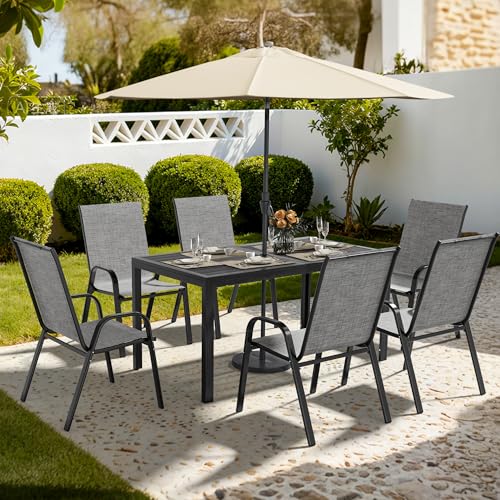
Outdoor Dining Table and Chairs with Umbrella
Everything you need to choose a shaded dining set that fits your space, your climate, and the way you entertain outdoors.
Explore the Buying GuideWhy this guide matters: An outdoor dining table and chairs with umbrella is the centerpiece of backyard entertaining. It defines where meals happen, where conversations linger, and how much of the day you can comfortably spend outside. This guide walks you through every decision — table size, chair style, umbrella mechanics, materials, and layout — so you can choose a set that works for years, not just one season.
What Defines a Great Shaded Dining Set
A shaded dining set combines three interconnected components: the table, the seating, and the umbrella (plus a base or weighted support). Each element affects the others. A heavy umbrella needs a sturdier table or a freestanding base. Tall chairs demand a taller table. A large canopy can dominate a small patio. The best sets are engineered as a system, not assembled from mismatched parts.
When you shop for an outdoor dining set with umbrella, look for a table that already includes a center hole sized to standard umbrella poles — usually 1.5 to 2 inches in diameter. The umbrella should extend roughly two feet beyond the tabletop on every side for effective shade. A tilt mechanism and crank lift make the set far more usable across the day, especially in west-facing yards where afternoon sun moves quickly.
Buying Guide: Sizes, Seating, and Shade
Match the Set to Your Guest Count
The most common configurations are four, six, and eight seats. A four-person set suits a small patio or balcony and pairs naturally with a round table and a compact umbrella. Six-seat sets are the workhorse for family dining and casual entertaining. Eight-seat sets demand generous clearance — plan for at least three feet of open space on all sides so chairs can pull out without hitting walls, planters, or railings.
- Two-seat sets: ideal for balconies and breakfast nooks; look for bistro-height or standard-height options.
- Four-seat sets: the best balance of footprint and function; round tables maximize conversation.
- Six-seat sets: the standard for family patios; rectangular tables fit narrow decks well.
- Eight-seat sets: for dedicated dining zones; consider extension tables if space is tight between events.
For a deeper comparison of seat counts and layouts, see our four-person outdoor dining set with umbrella overview and the six-person outdoor dining set with umbrella guide.
Table Shape and Umbrella Placement
Round tables distribute shade evenly and soften traffic flow on small patios. Rectangular tables offer more usable surface for serving dishes and place settings, and they suit long, narrow decks. Oval tables split the difference. Whatever the shape, confirm the umbrella hole is centered and reinforced — cheaply made tables can crack at the hole under wind load.
If your table lacks a hole, a freestanding umbrella base is the safe alternative. Never clamp an umbrella to a table edge; the leverage from wind can tip the entire set.
Chair Types That Pair Well With Umbrella Tables
Stackable chairs are practical for seasonal storage and quick reconfiguration. Swivel chairs make it easier to get in and out of a shaded table without moving the whole chair. Armchairs add comfort but consume more clearance. Benches work well on one side of a rectangular table, especially for families with children.
- Outdoor dining chairs — the foundational choice; prioritize frame rigidity and UV-stable finishes.
- Stackable chair sets — best for small storage footprints and flexible guest counts.
- Swivel dining chairs — smoother entry and exit under a canopy.
- Bench-and-chair combinations — maximize seating per linear foot.
Umbrella Types and Mechanisms
The umbrella is often the most-used part of the set and the most frequently replaced. Choose based on sun angle, wind exposure, and how much effort you want to spend adjusting shade.
- Market umbrellas: the classic center-pole design with a crank and often a tilt; best for calm, sunny patios.
- Tilt-and-crank umbrellas: allow shade to be redirected without moving the base; excellent for afternoon sun.
- Offset or cantilever umbrellas: the pole stands to the side, opening up the table surface; require a heavy base and more clearance.
- Double-canopy umbrellas: vented tops reduce wind uplift and improve airflow under the shade.
Fabric quality matters. Solution-dyed acrylics resist fading and mildew far better than polyester blends. Look for a vented canopy and a powder-coated or aluminum pole.
Materials: Durability Without Compromise
| Material | Tier | Best For | Notes |
|---|---|---|---|
| Powder-coated aluminum | Mid-range to premium | Humid, coastal, rainy climates | Lightweight, rust-resistant, easy to move |
| Teak or acacia hardwood | Premium to luxury | Natural, warm aesthetics | Requires periodic sealing; ages gracefully |
| HDPE wicker over aluminum | Essential to mid-tier | Traditional looks with modern durability | UV-stable, low maintenance, won't crack |
| Powder-coated steel | Entry-level to mid-range | Stable, heavy-duty seating | Heavier; check welds and coating quality |
| High-grade resin | Entry-level | Casual, easy-clean setups | Light and weatherproof; less premium feel |
Cushions deserve equal attention. Outdoor foam should be quick-drying and covered in solution-dyed, water-repellent fabric. Removable, zippered covers make seasonal cleaning far easier. If you plan to leave cushions out, look for mold-resistant batting and vented covers.
Layout and Clearance
Measure twice before you commit. A common mistake is buying a table that fits the patio but leaves no room to walk around it. As a rule of thumb, allow 36 inches of clearance between the table edge and any wall, railing, or planter. For a six-seat rectangular table, that often means a patio at least 10 by 12 feet. For a four-seat round table, 8 by 8 feet is a comfortable minimum.
Also consider umbrella swing. A tilt umbrella needs room to angle without hitting a wall or roof overhang. A cantilever umbrella needs clearance on one side for its base and arm.
Weather, Storage, and Longevity
No outdoor set is maintenance-free, but the right choices reduce effort dramatically. Powder-coated frames with stainless hardware resist rust. Vented umbrellas shed wind better than solid canopies. Furniture covers extend the life of cushions and tabletops during off-season months. If you live in a region with harsh winters, stackable chairs and a folding or removable umbrella canopy make seasonal storage far easier.
For related care guidance, see our resources on outdoor cushion care and weatherproofing strategies for patio furniture.
How to Choose: A Step-by-Step Checklist
- Measure your space — including clearance for chairs, walkways, and umbrella swing.
- Decide your seat count — four, six, or eight, based on typical gatherings, not maximum capacity.
- Choose a table shape — round for conversation, rectangular for serving and narrow decks.
- Confirm umbrella compatibility — hole diameter, pole fit, base weight, and tilt mechanism.
- Pick frame and fabric materials — match to your climate and maintenance preferences.
- Plan storage — stackable chairs, removable canopy, and covers for off-season.
- Check the return and warranty terms — especially for umbrella mechanisms and cushions.
Frequently Asked Questions
What is the ideal size for an outdoor dining table and chairs with umbrella?
The ideal size depends on your guest count and available space. A four-person set typically works well for small patios, while six- and eight-person sets suit larger decks. Always leave at least 36 inches of clearance around the table for chair pull-out and walkway.
How do I choose the right umbrella for my outdoor dining set?
Match the umbrella canopy diameter to your table size. A good rule is a canopy that extends 2 feet beyond the table edge on all sides. Ensure the umbrella pole fits your table's hole diameter and consider a tilt or crank mechanism for adjustable shade.
What materials are best for outdoor dining tables and chairs with umbrella?
Aluminum and powder-coated steel resist rust and are lightweight. Teak and acacia offer natural beauty with proper sealing. High-density polyethylene (HDPE) wicker over aluminum frames provides a traditional look with modern durability. Choose UV-resistant, water-repellent cushions.
Can I use an umbrella with any outdoor dining table?
Only tables with a pre-drilled umbrella hole or a compatible umbrella base can safely support an umbrella. Never clamp an umbrella to a table without a hole. For tables without a hole, use a freestanding umbrella base placed beside the table.
Final Thoughts
A well-chosen outdoor dining table and chairs with umbrella turns a patio into a room without walls. Prioritize fit and function over ornament: measure your space, confirm umbrella compatibility, choose weather-ready materials, and plan for storage. If you do those four things, the set will serve you through countless meals and gatherings. For further exploration, compare round four-seat sets, six-seat dining sets, and eight-seat sets with umbrella to narrow your shortlist.