Outdoor Dining Table with Folding Chairs: The Complete Buyer's Guide
A space-smart, flexible way to enjoy al fresco meals — learn how to pick a table and folding chair combination that fits your patio, your storage, and your lifestyle.
An outdoor dining table with folding chairs is one of the most practical investments you can make for a backyard, balcony, or deck. Unlike fixed seating sets, folding chairs collapse flat for storage, move easily between the lawn and the patio, and let you expand or shrink your seating capacity as guests arrive or leave. For homeowners working with limited square footage, this combination delivers full dining functionality without permanently occupying the space.
This guide walks through the materials, table shapes, sizing formulas, and chair construction details that matter when you are comparing sets. By the end, you will understand exactly what to look for and how to match a configuration to your outdoor area.
Quick orientation: If you are still comparing configurations, our broader guides to outdoor dining tables and outdoor dining cover fixed and expandable options, while this page focuses specifically on the folding-chair pairing.
Why Pair a Dining Table with Folding Chairs?
The appeal of folding chairs goes well beyond saving space. They solve several practical problems at once:
- Storage flexibility. When the season ends or a storm approaches, folding chairs stack or hang flat against a wall, freeing your patio completely.
- Reconfigurable seating. Pull two chairs out for a quiet breakfast, or unfold six for a weekend dinner. The table stays put while the seating adapts.
- Portability. Folding chairs travel to picnics, camping trips, and sporting events, which means one purchase serves multiple purposes.
- Easier cleaning. With chairs out of the way, sweeping, pressure-washing, and covering the table become far simpler tasks.
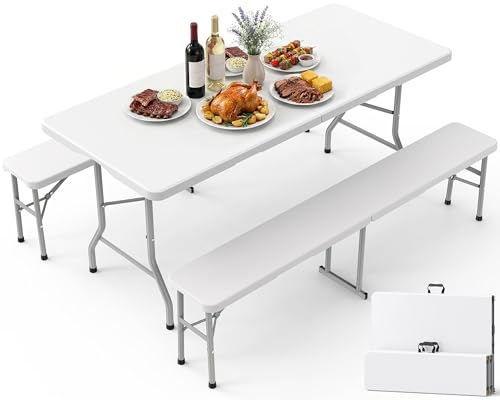
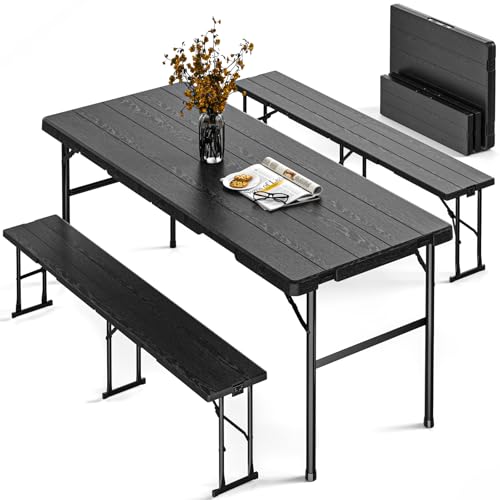
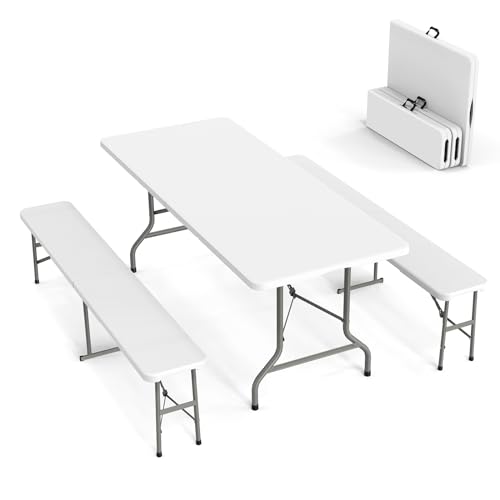
- Mixed seating options. Many households combine folding chairs with a bench on one side, giving a casual, communal feel to the dining area.
If you like the idea of combining seating types, our guide to an outdoor dining table with a bench on one side explains how to balance bench and chair counts for comfortable spacing.
Choosing the Right Table for Folding Chairs
Not every table works well with folding chairs. Folding chairs typically have a narrower seat depth and a more upright back angle than fixed dining chairs, so the table height and leg clearance matter more than you might expect. Aim for a table surface height between 28 and 30 inches for standard folding chairs, which is the range most patio dining tables use.
Round and Square Tables
Round tables are the friendliest option for folding chairs because there are no corners to navigate and every seat has equal legroom. A 36-inch round table seats two to four diners comfortably, while a 42- to 48-inch round table seats four with room to spare. Square tables offer the same compact footprint with slightly more usable surface area for plates and serving dishes.
For tight balconies, a round table and chairs set is often the most space-efficient arrangement available.
Rectangular and Oval Tables
Rectangular tables seat more people per unit of floor space and pair naturally with folding chairs along the long sides. A 60-inch rectangular table seats six (two on each long side, one at each end), and a 72-inch table seats six to eight. Oval tables soften the corners and improve flow around the table, which helps on decks where walking space is tight.
If shade is a priority, look at tables with a pre-cut opening. Our page on an outdoor dining table with umbrella hole and chairs covers the sizing and stability details for umbrella-compatible setups.
Tables with Integrated Features
Some tables build extra function into the center. A table with a cooler in the middle keeps drinks cold without a separate cooler taking up floor space, which is a strong option for entertaining-focused patios. Others integrate warmth: a table with a fire pit in the middle extends the dining season into cooler evenings.
If you want to explore those hybrid designs further, our collection of outdoor dining tables includes fire pit, cooler, and umbrella configurations side by side.
What to Look For in Folding Chairs
Folding chairs vary dramatically in build quality, and the differences show up in stability, comfort, and lifespan. Here is what separates a durable set from a wobbly one.
Frame Materials
- Powder-coated aluminum. Lightweight, rust-resistant, and easy to move. This is the sweet spot for outdoor use because it will not corrode even after repeated rain exposure.
- High-grade steel. Heavier and very stable, but it requires a rust-proof finish to survive outdoors. Look for reinforced cross-bracing and sealed joints.
- Resin and polypropylene. Weatherproof and simple to clean, though entry-level resin chairs can flex under heavier users. Mid-range and premium resin blends are noticeably more rigid.
- Solid wood or bamboo. Attractive and warm, but needs sealing and should be stored under cover during wet seasons.
Weight Capacity and Bracing
Check the stated weight capacity and, more importantly, the bracing pattern. A good folding chair has an X-brace or cross-bar under the seat and a locking hinge at the fold point. Reinforced hinges prevent the chair from collapsing unexpectedly, which is the single most common failure point on lower-tier models.
Seat Comfort
Folding chairs are not known for plush comfort, but the better ones include contoured seats, slightly reclined backs, and optional clip-on cushions. If you plan to linger over long dinners, look for models with a wider seat pan and a backrest angle closer to a fixed dining chair.
Portability Extras
Some folding chairs include a carry handle, a shoulder strap, or a built-in cup holder. These details matter if the chairs will double as event seating. Our guide to outdoor folding chairs for sporting events covers the features that make a chair genuinely portable.
Market Tiers: How Folding Chair Sets Differ
Rather than comparing specific brands, it helps to understand the three broad tiers that folding dining sets fall into. The classification below is based on construction quality, material grade, and feature depth — not on any specific figure.
Entry-Level Tier
Basic steel or resin frames, simple folding mechanism, and a compact table. Best for occasional use, balconies, and renters who need something lightweight. Expect adequate stability for casual meals.
Mid-Range Tier
Powder-coated aluminum or reinforced steel frames, smoother hinges, and better seat contouring. A solid choice for daily family use and year-round outdoor exposure with basic care.
Premium Tier
High-grade materials, welded joints, weather-resistant coatings, and thoughtful details like locking hinges and padded seats. Built for frequent entertaining and long-term outdoor placement.
Mid-range models usually offer noticeably smoother folding mechanisms and tighter frame tolerances than entry-level sets, which translates into less wobble over time. Premium-tier sets add refinements that matter most if the furniture stays outside through every season.
Side-by-Side Comparison by Category
| Configuration | Best For | Seating Capacity | Tier Typically Needed |
|---|---|---|---|
| Round table, 36 in | Balconies, two-person dining | 2–4 | Entry-level to mid-range |
| Square table, 40 in | Small patios, four diners | 4 | Mid-range |
| Rectangular table, 60 in | Family meals, decks | 4–6 | Mid-range |
| Rectangular table, 72 in | Entertaining, six to eight | 6–8 | Mid-range to premium |
| Oval table, 84 in | Large patios, formal outdoor dining | 6–8 | Premium |
| Table with bench on one side | Casual gatherings, mixed seating | 5–7 | Mid-range |
How to Size the Set to Your Space
Measure first, then shop. A dining set needs breathing room on all sides; without it, the chairs cannot pull out and the space feels cramped even when it is technically big enough.
- Measure the usable patio area, not the whole deck. Exclude planters, grills, and traffic paths.
- Add 36 inches of clearance around the table on every side where people will sit. This is the minimum space needed to slide a folding chair out and stand up comfortably.
- Account for the chair footprint. A folding chair in use occupies roughly 18 to 22 inches of depth behind the table edge.
- Leave a walking path of at least 24 inches between the dining set and any wall, railing, or other furniture.
For compact outdoor areas, our guide to an outdoor furniture set for a small screened-in porch applies the same clearance logic to a very tight footprint, and the principles transfer directly to small open patios.
Folding Chairs vs. Stackable Chairs
Folding chairs collapse flat; stackable chairs stack vertically. Each has a place. Folding chairs win when storage is extremely limited or when the chairs need to be carried elsewhere. Stackable chairs are usually more rigid and comfortable for long sitting sessions, but a stack of six still occupies floor space.
If you are weighing the two approaches, our comparison of an outdoor dining table with stackable chairs outlines when vertical stacking makes more sense than flat folding.
Editor's note: A hybrid approach works well for many households — keep two or three folding chairs permanently at the table and store the rest. This gives you a comfortable everyday setup plus overflow seating for guests.
Weather Resistance and Care
Folding chairs have more moving parts than fixed chairs, and hinges are where wear shows up first. A simple maintenance routine keeps them folding smoothly for years.
- Rinse and dry after rain. Standing water in the hinge points accelerates corrosion on steel frames.
- Lubricate hinges annually with a silicone spray or a drop of light machine oil.
- Tighten fasteners each season. Screws and rivets loosen gradually with repeated folding.
- Store during off-season. Even weather-resistant chairs last longer when kept under cover through winter.
- Use covers on the table. Our guide to outdoor furniture covering explains how to protect table surfaces from UV fading and debris.
If your furniture stays outside year-round, the broader article on outdoor furniture that can withstand weather covers material behavior across seasons and climates.
Matching the Set to Your Patio Style
Folding dining sets are available in enough material and finish combinations to suit most design directions:
- Modern and minimalist: aluminum frames with matte finishes, slatted table tops, and slim folding chairs.
- Rustic and farmhouse: wood-look table tops paired with slatted wooden folding chairs.
- Coastal: white or weathered finishes, resin or aluminum frames, and light-colored sling seats.
- Industrial: steel frames, dark powder-coated finishes, and mesh or perforated seats.
For a deeper look at material and style pairing, our collection of outdoor furniture guides by category is a good starting point. If you prefer the look of a traditional wood set, the article on an outdoor furniture wooden table and chairs covers finishes and care for timber options.
Final Buying Checklist
Before you commit to a set, run through these points:
- Confirm the table height suits standard folding chairs (28–30 inches).
- Check that chair frames are powder-coated aluminum, reinforced steel, or high-grade resin.
- Verify the hinge type — locking hinges are safer than friction hinges.
- Measure clearance: 36 inches per seated side, 24 inches for walking paths.
- Decide whether the chairs need to travel; if so, prioritize carry handles and lighter frames.
- Consider an umbrella hole if the table will sit in direct sun.
- Plan storage for the chairs during the off-season.
Ready to compare actual models? Browse our curated selection below for tables and folding chairs that meet the criteria in this guide.
View Recommended SetsFrequently Asked Questions
Are folding chairs sturdy enough for everyday outdoor dining?
Yes. Mid-range and premium-tier folding chairs use reinforced steel or aluminum frames with cross-bracing and locking hinges, making them stable for daily use. Entry-level tier models are better suited for occasional seating or lighter users.
What size outdoor dining table fits a small patio?
A 30- to 36-inch round or square table seats two to four people comfortably and fits on compact balconies. For four diners on a slightly larger patio, a 48-inch rectangular table is a good fit. Always leave 36 inches of clearance on seated sides.
Can folding chairs be left outside in the rain?
Powder-coated aluminum and high-grade resin frames are weather-resistant and can remain outdoors. Steel frames need a rust-proof finish and periodic hinge lubrication. Wooden folding chairs should be sealed and stored during prolonged wet weather.
How many folding chairs can a typical outdoor dining table accommodate?
Round tables up to 40 inches seat four. Rectangular tables between 60 and 72 inches seat six, and 84-inch or larger tables seat up to eight. Folding chairs along the long sides allow for the most efficient seating density.
Should I choose a bench instead of folding chairs on one side?
A bench on one side creates a casual, communal feel and seats more people per unit of width, but it is harder to move. Folding chairs on both sides remain the most flexible arrangement for households that need to reconfigure seating often.