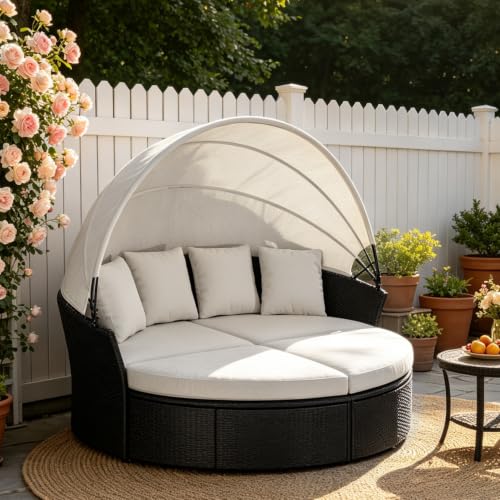
Outdoor Patio Round Daybed with Retractable Canopy: The Complete Buying Guide
Everything you need to evaluate frame materials, canopy mechanics, cushion systems, and placement before choosing a round daybed for your outdoor space.
Why this guide exists: A round daybed with a retractable canopy is one of the most complex pieces of outdoor furniture you can buy. It combines a structural frame, a moving shade mechanism, and layered cushioning — three systems that must work together for years of comfortable use. Most shoppers focus on appearance and overlook the details that determine whether the daybed stays functional through several seasons.
This guide walks through each component in the order that matters: frame first, then canopy, then cushions, then placement. By the end, you should be able to read any product listing and understand exactly what you are evaluating.
What Makes a Round Daybed with Canopy Different
A standard outdoor patio furniture piece is a static object. A round daybed with a retractable canopy is a small system. The circular base supports a continuous seating surface, the backrest wraps around part of the perimeter, and a curved track carries the canopy fabric from an open position to a folded position behind the backrest.
That design delivers two distinct experiences in one footprint. With the canopy open, the daybed functions as a shaded lounger — useful for reading, napping, or entertaining guests who prefer filtered light. With the canopy retracted, it becomes an open sun lounger similar in spirit to a outdoor recliner, but with the social orientation of a circular seat.
The trade-off is mechanical complexity. Every moving part is a potential wear point, which is why canopy track quality matters more than most buyers expect. A daybed with a beautiful frame and a flimsy track will frustrate you within a season. A daybed with a modest frame and a well-engineered track will keep working quietly for years.
Frame Materials: The Structural Foundation
The frame determines how the daybed handles weight, weather, and time. Three material families dominate the market, and each behaves differently.
Powder-Coated Aluminum
Aluminum is the most common choice for round daybeds because it is light enough to reposition and naturally resistant to rust. A powder-coated finish adds a protective layer against scratching and UV fading. High-grade aluminum frames with a reinforced weld pattern are the benchmark for mid-range and premium models. The main weakness is that aluminum can dent under sharp impact, so avoid dragging the daybed across rough surfaces.
Steel and Wrought Iron
Steel frames feel substantial and hold heavier cushion loads without flexing. The catch is corrosion. Unless the frame uses a rust-proof finish with a galvanized or e-coat base, moisture will find seams and joints. Steel daybeds suit covered patios and pergolas better than fully exposed decks. If you are shopping for a structure to pair with the daybed, a covered outdoor patio layout reduces weather exposure considerably.
Weather-Resistant Resin and Poly
Resin and poly frames are molded rather than welded, which allows smooth circular shapes without visible joints. They resist moisture completely and never rust. The limitation is structural stiffness — larger resin daybeds can flex slightly under heavy loads, and the finish may chalk over many years of direct sun. Resin is a sensible choice for coastal areas where salt air attacks metal hardware.
How Retractable Canopy Systems Work
The canopy is the defining feature, and the mechanism varies widely across the market. Understanding the three main approaches helps you match the daybed to how you actually use it.
Manual Pull and Fold
The simplest system uses a fabric panel attached to a curved rail. You pull the canopy forward by hand and secure it with ties, clips, or a friction lock. Entry-level models rely on this approach. It works, but the fabric can bunch unevenly if the rail is not perfectly aligned, and repeated pulling stresses the attachment points.
Smooth-Glide Track with Locking Positions
Mid-range daybeds use a machined track that lets the canopy slide with less effort and lock at multiple positions — fully open, half-shaded, or fully retracted. This is the sweet spot for most buyers. The mechanism is simple enough to maintain but refined enough that daily use does not feel like a chore. Look for a track with sealed bearings or nylon glides rather than bare metal-on-metal contact.
Crank and Motorized Systems
Premium and commercial-grade daybeds offer a hand crank or a small motorized drive. Crank systems remove the need to reach overhead, which matters for taller users or anyone with shoulder limitations. Motorized canopies add convenience but introduce electronics into an outdoor environment — verify the motor housing is rated for moisture and that a manual override exists.
| Canopy System | Tier | Best For |
|---|---|---|
| Manual pull and fold | Entry-level | Occasional use, covered patios, seasonal setups |
| Smooth-glide locking track | Mid-range | Daily use, mixed sun and shade, family patios |
| Crank or motorized drive | Premium / commercial-grade | Frequent adjustment, accessibility needs, hospitality settings |
Canopy Fabric and Sun Protection
The fabric is the part of the canopy that degrades first. Solution-dyed acrylic is the standard for quality outdoor canopies because the color is locked into the fiber rather than applied as a surface dye. It resists fading, holds up to repeated folding, and breathes well enough to avoid trapping heat underneath.
Polyester canopies are common on entry-level daybeds. They are lighter and shed water effectively, but UV exposure breaks down the fibers faster, and the color may shift after a few seasons. If the listing does not name the fabric, assume polyester.
Check two specifications: UPF rating and water repellency. A UPF 50+ canopy blocks the vast majority of UV radiation, which matters for a lounger where you may spend an hour or more. Water repellency is a finish, not a permanent property — most canopy fabrics need re-treatment every couple of years to maintain beading.
Cushions: Comfort, Drainage, and Longevity
A round daybed uses two cushion types: a seat cushion that follows the circular base and a backrest cushion that wraps the inner perimeter. The quality of these cushions determines whether the daybed feels like a lounger or like a bench with padding.
Foam and Fill
Quick-dry foam is the practical choice for outdoor daybeds. It uses an open-cell structure that lets water pass through instead of absorbing it, so the cushion dries within hours after rain. Standard upholstery foam holds moisture and develops mildew. If the listing does not specify quick-dry foam, assume standard foam.
Seat cushions in the 4 to 6 inch range balance comfort and accessibility. Thicker cushions feel plusher but raise the seat height, which can make a deep round daybed awkward to enter. Backrest cushions benefit from slightly more loft — 6 to 8 inches — because they are compressed against the frame.
Covers and Maintenance
Removable, zippered covers are close to essential. Round daybed cushions are large and awkward to clean in place, so the ability to unzip and wash or replace a cover extends the usable life of the cushion significantly. Look for covers with UV-stabilized thread, since standard thread degrades faster than the fabric itself.
If you plan to keep the daybed outside year-round, a storage solution for cushions is worth planning. A patio storage cabinet with shelves keeps cushions dry and out of sun during off-seasons. For daybeds used with other seating, coordinating outdoor pillows and replacement covers keeps the look consistent over time.
Size and Placement Planning
Round daybeds look compact in photos but occupy more floor area than expected once you account for the canopy sweep and the space needed to walk around them.
Diameter and Clearance
Most round daybeds measure 60 to 80 inches across. A 60-inch model fits balconies and small patios; 70 to 80 inches accommodates two adults reclining with room to spare. Beyond the daybed footprint, plan for at least 30 inches of clear walkway on the sides you will use for entry. The canopy retracts inward, so it does not add to the footprint, but it does require overhead clearance — verify that the open canopy will not collide with a pergola beam or umbrella frame.
Pairing with Other Furniture
A round daybed works best as a focal point rather than part of a matched set. On a larger patio, it pairs naturally with a complete outdoor patio set for dining, or with a patio with fire pit arrangement for evening use. On a compact patio, it can replace both a sofa and a lounge chair, simplifying the layout.
If your patio also includes a dining zone, a patio table and chairs set plus the daybed covers both daytime meals and afternoon lounging without overcrowding the space. For patios with a pool, a poolside layout benefits from a daybed that can be shaded during peak sun and opened for drying off afterward.
Surface and Anchoring
Round daybeds sit on a continuous base ring, which distributes weight well on flat surfaces like concrete, stone, and composite decking. On uneven ground, the base may rock slightly. Wind is the other consideration — a canopy acts like a sail, so on exposed decks, choose a model with a weighted base option or plan to retract the canopy when not in use.
Quality Tiers: What Changes as You Move Up
Round daybeds fall into three broad tiers, and the differences are consistent across brands.
Entry-Level
Basic aluminum or resin frame, manual pull canopy, polyester fabric, standard foam cushions with fixed or simple covers. Suitable for occasional use on covered patios.
Mid-Range
Reinforced aluminum frame, smooth-glide locking canopy track, solution-dyed acrylic fabric, quick-dry foam with removable zippered covers. The practical choice for daily use.
Premium / Commercial-Grade
Heavy-duty welded frame, crank or motorized canopy, high-grade acrylic with vent panels, layered quick-dry cushion system, replaceable component parts. Built for frequent use and longer service life.
The jump from entry-level to mid-range is the most meaningful for most buyers. It is the point where the canopy mechanism stops being a compromise and the cushions stop being a maintenance chore. Moving from mid-range to premium buys convenience and longevity rather than a fundamentally different experience.
Assembly, Care, and Seasonal Maintenance
Most round daybeds ship partially assembled. Expect to attach the base, backrest, canopy track, and fabric — roughly 45 to 90 minutes with two people. Premium models usually include pre-mounted hardware and clearer instructions, which shortens the process.
Routine Care
- Rinse the frame monthly with plain water; avoid abrasive cleaners on powder-coated finishes.
- Brush canopy fabric dry before folding to prevent mildew in the folds.
- Vacuum or brush cushion covers regularly; wash zippered covers according to the care label.
- Lubricate the canopy track sparingly with a silicone-based product — not oil, which attracts grit.
Seasonal Maintenance
Before winter, clean and fully dry the canopy fabric, then store it indoors if your climate freezes. Remove cushions and store them in a dry space. Inspect the frame joints for loose bolts and tighten as needed. In coastal areas, rinse metal hardware more frequently to remove salt residue.
If the daybed shares a patio with other furniture, a consistent maintenance routine across all pieces saves time. Guides on outdoor patio furniture care and outdoor seating set maintenance cover the broader routines that apply to the whole space.
Common Mistakes to Avoid
- Ignoring the track. Buyers inspect the frame and cushions, then discover the canopy binds after a few months. Test the track in person if possible, or read reviews that specifically mention canopy movement.
- Underestimating footprint. A round daybed plus walkway clearance can consume more patio area than a sofa and two chairs. Measure before ordering.
- Skipping replacement-part checks. Canopy fabric and cushions wear out before frames do. Confirm that replacements are available for the model you choose.
- Placing under low structures. An open canopy needs vertical clearance. A pergola beam or low umbrella frame can block full extension.
- Leaving the canopy open in wind. The canopy acts as a sail. Retract it when the daybed is not in use, especially on exposed decks.
Frequently Asked Questions
What size round daybed fits a standard patio?
Most round daybeds measure between 60 and 80 inches in diameter. A 60-inch model suits compact patios and balconies, while 70 to 80 inches gives room for two adults to recline comfortably. Always measure your clear space and leave at least 30 inches of walkway around the daybed.
How does a retractable canopy work on a round daybed?
Retractable canopies slide along a curved track mounted to the daybed frame. Entry-level models use a manual pull mechanism, mid-range versions use a smooth-glide track with locking positions, and premium models add a crank or motorized system. The canopy folds back into a compact stack behind the backrest when not in use.
Can a round daybed with canopy stay outside all year?
It depends on the frame and canopy fabric. Powder-coated aluminum frames with marine-grade cushions and solution-dyed acrylic canopy fabric handle year-round exposure well in mild climates. In freeze-thaw or heavy-snow regions, store the canopy fabric and cushions indoors during winter to extend their lifespan.
What cushion thickness is best for a round daybed?
A seat cushion of 4 to 6 inches and a backrest cushion of 6 to 8 inches provide balanced comfort without making the daybed hard to climb into. Quick-dry foam with a removable, zippered cover is the most practical choice for outdoor use.
Do round daybeds with canopies require assembly?
Most models ship partially assembled and require attaching the base, backrest, canopy track, and fabric. Expect 45 to 90 minutes with two people. Premium and commercial-grade models often include pre-mounted hardware and clearer instructions, which shortens setup time.
Final Checklist Before You Choose
Use this list to evaluate any round daybed listing you are considering:
- Frame material and corrosion warranty stated clearly.
- Canopy mechanism type identified — manual, locking track, crank, or motorized.
- Canopy fabric named, ideally solution-dyed acrylic with a UPF rating.
- Cushion foam type specified as quick-dry, with removable zippered covers.
- Diameter and required walkway clearance fit your patio measurements.
- Overhead clearance confirmed for full canopy extension.
- Replacement canopy fabric and cushions available for the model.
- Assembly requirements and tools listed in the product details.
When these eight points check out, the daybed is likely to perform as expected. If any point is missing from the listing, treat it as an open question rather than assuming a favorable answer.