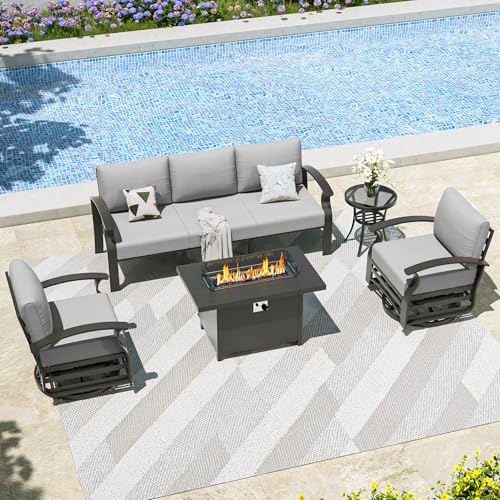
Patio Conversation Set with Fire Pit Table: The Complete Buyer's Guide
Everything you need to know before choosing a coordinated outdoor seating group with a built-in fire feature — materials, sizing, safety, and design considerations for a backyard that works year-round.
Jump to Buying FactorsWhat Is a Patio Conversation Set with Fire Pit Table?
A patio conversation set with fire pit table is a matched outdoor furniture grouping built around a central fire feature. The typical package includes a sofa or loveseat, two or more lounge chairs, and a rectangular or square fire pit table that doubles as a coffee table when the burner is not in use. Some configurations substitute a sectional for the sofa, or add swivel rockers and ottomans for flexibility.
The defining characteristic is the fire table itself. Unlike a separate fire pit placed beside a seating group, an integrated fire table anchors the arrangement and creates a shared focal point. This layout encourages face-to-face conversation rather than rows of seating facing outward, which is why the format is called a "conversation" set.
These sets are distinct from a standard patio conversation set without a fire feature, and from a dedicated conversation set with dining table where the table height is designed for meals rather than lounging. If you are still deciding between formats, comparing the two side by side is worthwhile before committing.
Why Choose a Conversation Set with a Fire Pit Table
The combination solves several outdoor living problems at once. First, it extends the usable season. A fire table provides radiant warmth that makes evenings in spring and autumn comfortable long after the sun drops. Second, it consolidates the furniture layout: instead of buying a coffee table and a separate fire pit, one piece serves both roles. Third, the coordinated design removes guesswork — the seating, table, and cushions are matched in scale and style.
Homeowners who entertain frequently often find this format more practical than a dining-focused arrangement, because guests naturally cluster around the fire. The table surface remains available for drinks, small plates, and decor when the burner is off, so the set functions as a full lounge area during the day.
For households that want maximum layout flexibility, a conversation set with swivel rockers adds motion and easier entry and exit, which can be helpful for older guests or tighter spaces. If cushion longevity is a concern, replacement options such as conversation set replacement cushions are worth checking before you buy, since cushion availability affects how long the set stays usable.
Common Configurations
Conversation sets with fire tables generally fall into a few recognizable layouts. Knowing which one suits your space and guest count is the first decision to make.
Four-Piece Set
Typically a loveseat, two chairs, and a fire table. Suits balconies, small patios, and couples.
- Compact footprint
- Easier to rearrange
- Seats three to four
Five- to Six-Piece Set
A sofa, two chairs, sometimes an ottoman, plus the fire table. The most common family configuration.
- Balanced seating and circulation
- Seats five to six
- Works on mid-size patios
Sectional Arrangement
An L-shaped or U-shaped sectional paired with a fire table. Maximizes seating in a defined corner.
- Seats six or more
- Best for larger decks
- Less flexible to reconfigure
Bar-Height Variant
Elevated seating around a taller fire table. A niche format suited to entertaining standing guests.
- Distinct visual profile
- Suits casual gatherings
- Limited cushion options
Related formats exist for specific use cases. A bar-height dining set with fire table blends dining and fire features, while a standalone wicker deep seating set can be paired with a separate fire table if you prefer to buy components individually.
Key Buying Factors
Beyond appearance, several practical factors determine whether a set will serve you well for years. The descriptors below use relative market tiers rather than absolute figures, because pricing varies by region and season.
| Factor | What to Look For | Why It Matters |
|---|---|---|
| Frame construction | Powder-coated aluminum, high-grade steel, or solid hardwood | Determines rust resistance, weight, and lifespan |
| Burner material | Stainless steel burner with warranty coverage | Burners are the most failure-prone component |
| Tabletop surface | Tempered glass, stone, or ceramic tile with heat tolerance | Must withstand direct heat and weather cycling |
| Cushion density | High-resilience foam, quick-dry core, removable covers | Affects comfort and how the set ages |
| Ignition system | Push-button or electronic ignition with flame control | Ease of use and safety during operation |
| Assembly requirements | Pre-assembled vs. flat-pack with clear instructions | Affects setup time and structural integrity |
| Warranty coverage | Separate terms for frame, finish, cushions, and burner | Reveals which components the maker expects to last |
Entry-level sets often use lighter aluminum and thinner cushions, which is acceptable for sheltered porches but may not hold up on fully exposed decks. Mid-range models typically add better foam density and a more robust burner assembly. Premium and luxury tiers usually bring solid hardwood frames, higher-grade fabric, and refined ignition systems with longer warranties. The difference is rarely visible at a glance — it shows up in how the set performs after several seasons.
Frame and Table Materials
Aluminum Frames
Powder-coated aluminum is the most common frame material in the mid-tier and above because it resists rust, stays relatively light, and holds paint well. Look for fully welded joints rather than bolted connections where possible. Aluminum is a solid choice for coastal environments where salt air accelerates corrosion on steel.
Wicker and Rattan
All-weather wicker over an aluminum frame is a popular aesthetic. The weave resists fading and moisture, but the quality varies widely — tighter weaves and UV-stabilized resin last longer. If you favor this look, a wicker sectional paired with a fire table is a common and practical arrangement. Wicker seating pairs naturally with wicker coffee tables with glass tops if you later want to expand the layout.
Teak and Hardwood
Teak and similar dense hardwoods offer premium durability and a natural look that ages gracefully. They require periodic oiling or sealing depending on the finish, and they are heavier than aluminum. A hardwood set is a long-term investment that suits homeowners who value repairability and patina over lightweight convenience.
Fire Table Surfaces
The tabletop around the burner must tolerate heat cycling and moisture. Tempered glass is common in mid-range sets and easy to clean, though it can scratch. Stone and ceramic tile tops resist heat well but add weight. Some premium sets use cast concrete or porcelain, which combine durability with a refined appearance.
Fuel Type Comparison
The fuel source affects installation, operating cost, and where the set can be placed. The table below compares the three common options using relative descriptors rather than figures.
| Fuel Type | Best For | Considerations |
|---|---|---|
| Propane (tank) | Flexible placement, renters, decks without gas lines | Requires tank storage; tank visibility can be managed with a cover or built-in housing |
| Natural gas | Permanent installations with an existing gas line | Requires professional connection; no tank refills but placement is fixed |
| Wood-burning | Rustic settings, open yards with ample clearance | Produces smoke and embers; not suitable for covered spaces or wooden decks without a hearth pad |
Propane and natural gas models dominate the conversation-set category because they integrate cleanly into a table and produce predictable, controllable flames. Wood-burning fire tables exist but are less common in coordinated sets due to clearance requirements and smoke management. Whichever fuel you choose, confirm that the set's burner is rated for that fuel — conversions are sometimes possible but not always supported by the manufacturer.
Sizing and Layout Planning
Measure your space before shopping, and account for more than the furniture footprint. You need clearance for walking, pulling chairs back, and keeping combustibles away from the flame.
- Seating depth: Allow 18 to 24 inches in front of each seat for legroom and safe distance from the burner.
- Circulation path: Keep at least 24 to 36 inches of open space behind primary seating so guests can move without squeezing past.
- Fire table clearance: Follow the manufacturer's specified clearance from walls, railings, and overhead structures — typically 24 to 36 inches, more for wood-burning units.
- Rug sizing: An outdoor rug should extend at least 6 to 12 inches beyond the front feet of all seating to visually unify the grouping.
- Umbrella consideration: If you plan to add shade, check whether the fire table has an umbrella hole or whether a separate outdoor patio umbrella and base can be placed beside the set without blocking circulation.
For narrow patios, a four-piece set oriented along one wall often works better than a symmetrical arrangement. For larger decks, an L-shaped sectional with the fire table at the corner creates a natural gathering zone. Sketch the layout on paper with measurements before ordering — returns on large furniture are cumbersome.
Safety and Placement
Fire features require respect. These guidelines apply to virtually all residential fire tables, but always defer to the manufacturer's manual and local codes.
- Never place a fire table under a low ceiling, awning, or overhanging branches without confirming clearance ratings.
- Keep the burner area free of debris and never leave a lit fire unattended.
- Store propane tanks upright in a ventilated area, away from the set when not in use.
- Use a fire-resistant mat or hearth pad beneath wood-burning units, and verify deck suitability for any fuel type.
- Keep children and pets at a safe distance, and consider a glass wind guard for windy locations.
- Test the ignition system and check for leaks at connections before the first use each season.
If your patio is covered, propane and natural gas are generally the safer options because they produce minimal smoke and embers. Wood-burning units should be reserved for open-air settings with generous clearance.
Care and Maintenance
A conversation set with a fire table involves two maintenance tracks: the furniture and the fire feature. Both benefit from a seasonal routine.
Furniture Care
- Clean frames with mild soap and water; avoid abrasive cleaners on powder-coated surfaces.
- Brush off cushions and store them or use covers during extended wet periods. If storage space is limited, an outdoor waterproof storage box for cushions keeps fabric dry and extends its life.
- Check wicker for loose strands and hardwood for drying or cracking; re-oil hardwood annually if the finish dulls.
- Cover the set during off-season months, or move cushions indoors. A waterproof material for garden furniture cover is a sensible addition for exposed decks.
Fire Table Care
- Cover the burner when not in use to keep debris and moisture out.
- Inspect the burner ports for blockage each season and clear them gently.
- Check gas connections for leaks using soapy water before the first lighting of the season.
- Clean glass or stone tabletops with products suitable for the surface; avoid thermal shock by not placing cold objects on a hot surface.
Pre-Purchase Checklist
Before You Order
- Measure the patio or deck and sketch the intended layout with clearances.
- Decide on fuel type based on location, ventilation, and whether a gas line exists.
- Confirm the seating count matches your typical guest list.
- Check cushion availability and replacement options for the model.
- Review warranty terms for frame, finish, cushions, and burner separately.
- Confirm assembly requirements and whether tools are included.
- Verify local fire regulations for the chosen fuel type and placement.
- Plan storage for cushions and covers if the set is fully exposed.
Frequently Asked Questions
What is a patio conversation set with fire pit table?
A coordinated outdoor furniture grouping that includes seating — typically a sofa or loveseat, chairs, and a central fire pit table. The fire table serves as both a heat source and a table surface, creating a shared focal point for conversation and extending outdoor use into cooler evenings.
How much space do I need for a conversation set with fire pit table?
Compact four-piece sets can work in a 7 by 7 foot area, while larger sectional arrangements may require 12 by 12 feet or more. Always allow at least 18 to 24 inches in front of seating and follow the manufacturer's clearance requirements around the fire feature.
Are fire pit tables safe to use on a wooden deck?
Many propane and natural gas fire tables are suitable for wooden decks because they are designed with heat shielding and elevated burners. However, you must verify the specific model's rating and follow local fire codes. Wood-burning units require a hearth pad and are generally not recommended for wooden decks without professional guidance.
What materials are best for a patio conversation set with fire pit table?
Powder-coated aluminum frames offer an excellent balance of rust resistance and weight for mid-range and premium sets. Wicker and rattan provide a classic look with good weather resistance. Teak and dense hardwoods represent the top tier for natural durability. For the fire table, stainless steel burners and tempered glass or stone tops are common for heat tolerance.
Can I use a conversation set with fire pit table on a covered porch?
Yes, provided the area is well ventilated and meets clearance requirements from the ceiling and walls. Propane and natural gas models are better suited to covered spaces than wood-burning units. Check the manufacturer's manual and local regulations before placing any fire feature under a roof.
Should I buy a set with a fire table or add a separate fire pit?
An integrated set simplifies layout and guarantees coordinated design, but limits flexibility if you later want to move components independently. A separate fire pit allows you to choose seating and fire feature independently, and may suit larger yards where the fire is a distinct zone. For compact patios and unified aesthetics, the integrated set is usually the more practical choice.
Making the Final Decision
A patio conversation set with fire pit table is one of the most useful outdoor furniture purchases you can make if your goal is a space that works for both daytime lounging and evening gatherings. Focus your evaluation on frame construction, burner quality, cushion durability, and clearance fit — these are the factors that determine long-term satisfaction. Use the checklist above, measure twice, and choose a tier that matches how exposed your patio is and how often the set will be used.
If you are still comparing formats, our guides on standard conversation sets and conversation sets with dining tables can help you weigh the alternatives. For wicker-specific preferences, the wicker sectional guide covers material and weave considerations in more depth.
Next step: Review the recommended products below to compare specific models that match the configurations and materials discussed in this guide.