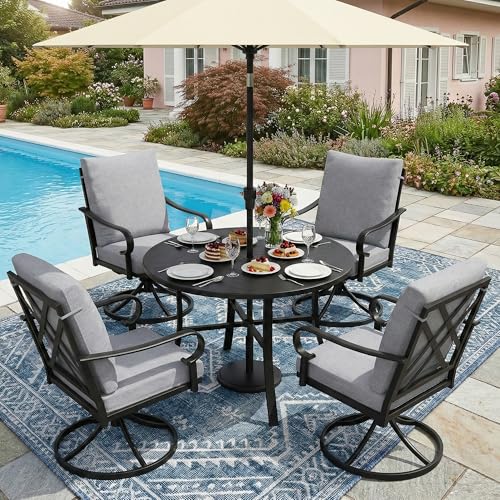
Round Outdoor Dining Table with Swivel Chairs: The Complete Guide
Everything you need to know before choosing a round patio dining set with swivel chairs — sizing, materials, comfort, layout, and care.
START THE GUIDEWhy this guide exists: A round outdoor dining table paired with swivel chairs is one of the most sociable and space-efficient patio setups you can own. But the wrong table diameter, chair clearance, or material can turn a great idea into a cramped, wobbly, or short-lived investment. This guide walks you through every decision point so you can buy with confidence.
If you are researching round outdoor dining table with swivel chairs sets, you have probably already noticed how many variations exist: glass tops and aluminum tops, four-chair and six-chair configurations, cast aluminum and resin wicker frames, and swivel chairs that rock, glide, or simply rotate. The goal of this page is not to push a single model, but to explain the trade-offs clearly so that the set you choose fits your space, your climate, and the way you actually entertain.
Round dining tables are a classic choice for patios because they remove the awkward corner seat and let every guest face the center. Adding swivel chairs amplifies that advantage: diners can turn toward the conversation, step out without dragging the chair across the deck, and pivot to enjoy a view or reach a side table. The combination is especially strong for smaller patios, balconies, and breakfast nooks where a rectangular set would feel heavy.
Why a Round Table with Swivel Chairs Works So Well
Round tables and swivel chairs solve two different problems, and together they create a dining area that feels more flexible than the sum of its parts.
The round table advantage
- No dead corners: Every seat has a direct line to the center, so passing dishes and conversation both feel natural.
- Compact footprint: A round table can often fit in a footprint where a rectangular table of similar seating capacity would not, which matters on a small patio or a narrow deck.
- Smoother circulation: With no sharp corners, guests move around the table more easily — useful when the patio also serves as a walkway to the garden.
- Visually softer: Curves balance the hard lines of house walls, fences, and deck boards.
The swivel chair advantage
- Easier entry and exit: You rotate out instead of pushing the chair backward, which is a real benefit on a tight patio.
- Better conversation: Guests can turn toward the speaker or the fire pit without repositioning furniture.
- Improved access: On a round table, a slight rotation lets you reach the lazy Susan or a shared platter more easily.
- More relaxed feel: The gentle motion of a swivel mechanism makes long dinners feel less formal.
If you want to explore the full category before narrowing down, see the broader collection of round outdoor dining sets with swivel chairs and the dedicated six-seat round outdoor dining table with swivel chairs options for larger families.
Sizing: Matching the Table to Your Space and Your Guests
Sizing is the single most common mistake in patio dining purchases. A table that looks generous in a showroom can feel cramped on a real patio once chairs swivel and guests pull them out.
Table diameter and seating capacity
- 36–42 inch diameter: Best for two to four people. Ideal for a balcony or a small breakfast patio.
- 48 inch diameter: Comfortably seats four, and can seat five with a slightly tighter arrangement.
- 54 inch diameter: The sweet spot for six diners without feeling crowded.
- 60 inch diameter and above: Seats six generously or eight in a pinch; requires a large patio or deck.
A useful rule of thumb is to allow roughly 24 inches of table edge per diner. For swivel chairs, add a little more breathing room because the chair body rotates.
Clearance behind swivel chairs
Plan for at least 36 inches of clear space between the table edge and the nearest wall, railing, or planter. Swivel chairs do not need to be pushed back as far as fixed chairs, but the rotation arc and the ability to stand up comfortably still require room. On a tight patio, a 42-inch table with four swivel chairs can work in a footprint that would feel cramped with a rectangular set of similar capacity.
For a deeper look at seat counts and dimensions, the guide to a round outdoor dining table and chairs for six covers layout diagrams and clearance measurements in more detail.
Materials: What Holds Up Outdoors
The table top and the chair frame can be made from very different materials, and each has a distinct personality in terms of maintenance, weight, and appearance.
Table top options
- Powder-coated aluminum: Rust-proof finish, lightweight, and easy to move. A strong all-round choice for humid or coastal climates.
- Glass tops: Bright and easy to wipe down, but heavier and more prone to chipping at the edges. Tempered glass is essential. If you are replacing a top, see the options for a round glass patio table with umbrella hole or a tempered glass replacement for a patio table.
- Cast aluminum: Heavier and more ornate, often with decorative patterns. Excellent stability in windy conditions.
- Teak and dense hardwoods: A natural, warm look that ages gracefully. Requires periodic sealing or oiling depending on climate.
- Resin wicker over aluminum: A woven aesthetic with a weather-resistant core. Good for a relaxed, coastal, or bohemian patio.
- Concrete or composite stone: Very stable and contemporary, but heavy and best treated as a semi-permanent installation.
Swivel chair frame options
- Powder-coated aluminum: The most common outdoor swivel chair frame. Light, rust-resistant, and easy to reposition.
- Steel with a rust-proof finish: Heavier and very stable, but the finish quality matters a great deal in wet climates.
- Resin wicker over aluminum: Adds texture and hides minor scuffs; pair with quick-dry cushions.
- Teak or hardwood: A classic look for a natural patio; swivel mechanisms are usually housed in a metal base.
Whatever the frame, look for sealed or stainless swivel bearings. A gritty or squeaky swivel is the most common failure point on outdoor swivel chairs, and it is usually caused by dust and water reaching an unprotected bearing.
Understanding Quality Tiers
Rather than focusing on numerical figures, it helps to think about where a set sits in the market. The descriptors below are used consistently throughout this guide.
Essential Tier
Basic powder-coated frames and simpler swivel mechanisms. A solid choice for a first patio set, a seasonal cabin, or a covered balcony where the furniture is not exposed to constant weather.
Balanced Tier
Better welds, smoother swivel bearings, thicker cushions, and more consistent finishes. Typically the best value for a primary patio that is used regularly.
High-End Tier
Heavy-duty aluminum or hardwood, sealed stainless swivel hardware, and high-grade outdoor fabrics. Built for daily use and long-term exposure.
Flagship Tier
Cast aluminum or premium hardwood, commercial-grade swivel mechanisms, and designer cushion systems. A long-term investment for a signature outdoor room.
A mid-range set usually offers a noticeably smoother swivel action and a more durable finish than an entry-level set, while a premium set focuses on longevity and consistency of materials. The right tier depends on how often the set will be used and how exposed it will be to sun, rain, and salt air.
Quick Comparison by Use Case
| Use Case | Recommended Tier | Best For | Key Consideration |
|---|---|---|---|
| Small balcony or breakfast nook | Entry-level / Essential tier | Two to four diners | Compact 36–42 inch diameter with lightweight swivel chairs |
| Family patio used daily | Mid-range / Balanced tier | Four to six diners | Smooth swivel bearings and quick-dry cushions |
| Coastal or humid climate | Premium / High-end tier | Four to six diners | Powder-coated aluminum or sealed hardwood; stainless swivel hardware |
| Entertaining-focused outdoor room | Luxury / Flagship tier | Six to eight diners | 54–60 inch diameter, cast aluminum or premium hardwood, designer cushions |
Key Buying Factors to Check Before You Commit
1. Umbrella hole or no umbrella hole
A center umbrella hole is a practical addition for sunny patios, but it changes the table top and the base requirements. If shade is a priority, look for a set with a pre-drilled hole and confirm the umbrella base is rated for the canopy size. The guide to a round outdoor dining table with umbrella hole explains the sizing relationship between table, hole, and base.
2. Swivel mechanism quality
Test the swivel action if possible. A good mechanism rotates smoothly with a slight resistance and returns to center without wobble. Check whether the bearing is sealed, and whether the chair has a locking or tension adjustment. A wobbly swivel is difficult and sometimes impossible to repair.
3. Cushion fabric and drainage
Outdoor dining chair cushions should use solution-dyed acrylic or comparable outdoor fabric, with quick-dry foam and drainage channels. Removable, washable covers extend the life of the set considerably. If you are refreshing an existing set, replacement outdoor dining chair cushions are widely available in standard round-chair sizes.
4. Table stability and wind
Round tables catch wind differently from rectangular ones. On an exposed deck, a heavier top or a weighted base is worth considering. Cast aluminum and concrete tops resist tipping better than thin glass tops. If the table has a pedestal base, check that the foot is wide enough for the table diameter.
5. Assembly and delivery
Most round dining sets ship flat-packed. Check the number of boxes, the tools required, and whether the swivel chairs arrive pre-assembled. Sets with pre-assembled chairs reduce setup time but usually ship in larger cartons.
6. Lazy Susan and accessories
On a round table, a lazy Susan is a genuinely useful accessory because it lets everyone reach shared dishes without passing plates. If you plan to use one, confirm the table top is flat and level, and choose a lazy Susan with a non-slip base. The guide to a round outdoor dining table with lazy Susan covers sizing and compatibility.
Layout Ideas for a Round Dining Set
Placement matters as much as the set itself. A few layouts that work well:
- Centered on a patio: A round table in the middle of a square or circular patio creates a natural focal point. Leave at least 36 inches of clearance on all sides for swivel chairs.
- Tucked into a corner: On a smaller patio, a round table can sit closer to a corner than a rectangular one because there are no sharp edges to navigate. Keep the open sides facing the main circulation path.
- Paired with a lounge zone: A round dining set transitions well into a lounge area. Use an outdoor rug to define the dining zone and a separate rug or hard surface for lounging.
- Under a pergola or umbrella: A round table fits neatly under a square pergola or a market umbrella. Center the table on the umbrella pole for a balanced look.
- On a deck with a view: Angle the set slightly toward the view rather than squaring it to the house. Swivel chairs make this orientation practical because guests can turn easily.
If the dining area is part of a larger outdoor room, consider how it connects to adjacent zones. The round outdoor coffee table with fire pit and the round outdoor coffee table with umbrella hole are useful references for coordinating a lounge zone with the dining set.
Care and Maintenance for a Round Dining Set
A round outdoor dining table with swivel chairs is an investment that rewards a small amount of routine care.
- Clean weekly: Wipe the table top with a mild soap solution and rinse. Avoid abrasive pads on powder-coated and glass surfaces.
- Flush the swivel: Rinse the swivel base periodically to remove grit, then dry and apply a silicone lubricant to the bearing if recommended by the manufacturer.
- Store cushions: Bring cushions inside or into a storage box during heavy rain and off-season. Quick-dry foam still benefits from being kept dry.
- Cover the set: A breathable cover protects the table and chairs during long periods of disuse. Avoid non-breathable plastic, which traps moisture.
- Check fasteners: Tighten bolts at the start of each season. Swivel chairs experience more vibration than fixed chairs, so fasteners can loosen over time.
- Protect glass tops: Use coasters and avoid placing hot dishes directly on glass. Tempered glass is strong but can crack from thermal shock.
If you are replacing worn parts rather than the whole set, the guides to replacement outdoor dining chair cushions and replacement glass table tops for patio furniture are useful starting points. For a broader refresh, see the resin wicker patio furniture overview.
Common Mistakes to Avoid
- Buying the table before measuring the patio: Measure the available footprint, then subtract 36 inches on every side before choosing a diameter.
- Ignoring the swivel clearance: Swivel chairs need room to rotate and for guests to stand up. A table that fits but leaves no rotation space will feel cramped.
- Choosing glass without tempered confirmation: Always confirm that a glass top is tempered. Non-tempered glass is not appropriate for outdoor dining.
- Overlooking the umbrella base: An umbrella hole is only useful if the base is rated for the canopy. A lightweight base can tip in wind.
- Skipping the cushion cover check: Cushions that cannot be removed and washed will age faster than the frame.
- Ignoring wind exposure: On an exposed deck, choose a heavier top or a weighted pedestal base.
Ready to Explore Round Dining Sets?
Browse the recommended options below, compare features, and check availability for the set that matches your patio size and style.
VIEW RECOMMENDED SETSFrequently Asked Questions
How many people fit at a round outdoor dining table with swivel chairs?
A 42-inch round table comfortably seats four, a 48-inch table seats four to five, and a 54-inch table seats six. Swivel chairs need slightly more clearance behind them, so plan for at least 36 inches of open space on all sides.
Are swivel chairs suitable for outdoor dining tables?
Yes. Outdoor swivel chairs are built with weather-resistant frames and sealed bearings. They make it easier to get in and out of a round table and allow guests to turn toward conversation or the view without pushing the chair back.
What material is best for a round outdoor dining table?
Powder-coated aluminum is the most popular choice for its rust-proof finish and light weight. Teak and other dense hardwoods offer a natural look and long service life. Resin wicker over an aluminum frame combines durability with a woven aesthetic.
Do round outdoor dining tables need an umbrella hole?
An umbrella hole is optional but highly practical for sunny locations. A center hole lets you add a market umbrella for shade without a separate base taking up floor space. Pair it with a base rated for your umbrella size.