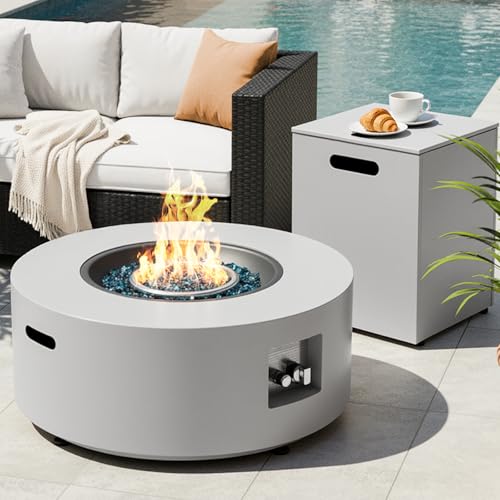
Gas Fire Pit with Propane Tank Inside: The Complete Guide
Everything you need to know about self-contained gas fire pits that conceal the propane tank within the unit — clean looks, easy setup, and warm evenings without the hassle of an exposed cylinder.
Why this guide matters: A gas fire pit with the propane tank inside combines the ambiance of a real flame with the convenience of push-button ignition. The hidden tank keeps the design streamlined, protects the cylinder from the elements, and removes the awkward exterior hose. This guide walks you through every decision — from tank capacity and material choice to safety clearances and placement — so you can choose with confidence.
What Is a Gas Fire Pit with a Propane Tank Inside?
A gas fire pit with a propane tank inside is a self-contained unit where the fuel cylinder is stored within a compartment built into the base or table body. Instead of an external tank connected by a visible hose, the cylinder sits behind a hinged door or lift-off panel. This design is common in gas fire pit tables and gas fire pit tables with hidden propane tanks, where the tank compartment doubles as structural ballast.
The key distinction from other fire pits is the concealed fuel source. A gas fire pit with a hidden propane tank looks like a clean piece of furniture from every angle — no cylinder, no regulator hose draped across the patio, and no trip hazard. The trade-off is that the tank compartment must be sized to the cylinder, and swapping tanks requires opening a panel rather than lifting a lid off an external tank.
Most units in this category use standard 20 lb propane cylinders, though some larger tables accommodate two tanks for extended burn time. Smaller models may take 1 lb disposable canisters, but those are the exception rather than the rule for this build style.
How the Internal Tank System Works
Understanding the mechanics helps you evaluate a unit before committing. The internal tank system consists of four main parts:
- Tank compartment: A vented enclosure at the base of the fire pit, usually accessed through a hinged door. Ventilation is critical — propane is heavier than air, and any leak must be able to escape the enclosure.
- Regulator and hose: A short, factory-fitted assembly connects the cylinder to the burner. Because the tank sits close to the burner, the hose run is minimal, which reduces leak points.
- Burner and ignition: Typically a stainless steel ring or linear burner with a push-button or electronic ignition. Mid-tier and premium models often add a flame-sensing safety shutoff.
- Control knob: Usually recessed into the tabletop or side panel. Some high-end tiers include a key valve and a separate igniter for finer flame control.
When the tank runs out, you open the compartment, disconnect the regulator, lift out the empty cylinder, and swap in a full one. The physical effort is modest, but the compartment opening — height, width, and door style — matters if you plan to swap tanks frequently.
Quick Tip: Check the Compartment Clearance
Before buying, confirm the internal height of the tank compartment. A standard 20 lb cylinder stands roughly 18 inches tall with the valve. If the door opening is smaller than the cylinder's diameter, you may need to tilt the tank during removal — awkward but workable. A front-loading door that opens fully is the most user-friendly design.
Types of Gas Fire Pits with Internal Propane Tanks
The category splits into several formats, each suited to a different patio layout and use case.
1. Fire Pit Tables
The most popular format. A table-height unit with a central burner and a tank compartment below. These double as a coffee table or a low dining surface when the flame is off. Many homeowners pair a fire pit table with a garden furniture conversation set to create a cohesive seating zone. The tabletop may be slatted, glass, or stone-look; each surface has different cleaning and heat characteristics.
2. Rectangular and Linear Fire Pits
Long, narrow units designed for modern patios. The internal tank usually sits at one end, with the burner running the length of the body. These work well as a divider between a seating area and a garden lounger zone, or along the edge of a deck. Because the tank is offset, check that the unit's weight distribution remains stable on your surface.
3. Round and Square Fire Pit Tables
Classic formats that suit symmetrical seating arrangements. A round fire pit table pairs naturally with four chairs or a curved sofa. The internal compartment is typically centered, which gives the unit a low center of gravity and good stability in windy conditions.
4. Convertible and Multi-Function Units
Some tables include a lid that converts the burner area into a flat surface, effectively turning the fire pit into a coffee table. These are ideal for small patios where every square foot must serve two purposes. The tank compartment remains accessible from the side.
Key Features to Evaluate Before You Choose
Once you have settled on the format, compare units on these attributes. They matter more than surface styling over the life of the product.
Burner Material and Output
Stainless steel burners resist corrosion and hold up to repeated heat cycles. Lower-tier units sometimes use painted steel, which can flake over time. Heat output is usually expressed in BTUs; for a typical patio table, a mid-range output is enough to take the chill off a seating area, while higher-output units suit larger, more open spaces. Match output to the size of the zone you want to warm — an oversized burner in a small enclosure feels intense and wastes fuel.
Ignition System
Push-button piezo ignition is the baseline. Electronic ignition with flame sensing is a step up: if the flame goes out, the gas supply shuts off automatically. This safety feature is worth prioritizing, especially in households with children or pets. Premium and luxury tiers often include a key valve plus electronic ignition for precise control.
Tank Compartment Design
Look for a hinged door with a magnetic or latch closure, a ventilated floor or side panels, and enough internal clearance to slide a 20 lb cylinder in and out without contortion. A compartment that opens from the front is generally easier to service than one that requires removing the tabletop.
Construction Material
Powder-coated steel and aluminum are common and hold up well with basic care. Cast aluminum and stone-look composite materials sit in the mid-tier and premium range and offer better weather resistance. If your patio is exposed year-round, prioritize units described as suitable for garden furniture that can be left outside all year — the same weatherproofing principles apply to fire pit bodies and burners.
Safety Certifications and Clearances
Check for recognized safety listings and follow the manufacturer's clearance requirements. Keep the unit away from overhead structures, combustible materials, and enclosed spaces. A gazebo or covered pergola can be a wonderful setting, but only if the fire pit is rated for use under a roof and the clearance to the ceiling meets the manual's specification.
Comparing Quality Tiers
Rather than shopping by price, compare units by their position in the market. The table below describes what each tier typically delivers so you can decide where your priorities lie.
| Tier | Typical Burner & Ignition | Construction | Best For |
|---|---|---|---|
| Entry-Level | Painted steel burner, piezo ignition | Powder-coated steel body, basic venting | Occasional use, covered patios, first fire pit |
| Mid-Range | Stainless burner, push-button ignition, manual flame control | Aluminum or composite body, hinged tank door, better venting | Regular evening use, exposed patios, family households |
| Premium | Stainless burner, electronic ignition with flame sensing | Cast aluminum or stone-look composite, weather-resistant finish, refined door hardware | Frequent use, design-focused patios, windy sites |
| Luxury | High-output stainless burner, key valve plus electronic ignition, dual-tank option | Heavy-gauge materials, precision fit, integrated cover or lid | Large seating zones, entertaining-focused patios, long-term investment |
Across tiers, the biggest practical differences are ignition reliability, burner corrosion resistance, and how easily the tank compartment opens. A well-specified mid-range unit often delivers the smoothest ownership experience for a typical household.
Placement and Patio Layout
Where you place the fire pit determines how much you enjoy it. Treat the unit as the anchor of a seating zone, then arrange furniture around it.
- Conversation circle: A round or square fire pit table centered in a seating group. Allow enough room between the table edge and chairs for legs and for guests to move without brushing the hot surface.
- Linear divider: A rectangular unit placed between a dining area and a garden lounger or garden seat zone, creating a visual boundary without blocking sightlines.
- Corner anchor: A compact square unit in a corner of a small patio, paired with two chairs. This layout works well on balconies and compact decks.
- Dining adjacency: Place a fire pit table near, but not directly against, a garden table and chairs for a small garden so the flame area remains a distinct zone.
Keep the tank compartment door accessible. If the fire pit is pushed against a wall or railing, you will struggle to swap tanks. Leave clearance on the door side — typically the front or one end of the unit.
Wind and Stability
Internal-tank fire pits are heavier at the base than external-tank models, which improves stability. On exposed decks and windy sites, a heavier unit is an advantage. If your patio catches strong gusts, prioritize a unit with a wide base and a recessed burner — and avoid lightweight entry-level bodies that can shift in high wind.
Safety Essentials for Internal Tank Fire Pits
Propane is safe when handled correctly, and internal-tank designs are engineered around the fuel source. Follow these practices:
- Ventilation is non-negotiable. Never block the compartment vents. If a unit's vents are covered by furniture or debris, gas could accumulate. Keep the area around the base clear.
- Check the hose and regulator. Inspect the connection each time you swap a tank. A soapy-water test on the connection is a quick way to spot a leak — bubbles indicate escaping gas.
- Respect clearances. Keep the unit away from combustible materials, low branches, and fabric. Follow the manual's distance requirements for overhead structures and side clearance.
- Never use indoors or in enclosed spaces. This includes garages, screened porches without proper ventilation, and tents. Carbon monoxide is a serious risk.
- Store spare cylinders correctly. Keep spare tanks upright, outdoors, away from heat sources, and out of direct sun. Do not store them inside the fire pit compartment when not in use if the manual advises against it.
- Turn off the gas at the cylinder when the fire pit is not in use, not just at the control knob.
If your patio includes a covered structure such as a gazebo, confirm the fire pit is rated for that use and that the ceiling height meets the clearance requirement. When in doubt, position the unit in the open.
Maintenance and Seasonal Care
An internal-tank fire pit is a long-term investment, and basic care keeps it working smoothly across seasons.
- Cover it when not in use. A fitted cover keeps debris out of the burner and protects the finish. Fabric covers designed for the unit's dimensions fit best.
- Clean the burner ports. Dust and spider webs can block burner holes. A soft brush and a visual check before each season are usually enough.
- Inspect the compartment. Look for rust, debris, or pest nests inside the tank enclosure. Clear the vents and check that the door latch still closes firmly.
- Protect the finish. Wipe the body with a damp cloth and mild soap. Avoid abrasive cleaners on painted or powder-coated surfaces.
- Winter storage. If you live in a region with hard freezes, disconnect the tank and store the cylinder per local guidance. Many units can remain outdoors under a cover, but check the manual for temperature limits.
The same care principles that apply to garden furniture — cleaning, covering, and seasonal inspection — extend the life of a fire pit table. If you want a broader routine, review our guidance on garden furniture you can leave out all year.
Matching the Fire Pit to Your Existing Patio
A fire pit should feel like part of the patio, not an afterthought. Consider these pairings:
- With a conversation set: A round fire pit table centered in a garden furniture conversation set creates a natural focal point.
- With loungers: Place a rectangular fire pit at the foot of a pair of garden loungers for a resort-style setup.
- With a dining zone: A fire pit table near a garden table extends the evening and gives guests a place to gather after the meal.
- With a bench: A linear fire pit in front of a garden bench creates a compact, cozy corner.
- With planters and greenery: Framing the fire pit with gardening planter boxes softens the hard edges and ties the unit into the garden.
Frequently Asked Questions
How long does a propane tank last in an internal-tank fire pit?
Burn time depends on the burner's output and the flame setting. A standard 20 lb cylinder typically provides many hours of use at a moderate flame, but the exact duration varies by unit. As a rule of thumb, higher-output burners consume fuel faster; a lower flame setting extends burn time considerably. Keep a spare cylinder on hand if you entertain often.
Can I use a larger tank than the one the fire pit came with?
Only if the compartment physically accommodates it and the regulator is compatible. Most internal-tank units are designed around a 20 lb cylinder. Larger tanks usually require an external connection and may not fit the enclosure. Never force a tank into a compartment that doesn't close properly — ventilation and clearance are safety requirements.
Are internal-tank fire pits safe on a wooden deck?
Yes, provided the unit is rated for deck use and you follow clearance requirements. The tank is contained within the unit, and heat is directed upward. Use a heat-resistant mat or the manufacturer's recommended base if the deck surface is sensitive, and keep the unit away from railings and combustible materials.
How often should I check the hose and regulator?
Inspect the hose and regulator each time you replace the tank, and do a soapy-water leak test on the connection. Replace the hose if it shows cracks, stiffness, or fraying. Regulators typically last several seasons but should be replaced if flame behavior becomes erratic.
Can the fire pit be left outside in winter?
Many units can remain outdoors under a fitted cover, but check the manual for temperature limits and storage guidance. Disconnect and store the propane cylinder according to local regulations, and bring the unit inside if the manufacturer specifies indoor storage during freezing conditions.
What is the advantage of a hidden tank over an external tank?
A hidden tank keeps the design clean, eliminates the trip hazard of an external hose, and protects the cylinder from weather and tampering. The trade-off is that the unit is heavier and tank swaps require opening the compartment. For most patios, the visual and safety benefits outweigh the extra weight.
Ready to Compare Models?
Explore our curated selection of gas fire pits with internal propane tanks and find the format that fits your patio.
View Recommended Products