
Outdoor Fire Pit: The Complete Buying Guide
Everything you need to choose, place, and enjoy a fire pit that fits your backyard, your lifestyle, and your safety requirements.
An outdoor fire pit transforms a plain patio into a destination. It extends the usable hours of your backyard well into the evening, creates a natural gathering point, and adds a layer of warmth and ambiance that few other outdoor features can match. But behind the appeal lies a series of practical decisions: which fuel type suits your space, which material will survive your climate, and where the unit can legally and safely be placed. This guide walks you through each of those decisions so that you can buy with confidence rather than guesswork.
Whether you are building a new seating area from scratch or simply adding a focal point to an existing patio, the information below is organized around the questions buyers actually ask before they commit. If you are still shaping the overall layout of your outdoor space, our broader outdoor living guide is a useful companion, and homeowners planning a full seating arrangement may also want to explore conversation sets with swivel chairs that pair naturally with a central fire feature.
Quick summary: Choose fuel first (wood for ambiance, gas for convenience), then match the material to your climate, then confirm placement against local clearance rules. Tier selection — entry-level, mid-range, or premium — should follow those three decisions, not lead them.
Why an Outdoor Fire Pit Belongs in Your Backyard
A fire pit is one of the few outdoor purchases that changes how a space is used rather than merely how it looks. The practical benefits are well documented by long-time owners:
- Season extension: A fire pit makes cool evenings and shoulder-season nights comfortable, effectively lengthening the usable outdoor season in most climates.
- Natural gathering point: Circular seating around a fire encourages conversation in a way that rows of chairs rarely do.
- Ambiance and lighting: Open flame provides warm, low-level lighting that complements string lights and lanterns.
- Defined outdoor room: A fire pit anchors a seating zone and gives an open patio a clear center of gravity.
- Long-term investment: A well-chosen unit in a durable material can serve for many seasons with basic care.
The key word is "well-chosen." A fire pit that is undersized for the seating area, made from a material unsuited to the local climate, or placed without regard to clearance rules will quickly become a source of frustration. The sections below address each of those risks in turn.
Fuel Types: Wood, Propane, and Natural Gas Compared
The single most consequential decision is fuel type, because it determines ignition, heat output, maintenance, and even where the unit can be placed. There is no universally best option — only the best fit for your priorities.
Wood-Burning Fire Pits
Wood-burning units deliver the authentic experience many buyers are chasing: crackling logs, visible embers, and radiant heat that reaches further than most gas designs. They are typically the simplest mechanically, with no hoses, regulators, or ignition systems to fail. The trade-offs are real, however. Wood requires a steady supply of seasoned fuel, produces ash that must be emptied, generates smoke that can bother neighbors or aggravate respiratory conditions, and demands more careful attention during use.
Wood pits suit homeowners with access to firewood, generous outdoor space, and a tolerance for hands-on operation. They are less suitable for covered patios, tight urban lots, or households where smoke sensitivity is a concern.
Propane Fire Pits
Propane units ignite instantly, produce consistent flames with no smoke or ash, and can be moved more easily because they do not require a fixed fuel line. Most models use a standard refillable tank that is either hidden inside the base or connected externally. Heat output is steady and adjustable, and cleanup is essentially limited to wiping down the surface. The main considerations are tank management — you will need a spare or a reliable refill routine — and the fact that some designs produce less radiant heat than a wood fire of similar footprint.
For patios, decks, and courtyards where convenience and smoke-free operation matter, propane is often the practical choice. Buyers comparing fire features more broadly may find our guide to the propane fire table useful, since fire tables and fire pits share much of the same fuel infrastructure and placement logic.
Natural Gas Fire Pits
Natural gas offers the same convenience as propane without the tank swaps, but it requires a permanent gas line connection installed by a licensed professional. That upfront complexity is offset by unlimited run time and a cleaner look with no visible cylinder. Natural gas units are best suited to permanent installations where the fire pit will remain in place for many years, often integrated into a built-in seating wall or an outdoor fire table arrangement.
| Fuel Type | Best For | Ignition & Control | Maintenance Level | Placement Flexibility |
|---|---|---|---|---|
| Wood | Authentic ambiance, rural or spacious yards, firewood access | Manual lighting; flame management required | Higher — ash cleanup, fuel storage | Moderate — smoke and embers limit covered areas |
| Propane | Patios, decks, urban lots, smoke-free zones | Instant push-button or match ignition | Low — surface wipe-down, tank refills | High — portable, no fixed line |
| Natural Gas | Permanent installations, built-in seating walls | Instant ignition with adjustable flame | Lowest — no fuel storage | Low — requires professional gas line |
As a general rule, entry-level fire pits are most often wood-burning or basic propane models, mid-range units add better burners and sturdier housings, and the premium tier is where you find natural gas integration, refined finishes, and heavier-gauge construction. Moving up a tier typically buys smoother ignition, more consistent heat, and longer service life rather than a fundamentally different experience.
Materials: What Will Survive Your Climate
Fire pit materials determine how the unit ages, how it handles heat cycling, and how much attention it needs between seasons. The table below summarizes the most common options.
| Material | Durability | Weather Resistance | Care Notes |
|---|---|---|---|
| Cast iron | Very high — heavy-duty and long-lived | Good with coating; prone to rust if neglected | Seasonal high-temperature coating; keep covered |
| Powder-coated steel | High — solid build for most climates | Good; chips should be touched up promptly | Wipe down, inspect coating annually |
| Stainless steel | High — rust-proof finish in most conditions | Excellent, including coastal areas | Minimal; occasional cleaning of surface residue |
| Aluminum | Moderate to high — lightweight, no rust | Excellent; will not corrode like iron | Low; check fasteners and hinges over time |
| Concrete / stone composite | High — substantial and stable | Good; seal to resist staining | Reseal periodically; avoid sudden thermal shock |
| Ceramic / clay | Moderate — can crack with rapid temperature change | Moderate; protect from freeze-thaw cycles | Bring indoors or cover in winter |
Coastal homeowners should lean toward stainless steel or aluminum, since salt air accelerates corrosion on iron and lower-grade steel. In cold climates, avoid clay and thin ceramic bowls that may crack during freeze-thaw cycles, and prioritize units with a drain hole to prevent water pooling. For everyone else, powder-coated steel offers a strong balance of durability and finish options, while cast iron remains the choice for buyers who want the heaviest, most permanent feel.
Sizing the Fire Pit to the Space
Fire pit size should be matched to both the seating arrangement and the physical limits of the patio. A common mistake is buying a unit that is too small for the circle of chairs around it, which leaves guests at the outer edge cold, or one so large that it crowds the walking path.
- Two to four seats: A compact bowl or a low fire table in the 24–30 inch range is usually sufficient and works well on balconies and small patios.
- Four to six seats: A 30–36 inch bowl, or a rectangular fire table roughly four to five feet long, provides comfortable heat reach for a standard conversation circle.
- Six or more seats: A 36–48 inch bowl or a large rectangular fire table suits a full outdoor living arrangement and can anchor a substantial seating zone.
Allow at least 3 feet of clear space around the unit for safety and circulation, and remember that the seating circle needs room to expand — plan for the full furniture footprint, not just the fire pit itself. On a compact minimalist deck, a single low-profile fire table often works better than a wide bowl because it doubles as a surface when the flame is off.
Placement and Safety: The Non-Negotiables
Placement rules are where enthusiasm most often outruns caution. Fire pits are subject to local codes, and the manufacturer's clearance specifications should be treated as minimums, not suggestions.
Core safety checklist
- Keep at least 10 feet between the fire pit and structures, fences, and overhanging branches; check local codes for stricter requirements.
- Maintain a 3-foot clear zone around the unit, free of furniture, décor, and combustible materials.
- Place the pit on a level, non-combustible surface such as stone, concrete, or a dedicated fire-resistant mat.
- Never use a wood-burning pit beneath a covered roof, pergola, or low awning.
- Keep a fire extinguisher or a bucket of sand nearby, and supervise children and pets at all times.
- Check wind direction before lighting so that smoke and embers do not drift toward seating or the house.
Deck installations deserve particular care. Propane and natural gas units can often be used on wooden decks when the manufacturer approves it, provided the unit is elevated and a heat-resistant barrier sits beneath it. Wood-burning pits on decks are riskier and are prohibited in many jurisdictions — confirm before you buy. If your outdoor space is a covered porch or a sheltered courtyard, a gas unit is almost always the safer and more practical selection.
Buyers planning a larger hardscape project should also account for drainage and prevailing wind during the design phase rather than after installation. Pairing the fire pit with a shade structure such as a gazebo or a cantilever umbrella with tilt and rotation requires extra planning, because the structure may restrict where an open flame can safely sit.
Design Integration: Making the Fire Pit Feel Intentional
A fire pit looks best when it reads as part of the room rather than an object dropped into it. A few principles do most of the work:
Create a defined seating circle
Arrange chairs and sofas to face the fire, with a consistent distance from the rim. Uniform spacing is what makes the arrangement feel designed. If you are choosing seating specifically for the fire area, deep-cushion pieces and swivel chairs work particularly well because they let guests turn toward the flame without repositioning furniture.
Layer the lighting
The fire itself should be the warmest light source in the scene. Keep string lights and lanterns dimmer and lower than you might for a non-fire layout, and avoid bright white fixtures that compete with the flame. This layered approach is the same principle used in our outdoor lighting guide.
Ground the area with a rug and side surfaces
An outdoor rug defines the seating zone and softens hardscape. A large outdoor rug sized to the full furniture footprint works better than a small mat that only covers the center. Side tables or a low outdoor coffee table give guests somewhere to set a drink, which reduces clutter around the pit.
Choose a cohesive material palette
Match the fire pit finish to the dominant metal or wood tone in your existing furniture. Mixing too many finishes in a small space fragments the look; sticking to two complementary tones keeps the scene calm. For a full discussion of palette options, see our guide to earthy tone palettes.
Think about off-season use
A fire pit should look finished even when it is not lit. Choose a unit whose surface and shape you are happy to see as a piece of furniture, and keep a fire pit cover on hand to protect it between uses.
Understanding Product Tiers
Rather than shopping by number, it helps to understand what each tier of the market generally delivers. The classification below is consistent throughout this guide and applies to both fire pits and fire tables.
| Tier | What It Typically Includes | Best For |
|---|---|---|
| Entry-level | Basic bowl or simple table design, lighter-gauge metal, manual or match ignition | Occasional use, first fire pit, small patios |
| Mid-range | Sturdy powder-coated or stainless housing, smoother ignition, better burner design | Regular use, standard family patios, most climates |
| Premium | Heavier-gauge construction, refined finishes, consistent flame control, integrated storage | Frequent entertaining, design-forward spaces, long-term ownership |
| Luxury / commercial-grade | Natural gas integration, architectural housings, professional installation support | Built-in installations, hospitality settings, permanent outdoor rooms |
Moving up a tier generally buys smoother operation and longer service life rather than a dramatically different experience. A mid-range unit is usually the sweet spot for homeowners who plan to use the fire pit regularly, while entry-level models remain a sensible first purchase for occasional use. Buyers furnishing a complete seating area around the fire may want to compare outdoor furniture conversation sets alongside the fire feature itself so that the two purchases are coordinated rather than sequential.
Recommended Outdoor Fire Pits & Fire Tables
⚠️ AFFILIATE DISCLOSURE: This website contains affiliate links. As an Amazon Associate, we earn from qualifying purchases. If you make a purchase through these links, we may receive a small commission at no additional cost to you. Read our full affiliate policy.

OutVue 42 Inch Fire Pit with 2 Grills, Lid, Poker | Large Wood Burning Fire Pits for Outside,Heavy Duty Fire Pit, BBQ& Outdoor Firepit & Round Metal Table 3 in 1 for Patio
Check price on Amazon
Gas One 22 in Outdoor– Wood Burning Fire Pit with Mesh Lid and Fire Picker – Durable Alloy Steel Fire Pits for Outside – Small Fire Pit for Backyard, Porch, Deck, Camping, BBQ
Check price on Amazon
Panovue 39 Inch Fire Pits with Outdoor Chimney and Wood Storage | Large Outdoor Fireplace, Mesh Spark Screen, Fire Poker Included, Built-In Log Storage, For Backyard Patio Camping
Check price on Amazon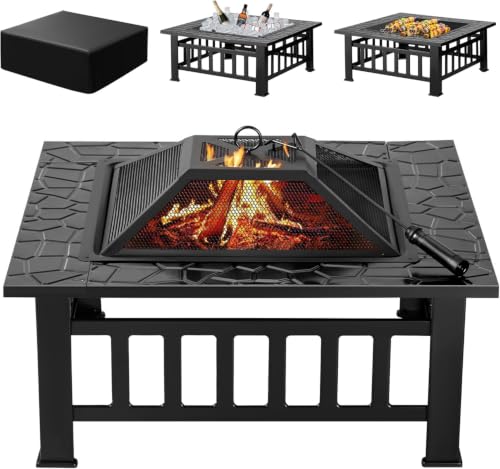
Devoko Outdoor Fire Pit, 32 Inch Firepit Table Metal Outdoor Fireplaces | with Waterproof Cover for Outside Patio Camping (Black)
Check price on Amazon
Panovue 22 Inch Fire Pit with Spark Screen, Firewood Grate and Poker | Wood Burning Fire Pit Design, Heavy-Duty Steel,Outdoor Fireplace, For Backyard Patio Camping and Gatherings
Check price on Amazon
OutVue 36 Inch Fire Pit with 2 Grills,Wood Burning Fire Pits for Outside | Fire Pit with Lid, Poker & Round Waterproof Cover, BBQ& Outdoor Firepit & Round Metal Table 3 in 1 for Patio, Picnic, Party
Check price on Amazon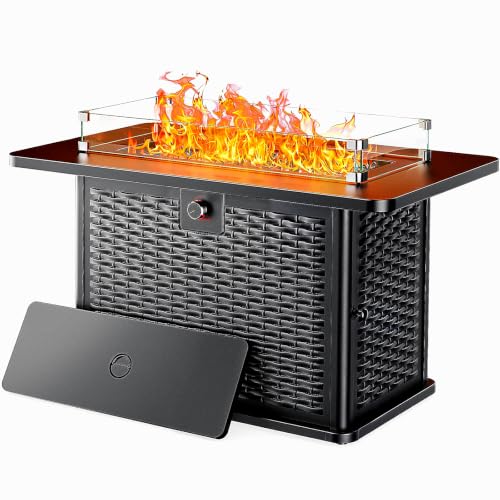
Ciays 43-Inch Rectangular Propane Fire Pit with 60,000 BTU Output, Fire Pit Table Premium Gas for Outside Patio with 304 Stainless Steel H-Burner, Glass Stones, and Wind Guard,Black
Check price on Amazon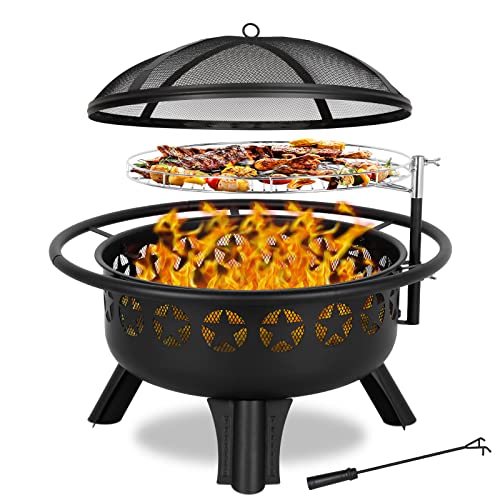
Hykolity 2 in 1 Fire Pit with Grill, Large 31" Wood Burning Fire Pit with Swivel Cooking Grate Outdoor Firepit for Backyard Bonfire Patio Outside Picnic BBQ, with Spark Cover, Fire Poker
Check price on AmazonFinal Buying Checklist
Before you commit, run through the following list. Each item corresponds to a decision covered above, and each one has a real effect on satisfaction after installation.
- Fuel: Confirm whether wood, propane, or natural gas best fits your patio, your smoke tolerance, and your willingness to manage fuel.
- Material: Match the unit to your climate — stainless or aluminum for coastal and humid areas, coated steel or cast iron for general use, and avoid freeze-prone ceramics in cold regions.
- Size: Size the pit to the seating circle, then confirm it still leaves 3 feet of clear space and a workable walking path.
- Placement: Verify local clearance rules and confirm the surface beneath the unit is non-combustible or properly protected.
- Tier: Choose entry-level for occasional use, mid-range for regular use, and premium for frequent entertaining or design-led spaces.
- Accessories: Plan for a cover, a heat-resistant mat where needed, and a nearby fire extinguisher or sand bucket.
- Integration: Check that the finish coordinates with your existing furniture and that the surrounding seating arrangement will actually face the fire.
If you are furnishing the surrounding area at the same time, our guides to lounge chairs and outdoor patio seating sets cover the seating side of the equation, while the patio essentials checklist helps you avoid overlooking smaller items that complete the space.
Frequently Asked Questions
What is the best fuel type for an outdoor fire pit?
The best fuel type depends on your priorities. Wood-burning fire pits deliver authentic crackling ambiance and high heat but require more maintenance and cleanup. Propane and natural gas fire pits offer instant ignition, consistent flames, and low maintenance, making them ideal for patios where smoke control matters. Choose wood for traditional atmosphere and gas for convenience.
How far should a fire pit be from the house?
Most safety guidelines recommend placing a fire pit at least 10 feet away from structures, fences, and overhanging branches. Some local codes require greater distances. Always check your local regulations and keep a clear zone of at least 3 feet around the fire pit free of combustible materials.
Are propane fire pits safe on a wooden deck?
Propane fire pits can be used on wooden decks when properly elevated and when the manufacturer approves deck use. Use a heat-resistant barrier beneath the unit, keep the tank upright and away from heat, and never place a fire pit directly on deck boards without a protective mat or stand. Always follow the manufacturer's clearance specifications.
How do I maintain a wood-burning fire pit?
Empty ashes after each use once fully cooled, cover the pit when not in use to prevent moisture buildup, and inspect the bowl for rust or cracks seasonally. For steel and cast iron pits, apply a high-temperature protective coating as needed. Keep the burner area clear and store the pit in a sheltered location during harsh weather.
Ready to bring warmth and ambiance to your backyard? Explore our recommended outdoor fire pits and fire tables above.
Explore Options