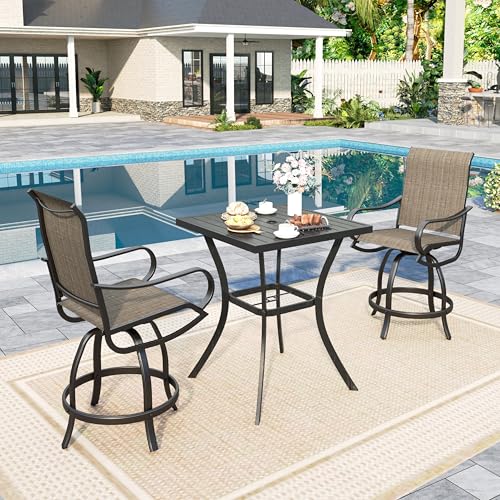
Why this guide matters: A high-top set with an umbrella combines three purchasing decisions in one — table height, chair style, and shade. Getting the combination right affects comfort, wind stability, and how much usable outdoor space you actually gain. This guide walks you through each decision in order so nothing gets missed before you commit.
What an Outdoor High Top Table and Chairs with Umbrella Actually Solves
Standard dining tables sit around 28 to 30 inches high, while bar-height tables sit between 40 and 42 inches. That extra height changes the entire dynamic of a patio. Guests stand and converse more naturally, sightlines clear over railings and planters, and the table footprint stays compact because the chairs tuck under the overhang rather than spreading outward.
Adding an umbrella to this setup addresses the single biggest reason people avoid their patio during peak hours: direct sun. Unlike a freestanding cantilever umbrella, an umbrella routed through the table's center hole is anchored by the table's own mass, which keeps the canopy stable in breezy conditions without a heavy separate base occupying floor space.
If you are still weighing whether a bar-height configuration is the right direction at all, the broader outdoor high top table and chairs overview covers the full range of styles before you narrow down to umbrella-ready models.
Table Height and Chair Pairing: The Numbers That Matter
Mismatched table and chair heights are the most common source of buyer regret in this category. The rule of thumb is straightforward: bar-height tables between 40 and 42 inches pair with chairs whose seat height lands between 28 and 30 inches. Counter-height tables between 34 and 36 inches pair with seats around 24 to 26 inches.
Seat-to-table clearance should fall between 10 and 12 inches. Less than that and your legs feel cramped; more than that and guests end up leaning forward to reach their plates. When shopping online, confirm both the table height and the chair seat height in the specification sheet rather than assuming they match — bundled sets occasionally mix counter-height tables with bar-height stools.
- Bar height: 40–42 inch table, 28–30 inch seat
- Counter height: 34–36 inch table, 24–26 inch seat
- Ideal clearance: 10–12 inches from seat top to table underside
- Footrest height: roughly 8–12 inches above the floor for comfortable posture
For a detailed breakdown of two-seat versus four-seat configurations, see the outdoor high top table and chairs with umbrella reference page, which compares standard bundle layouts.
Materials Compared by Tier
Rather than tracking shifting market figures, this guide classifies materials by market position and expected service life. The descriptors below are used consistently throughout the rest of the article.
| Tier | Typical Materials | Best For |
|---|---|---|
| Entry-level | Powder-coated steel frame, resin or plastic tabletop, polyester umbrella canopy | Renters, balconies, seasonal setups that move indoors |
| Mid-range | Aluminum frame, slatted or faux-wood top, solution-dyed acrylic canopy | Year-round patios in mild to moderate climates |
| Premium | Heavy-gauge aluminum or cast metal, natural-look composite top, marine-grade acrylic canopy | Coastal exposure, high-wind areas, permanent installations |
| Luxury | Teak or weather-sealed hardwood, stainless hardware, double-vent canopy systems | Design-led spaces where the set becomes a focal feature |
Aluminum dominates the mid-range and premium tiers because it resists corrosion without the weight penalty of steel. Powder-coated steel at the entry-level is serviceable but demands more attention to scratches, since exposed metal becomes a rust point. Hardwood sets sit at the luxury end and require periodic oiling, but reward that care with decades of service.
The outdoor metal high top table and chairs guide goes deeper into frame construction and finish quality if metal is your preferred direction.
Umbrella Mechanics: What Separates a Stable Setup from a Wobbly One
The umbrella is where most high-top bundles either shine or fail. Three variables determine real-world performance.
Pole Diameter and Hole Fit
A 1.5-inch pole in a 2-inch hole leaves visible play that amplifies in wind. Look for sets specifying matched pole and hole dimensions, ideally with a reducer ring included.
Base Weight Distribution
The table itself provides ballast only if it has a solid top or an integrated weight collar. Slatted tops offer less anchoring mass, so pair those with a weighted plate base.
Canopy Ventilation
A single or double wind vent at the canopy crown lets gust pressure escape upward rather than tipping the whole assembly sideways. Ventless canopies catch air like a sail.
Tilt and Crank Mechanism
Crank-lift with push-button tilt lets you angle shade as the sun moves. Manual lift pin systems are durable but less convenient for frequent adjustment.
If your table already has a pre-drilled opening and you only need the canopy, the outdoor high top table with umbrella hole page covers compatible canopy sizing. Those who prefer shade that stands independently of the table might instead compare the outdoor high top bar tables and chairs format alongside a freestanding cantilever unit.
Space Planning: How Much Room a High-Top Set Needs
High-top sets are space-efficient, but they still need breathing room. Allow roughly 24 inches of clearance behind each chair so guests can pull out and sit down without scraping a wall or railing. A two-seat round high-top typically occupies a footprint around 30 inches across, expanding to roughly 60 inches when chairs are in use. A four-seat square configuration runs closer to 40 inches across with a seated footprint near 72 inches.
Balcony owners should measure railing height before committing. A 42-inch table paired with 30-inch chairs puts seated eye level well above most balcony railings — a genuine advantage for views, but it also means the umbrella canopy needs to clear the railing without overhanging into a neighbor's space or a walkway below.
For tight urban spaces, the outdoor patio furniture for apartment balcony guide includes dimensional planning notes that apply directly to high-top configurations.
Two-seat buyers often find that a dedicated bistro format fits better than a scaled-down dining set. The outdoor high top bistro table and chairs comparison covers compact round and square options, while the outdoor high top table and 2 chairs page focuses specifically on paired configurations.
Weather Resistance by Climate
Climate should drive material choice more than aesthetics. In coastal environments, salt air attacks steel quickly and even powder coating develops micro-fractures over time; aluminum or teak is the durable path. In desert climates, UV degradation is the primary threat — solution-dyed acrylic canopy fabric holds color dramatically better than printed polyester, and composite tabletops resist the checking that plagues natural wood.
In cold-winter regions, the question becomes storage. Folding or stacking chairs make seasonal teardown practical, whereas a fixed welded set demands a full cover and ideally indoor storage for the canopy. Rain-heavy climates reward slatted or perforated tabletops that drain rather than pooling water, which otherwise accelerates finish breakdown around the umbrella hole.
Wind exposure deserves separate attention. If your patio funnels gusts, prioritize a set with a heavier base, a double-vent canopy, and chairs that nest fully under the table when not in use. The outdoor high top table and chairs with fire pit format raises a different stability question entirely, since the central element shifts from a lightweight pole to a substantial heat source.
Seating Comfort and Chair Construction
At bar height, small comfort details become magnified. A footrest is not optional — without one, legs dangle and circulation suffers within twenty minutes. Confirm the footrest is welded or bolted to the frame rather than a separate bar that can shift.
Back support height matters too. Low-backed bar stools suit short social gatherings, but anyone planning to linger over a meal or work outdoors will appreciate a chair back reaching at least mid-shoulder. Swivel mechanisms add convenience for getting in and out but introduce a wear point; mid-range and premium swivel chairs use sealed bearing rings that hold up far better than entry-level friction washers.
Readers considering swivel seating should review the outdoor high top table and swivel chairs breakdown, which explains how swivel bases interact with table stability and umbrella poles.
Cushions are a separate decision. High-top chairs benefit from thinner, firmer cushions than low lounge seating, since thick padding pushes seated height above the comfortable clearance range. Cushion care and replacement options are covered in the outdoor lounge chair cushions set of 2 guide if you plan to swap or upgrade padding over time.
Common Configuration Mistakes to Avoid
- Ignoring the umbrella hole diameter. Buying a canopy before measuring the opening leads to either a loose pole or a return shipment.
- Assuming bundled chairs match. Verify seat height independently rather than trusting the set description.
- Skipping the base weight check. A lightweight slatted table cannot anchor a large canopy in wind; add a weighted plate.
- Overlooking the footrest. Chairs without integrated footrests turn a pleasant meal into an endurance test.
- Forgetting winter storage. Non-folding welded frames need dedicated cover space; plan for it before purchase.
Buyers who want the full picture across every umbrella-ready variant — round, square, metal, swivel, two-seat, four-seat — will find the complete catalog on the outdoor high top table and chairs with umbrella hub, which links each configuration type.
Frequently Asked Questions
Can I use a freestanding umbrella with a high-top table that already has a hole?
Yes. A freestanding cantilever umbrella can sit beside the table while the hole remains unused or covered with a plug. This arrangement offers more shade flexibility but occupies additional floor space, which matters on small balconies.
How do I keep the umbrella from tipping in wind?
Three measures work together: choose a canopy with a wind vent, use the heaviest base your space allows, and consider lowering the canopy or removing it entirely when gusts are forecast. No table-based umbrella is designed for storm conditions.
Is a high-top table comfortable for elderly guests?
Bar height requires stepping up and can be challenging for guests with mobility limitations. Counter height, around 34 to 36 inches with 24-inch seats, is generally easier to access while still delivering the elevated sightline benefit.
How many chairs fit comfortably around a round high-top?
A 32-inch round high-top seats two comfortably and can squeeze three with slim chairs. A 40-inch round handles four without crowding. Square and rectangular tables of similar footprint seat the same number but offer more elbow room along the flat sides.
Do high-top sets require assembly?
Most shipped bundles require partial assembly — typically attaching legs to the tabletop and assembling chairs. Welded frame sets arrive pre-built but are heavier and harder to move through doorways. Assembly difficulty is worth checking in product reviews before ordering.
Ready to Compare Configurations?
Browse the full range of umbrella-ready high-top sets — two-seat, four-seat, round, square, and swivel variants — with detailed specifications for each.
Explore High-Top Sets