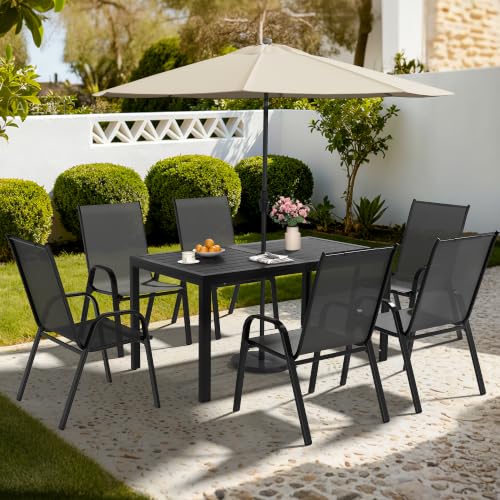
Patio Table with Umbrella and 6 Chairs: The Complete Buyer's Guide
Planning a six-seat outdoor dining setup? This guide walks you through table dimensions, umbrella compatibility, material choices, seating comfort, and layout planning so you can choose a patio table with umbrella and 6 chairs that fits your space and your lifestyle.
Who this guide is for: You already know you want a six-seat patio dining set with an umbrella. What you need now is clarity — how big the table should be, which materials hold up outdoors, what umbrella size pairs correctly, and how to arrange everything without crowding your deck. The sections below answer those questions in order, so you can move from research to a confident choice.
Why a Six-Seat Umbrella Patio Table Is the Sweet Spot for Most Households
A patio table with umbrella and 6 chairs sits in a practical middle ground. It is large enough for a family meal plus a couple of guests, yet compact enough for most standard decks and patios. Four-seat sets feel cramped the moment you host, while ten-seat arrangements demand serious square footage and often dominate the outdoor space.
Six seats also align naturally with common table geometries. Rectangular tables in the 60–72 inch range seat three per long side. Round tables around 60 inches in diameter seat six evenly. Both formats accept a center umbrella without compromising elbow room — a key advantage over narrower bistro-style layouts.
The umbrella itself is the element that transforms this configuration from a fair-weather table into a usable shade structure. A correctly sized canopy keeps the table surface cooler, protects food and drinks, and extends the hours you can comfortably dine outdoors. If shade planning is your primary concern, our broader guide to patio shade solutions covers umbrellas, pergolas, and other approaches side by side.
Table Sizing: How Much Surface Do Six People Actually Need?
The most common sizing mistake is choosing a table that technically seats six but leaves no room for plates, glasses, and a serving dish. Use the following benchmarks as your starting point.
Rectangular Tables
A rectangular table measuring 60 to 72 inches long and 36 to 40 inches wide comfortably seats six adults. Allow roughly 24 inches of table edge per person. The 36-inch width provides enough depth for place settings on both sides plus a center umbrella and a modest serving area.
Round Tables
A round table needs about 60 inches of diameter to seat six without shoulder contact. Round formats encourage conversation and fit well on square patios, but they consume more floor area than a comparably seated rectangular table.
Oval Tables
Oval tables blend the conversation-friendly feel of a round table with the elongated footprint of a rectangular one. They suit long, narrow patios particularly well and typically seat six across a 68–72 inch length.
Clearance Around the Table
Whatever the shape, plan for about 36 inches of clearance on every side where a chair pulls out. If you also want walking space behind seated guests, increase that to 44–48 inches. A six-seat set generally needs a patio or deck area of at least 10 by 10 feet, and 12 by 12 feet feels noticeably more comfortable.
Umbrella Compatibility: Hole Size, Pole Diameter, and Canopy Coverage
The umbrella is where six-seat sets most often go wrong. A table may advertise an umbrella hole, but the hole diameter, pole fit, and canopy span all need to align with the table's dimensions.
Umbrella Hole Diameter
Most patio dining tables use either a 1.5-inch or a 2-inch center hole. Umbrella poles are sized to match. Before ordering, confirm the table's hole diameter and the umbrella's pole diameter — a 2-inch pole will not fit a 1.5-inch hole, and a loose fit causes wobble. Tables designed specifically around a 2-inch umbrella hole pair with heavier poles and tend to feel more stable in breeze.
Canopy Size for a Six-Seat Table
For a rectangular 6-seat table, a 9-foot to 10-foot umbrella generally shades the full table plus the seated guests. A 60-inch round table pairs well with a 9-foot canopy. Oversizing the canopy relative to the table creates an unbalanced look and catches more wind; undersizing leaves the end seats in sun.
Base and Stability
The umbrella base carries most of the stability burden. A base rated for the canopy diameter is essential — a 9-foot canopy needs a substantially heavier base than a 7.5-foot one. If wind is a recurring concern at your location, review options built for exposed sites, such as a wind-resistant patio umbrella, and consider a base designed for the pole you choose.
Through-Table vs. Offset Umbrellas
Through-table umbrellas pass through the center hole and are the classic pairing for six-seat dining sets. Offset (cantilever) umbrellas hang the canopy from a side arm, freeing the table center for serving dishes, but they require a heavy side base and more floor space. For most six-seat dining layouts, a through-table umbrella remains the simpler, more space-efficient choice.
Material Comparison: What Holds Up Outdoors
Table and chair materials determine weight, maintenance, and how the set ages. The table below compares the most common options using relative market positioning rather than absolute figures.
| Material | Market Tier | Best For | Maintenance |
|---|---|---|---|
| Powder-coated aluminum | mid-range | Humid and coastal climates; frequent rearranging | Low — wipe down, touch up chips |
| Teak and hardwood | premium | Long-term investment; natural aesthetic | Moderate — periodic sealing or oiling |
| High-density polyethylene resin | entry-level | Low-maintenance family use; windy sites | Very low — soap and water |
| Wrought iron and steel | mid-tier | Traditional styling; heavy, grounded feel | Moderate — rust inspection and repainting |
| Cast aluminum | high-end tier | Ornate designs without the weight of iron | Low — occasional cleaning |
Powder-coated aluminum is the most popular choice for six-seat sets because it balances durability, weight, and weather resistance. Teak and other premium hardwoods reward owners who accept routine maintenance with decades of service. Resin sets are the practical pick for households that want to hose down the table and move on. For a deeper dive into material behavior, see our notes on wood furniture care and metal versus aluminum construction.
Chair Materials and Stackability
Chair construction matters as much as the table. Aluminum frames with sling or mesh seats dry quickly and stay light. Resin chairs resist moisture and are often stackable, which helps if you store the set seasonally. Wooden chairs feel substantial but need more care. If storage is tight, prioritize chairs that nest or stack; our guide to patio storage boxes covers keeping cushions and small items protected between uses.
Seating Comfort and Chair Fit
A six-seat table only works if the chairs tuck in properly. Check these points before buying:
- Armrest height vs. table apron: Chairs with high arms may not slide under the table edge. Confirm the arm height clears the table apron.
- Seat height: Standard dining chairs sit around 17–19 inches from floor to seat. Match this to the table's standard dining height, typically 28–30 inches.
- Chair depth: Deeper seats feel more comfortable for long meals but need more pull-out clearance. Measure both.
- Cushion thickness: If you plan to add seat cushions, account for the extra height — thick cushions can push knees into the table apron.
Many buyers pair a six-seat table with a mix of chair styles for a collected look. If you go that route, keep seat heights consistent so the table reads as one set. Replacement cushions and covers are worth checking at the same time; our outdoor cushion guide explains fabric ratings and quick-dry foams.
Layout and Placement on Your Patio
Where the set sits affects both usability and umbrella performance. A few placement principles:
- Keep the umbrella away from walls and fences: Canopies need airflow. A table pressed against a solid wall catches gusts and wears faster.
- Orient the long axis along the patio's longer dimension: This preserves walkway space and makes the set feel intentional rather than squeezed in.
- Leave a serving zone: A side table or a small cart near the dining set reduces trips inside. Our guide to patio side tables covers compact options that fit beside a six-seat arrangement.
- Consider sun path: Note where afternoon sun hits. A tilt umbrella or a repositioned table can make evening meals far more comfortable.
If your patio is on the smaller side, a rectangular table oriented along the long edge usually outperforms a round one. For tight spaces, our small deck dining sets guide explores configurations that still seat six without overwhelming the area.
Setup, Care, and Seasonal Storage
A six-seat set with an umbrella involves more moving parts than a simple bistro table, so a little planning pays off.
Pre-Season Setup Checklist
- Assemble the table on a level surface and confirm all bolts are snug.
- Insert the umbrella through the table hole and lock the pole in the base.
- Check that the umbrella crank and tilt mechanisms operate smoothly.
- Test chair pull-out clearance on all six sides.
- Apply a protective cover or sealant according to the material's requirements.
Routine Care
Wipe the table after meals, especially if food or drink spills near the umbrella hole where residue can collect. Rinse chair frames periodically to remove pollen and dust. Inspect the umbrella canopy for mildew and let it dry fully before closing — storing a damp canopy is the fastest route to stains and fabric degradation.
Seasonal Storage
If you live in a region with harsh winters, store cushions indoors and consider covering the table and chairs. Stackable chairs and a folding or removable-leg table simplify winter storage considerably. Our winter storage guide walks through protecting frames, fabrics, and umbrella canopies through the off-season.
Common Mistakes to Avoid
- Buying the table before measuring the patio: Table dimensions plus chair clearance often exceed expectations. Measure first, then shop.
- Ignoring umbrella hole size: A mismatched pole diameter is an immediate return. Confirm 1.5-inch versus 2-inch before ordering.
- Under-sizing the umbrella base: The canopy catches wind; the base must be rated for it. Skimping here is the leading cause of tip-overs.
- Skipping chair fit checks: High armrests or thick cushions can prevent chairs from tucking in, wasting the table's usable depth.
- Overlooking maintenance: Wood needs sealing, metal needs chip touch-ups, and fabric needs drying time. Choose a material whose upkeep matches your routine.
If you are still comparing configurations, the broader six-chair umbrella table collection and our patio table and chair set overview offer additional context on how six-seat sets compare with other sizes.
Frequently Asked Questions
What size patio table seats 6 people comfortably?
A rectangular table of roughly 60–72 inches long by 36–40 inches wide seats six adults comfortably. Round tables need about 60 inches in diameter. Allow approximately 24 inches of table edge per person and 36 inches of clearance around the table for chairs to pull out.
What umbrella size works with a 6-seat patio table?
A 9-foot to 10-foot umbrella generally provides good coverage for a rectangular six-seat table, while a 60-inch round table pairs well with a 9-foot canopy. Confirm the umbrella pole diameter matches the table's hole, commonly 1.5 or 2 inches, and use a base rated for the canopy size.
Which table material is best for a patio table with umbrella and 6 chairs?
Powder-coated aluminum is lightweight, rust-resistant, and well suited to humid or coastal climates. Teak offers a premium look and long service life with maintenance. High-density polyethylene resin is weather-proof and low-maintenance, while wrought iron and steel provide a solid, traditional feel at the cost of weight.
How do I keep an umbrella patio table from tipping in wind?
Use a heavy base sized to the umbrella canopy, keep the umbrella closed during high winds, and position the table on level ground. A crank-and-tilt umbrella can angle the canopy away from gusts. Matching base weight to canopy diameter is the most effective safeguard.
How much space do I need for a 6-seat patio dining set?
Plan for the table footprint plus about 36 inches of chair pull-out space on each side. A typical six-seat set needs at least a 10 by 10 foot area. If you want walking room behind seated guests, roughly 12 by 12 feet feels more comfortable.