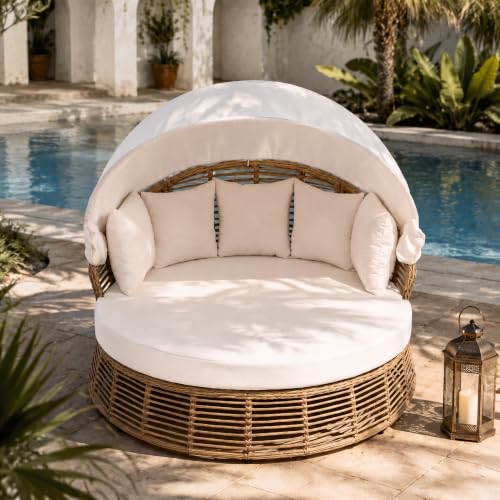
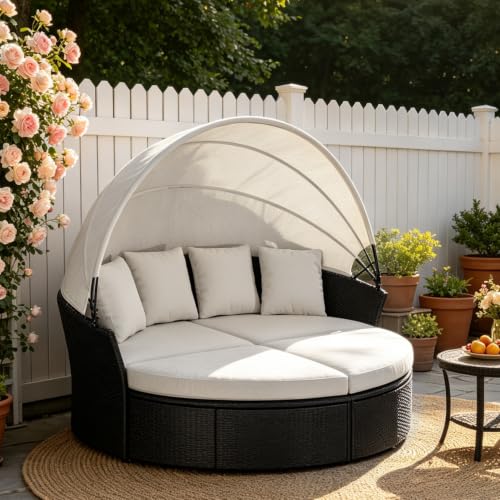
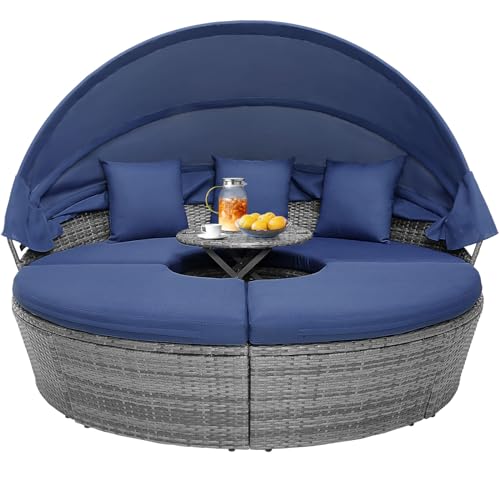
Round Outdoor Daybed: The Complete Buyer's Guide
Everything you need to know before choosing a circular daybed for your patio, poolside, or garden retreat — from frame materials and cushion construction to layout planning and long-term care.
Explore Top PicksWhy a Round Outdoor Daybed Belongs in Your Space
A round outdoor daybed is one of the few pieces of patio furniture that instantly changes how a space feels. Where rectangular loungers line up in rows, a circular daybed creates a natural gathering point — a place that invites conversation, reading, or simply doing nothing at all. The 360-degree seating orientation means no one gets stuck staring at a wall, and the silhouette breaks up the hard angles typical of decks and patios.
Beyond aesthetics, a round daybed solves a practical problem: it maximizes usable seating in a compact footprint. A circular design with a 70-inch diameter can comfortably seat three to four adults, whereas a comparable rectangular bench of similar square footage often seats only two. That efficiency makes these pieces especially valuable for balconies, pool decks, and garden corners where every square foot matters.
Round daybeds also pair beautifully with the rest of an outdoor living setup. They work as a standalone focal point near a round fire pit table, or as a secondary lounge zone beside a round aluminum patio table with umbrella hole. The curved form softens the transition between dining and lounging areas, which is why designers frequently recommend them for open-plan outdoor rooms.
Design tip: A round daybed placed at a 45-degree angle to your home's exterior wall creates a more dynamic, less rigid layout than aligning it parallel to the house. This small rotation also improves sightlines from inside.
Frame & Cushion Materials Explained
The frame and cushion construction determine how a daybed performs through rain, sun, and temperature swings. Understanding the trade-offs between material categories helps you match a product to your climate and maintenance habits.
Frame Materials
- Powder-coated aluminum: The most common choice for round daybeds because it is lightweight, rust-resistant, and easy to reposition. High-grade aluminum with a reinforced weld pattern handles wind better than thinner tubular frames. Look for a rust-proof finish and marine-grade hardware if your patio is coastal.
- Resin wicker over metal: A woven resin shell wrapped around an aluminum core delivers the woven look with better weather tolerance than natural rattan. This category is well-represented in resin wicker patio furniture collections. Entry-level resin can fade under intense UV; mid-range and premium weaves use UV-stabilized strands that hold color longer.
- Solid wood (teak, acacia, eucalyptus): A natural-wood circular daybed brings warmth and a spa-like feel. Teak is the top-tier choice for weather resistance; acacia is a solid mid-range option when sealed annually. Wood frames are heavier and typically stationary.
- Wrought iron and steel: Heavy-duty and stable, but require consistent touch-up to prevent oxidation. Best for covered porches rather than fully exposed lawns.
Cushion and Fabric Construction
- Solution-dyed acrylic: The benchmark for outdoor upholstery. Color is locked into the fiber, so it resists fading and mildew far better than surface-dyed fabrics.
- Olefin: A strong, quick-drying synthetic that performs well in humid climates. Often found on mid-range daybeds.
- Polyester blends: Common on entry-level models. Acceptable for covered patios but less durable under continuous sun exposure.
- Foam core: High-density, open-cell foam drains water and resists compression. Quick-dry foam inserts are the gold standard for uncovered outdoor use.
If you ever need to refresh the upholstery rather than replace the whole piece, replacement options exist for many outdoor seating categories — for example, replacement outdoor cushions for sectional sets can often be adapted to daybed bases with similar dimensions. Matching the foam density and fabric grade to the original is the key to preserving comfort.
Sizing and Placement: Getting the Fit Right
Round daybeds typically fall into three size bands, and choosing the right one depends on both the available space and how you plan to use the piece.
Compact (55–65 in diameter)
Best for balconies, small patios, and solo reading nooks. Seats two adults comfortably. Often available with a foldable canopy.
Standard (66–76 in diameter)
The most versatile band. Seats three to four adults and accommodates a full cushion set plus throw pillows. Ideal for family patios.
Oversized (78 in+ diameter)
Lounge-style proportions that function as an outdoor sofa substitute. Needs at least 3 ft of clearance on all sides for safe movement.
Clearance and Layout Rules
- Allow a minimum of 24–30 inches of walking space around the daybed's widest point.
- If the daybed sits near a pool, keep at least 36 inches from the water's edge to prevent splash damage to cushions.
- On a deck, verify the weight load per square foot — an oversized daybed with a canopy can be surprisingly heavy when fully cushioned.
- Measure doorways and gate widths before ordering; many circular frames ship partially assembled but still exceed standard 32-inch openings.
For tighter spaces, pairing a compact daybed with a round bistro table creates a complete conversation zone without crowding. The scale relationship matters: the daybed should read as the anchor, with the table as a supporting element.
Canopy vs. Open-Air Designs
Canopy daybeds add shade, privacy, and a resort-like aesthetic, but they also introduce maintenance considerations. Here is how the two formats compare in practice.
Canopy Models
- Pros: Built-in sun protection, windbreak for lighter breezes, visual drama, and a defined "room within a room" feel.
- Cons: Fabric tops collect debris and require cleaning; frames catch wind and may need anchoring; replacement canopy fabric is not always available.
- Best for: Poolside settings, sunny climates, and patios where privacy from neighbors is a priority.
Open-Air Models
- Pros: Lower wind profile, easier to clean, unobstructed views, and simpler to cover with a standard furniture cover.
- Cons: No integrated shade — you will need a nearby umbrella or pergola for midday comfort.
- Best for: Covered porches, pergola-shaded patios, and buyers who prefer a minimalist silhouette.
Hybrid option: Several mid-range and premium daybeds ship with a retractable canopy that can be removed seasonally. This gives you the flexibility of both formats without committing to a permanent top.
Comfort Layers: Cushions, Pillows & Support
A round daybed lives or dies by its cushion system. The base pad, back bolsters, and throw pillows each serve a distinct role, and the quality gap between tiers shows up most clearly here.
- Base cushion: Look for a minimum thickness of 4 inches with high-density foam. Entry-level pads often compress within one season; mid-range and premium pads use layered foam or foam-and-fiber blends that retain loft.
- Back support: Circular daybeds typically use a continuous curved backrest or a set of wedge bolsters. Wedge bolsters are more flexible for different sitting angles; continuous backrests offer more uniform support.
- Tie-downs and grip: Cushions should have ties or a non-slip underside. Without them, wind will constantly shift the pad on an open patio.
- Pillow count: A standard daybed benefits from four to six outdoor throw pillows. More than that becomes storage hassle during rain.
If the cushion covers wear out before the foam does, replacement fabric and cushion sets can extend the life of the frame considerably. Buyers refreshing other seating in the same space often explore replacement outdoor lounge chair cushions to keep a consistent fabric story across the patio.
Side-by-Side Category Comparison
The table below organizes round daybeds by market tier and primary use case. Tiers describe relative positioning within the category — they are not absolute measures.
| Tier | Typical Frame | Fabric Grade | Best For |
|---|---|---|---|
| Entry-level | Powder-coated steel or thin aluminum | Polyester blend | Covered porches, seasonal use |
| Mid-range | Reinforced aluminum or resin wicker | Olefin or solution-dyed acrylic (select panels) | Year-round patio use, family settings |
| Premium | High-grade aluminum, teak, or marine-grade wicker | Full solution-dyed acrylic with quick-dry foam | Poolside, coastal, full sun exposure |
| Luxury | Custom-welded aluminum, solid teak, or designer composites | Premium acrylic with replaceable covers | Resort-style installations, long-term investment |
In practice, the mid-range tier is the sweet spot for most homeowners. The jump from entry-level to mid-range brings meaningful gains in frame rigidity and fabric longevity, while the jump from premium to luxury is largely about design exclusivity and custom sizing rather than day-to-day durability.
Maintenance and Seasonal Care
Round daybeds are exposed to more surface area than rectangular loungers, so a simple care routine pays off quickly. Here is a season-by-season approach.
Routine Cleaning
- Brush off loose debris weekly, especially from the curved seat well where leaves collect.
- Clean cushions with a mild soap-and-water solution; rinse thoroughly and dry upright in the sun.
- Wipe metal frames with a damp cloth and dry immediately to prevent water spots.
- For resin wicker, use a soft brush and avoid pressure washers, which can fray the weave.
Seasonal Protection
- Use a fitted cover during off-season months. Breathable covers are preferable to fully waterproof ones, which can trap condensation.
- Store cushions indoors during prolonged rain or winter. Even quick-dry foam benefits from dry storage.
- Inspect welds and hardware at the start of each season; tighten bolts and touch up any paint chips on steel frames.
- If your daybed sits near a dining zone, keeping a round outdoor cushion for bistro chairs on hand ensures the whole seating group gets the same maintenance cadence.
For buyers replacing worn parts rather than the entire piece, the replacement market is broader than it first appears. Cushion covers, foam inserts, and even hardware kits are available for many popular frame styles, which supports the long-term investment case for choosing a well-constructed frame in the first place.
Frequently Asked Questions
How many people can a round outdoor daybed seat?
A compact model (55–65 inches) seats two adults, a standard model (66–76 inches) seats three to four, and an oversized model (78 inches and above) can seat four to five depending on cushion layout.
Can a round daybed stay outside in the rain?
Yes, provided the frame is aluminum or resin wicker and the cushions are quick-dry foam with solution-dyed acrylic covers. Wood and steel frames require more protection or a covered location.
Is a canopy daybed harder to maintain?
The canopy fabric needs periodic cleaning and may need replacement after several seasons of sun exposure. Open-air models are simpler to maintain but require nearby shade for midday use.
What is the ideal clearance around a round daybed?
Plan for 24–30 inches of walking space on all sides. Near a pool, increase that to at least 36 inches to protect cushions from splash and keep traffic safe.
Can I replace the cushions on an existing daybed?
Often yes. Many standard circular frames accept aftermarket cushion sets, and replacement covers are available for common pad shapes. Measure the seat depth and diameter before ordering.