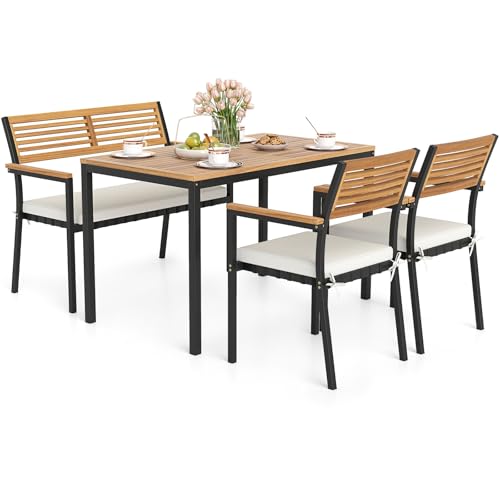
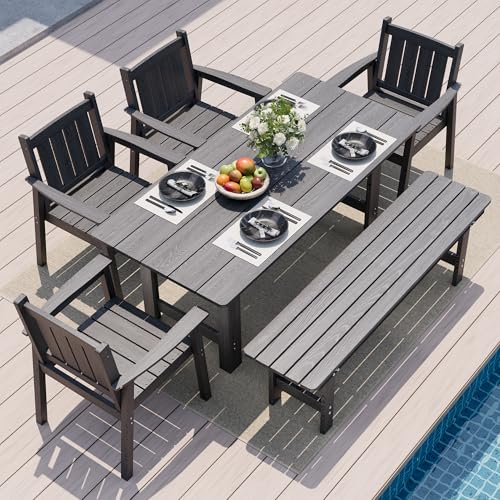
Outdoor Dining Table with Bench and Chairs
A complete buying guide to mixed seating sets — how benches and chairs work together, which frame materials last, and how to choose the right tabletop for your patio.
An outdoor dining table with bench and chairs is one of the most practical seating arrangements you can choose for a backyard, deck, or screened porch. Instead of committing to four identical chairs, a mixed set pairs a long bench on one or two sides with individual chairs on the others. The result is a set that seats more people in the same footprint, packs away more easily when not in use, and adds a relaxed, family-style character that all-chair sets often lack.
This guide is written for buyers who already know they want a bench-and-chair dining set and are now weighing the details: how much seating each layout actually provides, which frame materials survive weather and daily use, how tabletop surfaces affect maintenance, and how to size the table so people can sit and stand comfortably. You will also find guidance on cushions, storage, and the small design decisions that separate a set that lasts a decade from one that looks tired after two seasons.
By the end, you should be able to evaluate any bench-and-chair dining set with confidence — whether you are comparing outdoor dining furniture categories, browsing rustic dining table with bench and chairs styles, or checking a dining table set with an umbrella hole for a sunny spot.
Quick Facts: Bench-and-Chair Dining Sets
- Seating efficiency: A bench typically seats three adults where two chairs would fit, which is why mixed sets are common on compact patios.
- Typical layouts: Bench plus chairs on the opposite side, benches on both long sides with chairs at the ends, or a single bench paired with four chairs.
- Frame materials: Powder-coated aluminum, high-grade steel, solid wood, and resin/poly dominate the market; each trades weight, maintenance, and longevity differently.
- Tabletop surfaces: Slatted wood, metal mesh, faux stone, glass, and composite are the most common; slatted tops drain rainwater best.
- Care cycle: Most sets need a seasonal clean, fastener checks, and a protective cover during off-season storage.
Why Choose a Dining Table with Bench and Chairs?
The appeal of a bench-and-chair set goes beyond seating count. A bench creates a shared, continuous surface that works well for casual meals, kids, and large gatherings, while chairs at the opposite side or ends give guests back support and a clear place to sit. This combination is especially useful on patios where you want to host six to eight people without lining up six individual chairs that each need their own footprint.
Benches also slide completely under many table designs, which frees up walking space between meals. If your patio doubles as a play area or a passage to the garden, that reclaimed floor space matters. And because benches are one continuous piece, there are fewer legs to trip over and fewer joints to loosen over time.
From a design standpoint, a mixed set reads as intentional and lived-in. It suits rustic and farmhouse layouts particularly well, but a clean-lined aluminum bench with a slatted metal table works just as naturally in a modern setting. If you want a more traditional all-chair arrangement, our dining table with chairs and bench guide covers the reverse configuration and when it makes more sense.
Bench vs. Chairs: Honest Trade-Offs
Advantages of a Bench Side
- Seats more people per linear foot of table.
- Slides fully under the table to free up patio space.
- Fewer legs and joints to inspect and tighten.
- Encourages a relaxed, communal dining style.
- Often easier to move as a single piece than four chairs.
Trade-Offs to Accept
- No back support unless the bench has a backrest.
- Getting in and out requires sliding along the seat.
- Heavier to reposition than individual chairs.
- Less flexible for odd-numbered or uneven groups.
- Backless benches can feel less formal for dinner parties.
A practical compromise many buyers land on is a bench with a low backrest on one long side and four chairs on the other. It keeps the space-saving benefits while giving at least half the table proper back support. If your household includes older guests or anyone who prefers a defined seat, prioritize chairs on the side facing the house or the main walkway.
Frame Materials: What Lasts Outdoors
The frame determines how long the set survives sun, rain, and seasonal temperature swings. The table below compares the main options by market tier and maintenance profile — not by any figure — so you can match the material to how much upkeep you are willing to do.
| Material | Market Tier | Best For | Maintenance Profile |
|---|---|---|---|
| Powder-coated aluminum | Mid-range to premium | Humid or coastal climates; buyers who want low upkeep | Rust-proof finish; wipe clean and check fasteners annually |
| High-grade steel | Essential to mid-tier | Structured, heavier sets that stay put in wind | Requires touch-ups on chips; inspect for rust at joints |
| Solid hardwood (teak, acacia, eucalyptus) | Mid-range to luxury | Rustic and farmhouse looks; covered patios | Oil or seal yearly; expect natural color shift |
| Resin / poly lumber | Entry-level to mid-tier | Family patios, poolside, high-traffic use | Soap-and-water cleaning; no sealing needed |
| Wicker over metal frame | Mid-tier | Softer visual texture; covered outdoor rooms | Keep dry; inspect weave for loosening |
For most buyers, powder-coated aluminum is the balanced choice: it is light enough to move, does not rust through like untreated steel, and holds up in humid summers. Wood sets are a worthwhile investment if the patio is covered or if you enjoy the ritual of annual oiling. Resin sets sit at the entry-level end of the market but are genuinely hard-wearing, which makes them a solid choice for households with kids and pets.
Tabletop Types and What They Mean for Daily Use
The tabletop is where the set meets real life: plates, elbows, spilled drinks, and rain. Each surface type behaves differently.
- Slatted wood or composite: Water drains between slats, so surfaces dry quickly. Requires periodic sealing on natural wood; composite is lower upkeep.
- Metal mesh or perforated steel: Very durable and drains well, but can feel hot in direct sun and may show scratches over time.
- Faux stone or ceramic: Resists staining and heat, gives a premium look, and is heavy — best for permanent placements.
- Glass: Easy to wipe and visually light, but needs careful handling and shows water spots unless treated.
- Solid composite panels: Uniform surface, no drainage gaps, and generally very weather-resistant; slightly heavier than aluminum mesh.
If the table will sit in full sun and you plan to add an umbrella, confirm the top already has a pre-drilled hole. Many bench-and-chair sets do, but not all. Our guide to the outdoor dining set with umbrella hole explains how hole placement and umbrella base sizing interact.
Sizing the Table for Benches and Chairs
Bench-and-chair sets fail most often because the table is too narrow or too short for the seating mix. As a rule of thumb, allow roughly 24 inches of table edge per seated adult, and leave at least 12 inches between the table edge and any wall or railing so people can slide in and out.
Rectangular tables pair most naturally with benches because the bench length can match the table length. If your space is tight, a square table with a two-person bench on one side and two chairs on the other is a compact, efficient layout. For very small patios, consider whether a round patio dining table with umbrella hole plus a curved bench is a better fit than a long rectangle.
Cushions, Comfort, and Fabric Choice
Benches are firm by design, so cushions are not optional for long meals. Look for bench cushions that tie down or use non-slip backing, and check that the cushion depth matches the bench seat depth — an oversized cushion will slide and bunch. Chairs should have removable, washable covers where possible.
Fabric matters as much as foam. Solution-dyed acrylic and olefin are the standard choices for outdoor use because they resist fading and mildew. If you are matching new cushions to an existing set, our guides to outdoor dining replacement cushions and outdoor furniture fabric cover thickness, fill types, and colorfastness in more detail.
One practical detail: if the bench has a backrest, confirm the cushion is designed for a backed bench rather than a flat one. The two profiles are not interchangeable, and a flat-bench cushion on a backed bench will ride up every time someone leans back.
Care and Long-Term Maintenance
A bench-and-chair set is a long-term investment, and most of the maintenance is seasonal rather than daily. A simple routine keeps the structure sound and the finish intact:
- Weekly: Wipe the tabletop and brush off debris from bench slats so water drains freely.
- Monthly in season: Check bolts at bench legs and chair joints; tighten anything that has worked loose.
- Seasonally: Wash frames with mild soap, rinse, and dry. Treat wood with the manufacturer's recommended oil or sealant.
- Off-season: Store cushions indoors and cover the frame with a breathable cover. Our weatherproofing guide walks through cover selection and ventilation.
If you notice rust spots on a steel frame, address them early with a rust-removal treatment and a matching touch-up coating. Small chips become large problems when water gets under the finish. Our rust removal guide covers the step-by-step process without damaging surrounding paint.
Alternative Configurations Worth Considering
Bench-and-chair is one layout among several. If your priority shifts — more shade, more warmth, or more storage — these related configurations may suit you better:
- A dining table set with a fire pit extends the usable season into cooler evenings.
- A table with a cooler in the middle keeps drinks cold without a separate cooler on the patio.
- A rustic farmhouse table with bench and chairs leans further into the farmhouse aesthetic with heavier timber profiles.
- A table with a fire pit in the middle combines dining and ambiance in a single footprint.
If you are still deciding between dining and lounging priorities, browsing outdoor patio furniture categories side by side can clarify how much of your patio you want to dedicate to a full dining footprint versus a more flexible arrangement.
Frequently Asked Questions
How many people does a bench-and-chair set actually seat?
A standard bench paired with a same-length table typically seats three adults per bench side. Adding chairs at the ends or opposite side usually brings a six-foot table to six or eight seats total. Always check the manufacturer's stated seating count against your own measurements.
Should the bench go on the house side or the yard side?
Put the bench on the side with the least foot traffic and the best view. Chairs on the traffic side make it easier for guests to pull out and stand up, while the bench side becomes the relaxed, scenic seating.
Do I need a backrest on the bench?
Not strictly, but a low backrest makes long meals far more comfortable. If the set will be used for quick breakfasts and kids' snacks, a backless bench is fine. For dinner parties, choose a backed bench or place chairs on the side where adults will sit longest.
Can a bench-and-chair set stay outside all year?
Aluminum, resin, and composite sets can generally remain outdoors year-round in mild climates. Wood and steel benefit from a breathable cover during off-season months, and cushions should always be stored indoors to prevent mildew.
How do I keep a bench from tipping when someone sits on the end?
Choose a bench with legs set well inboard from the ends, or one with a center support leg on longer models. Avoid very lightweight benches on windy, exposed decks — heavier frames and wider leg spreads are more stable.
Ready to Compare Bench-and-Chair Sets?
Use the recommendations below to explore models that match the frame, tabletop, and seating layout you have settled on. Each listing opens on the retailer's product page so you can verify dimensions, materials, and warranty details before deciding.