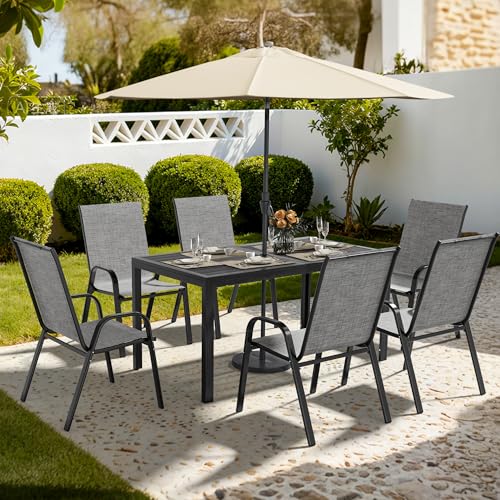
Patio Table with Chairs That Fit Underneath
Everything you need to choose a tuck-under patio dining set that keeps your outdoor space tidy, protects your chairs, and makes cleaning effortless.
A patio table with chairs that fit underneath is one of the most practical choices for any outdoor dining area. When the chairs slide fully under the table, you free up walking space, protect the seats from rain and sun, and make sweeping or hosing down the patio far easier. For anyone researching this kind of set, the real question is not whether tuck-under chairs are useful, but which table height, shape, and chair design actually deliver that clean, tucked-in look.
This guide walks through the measurements and design details that matter most. You will learn what clearance a chair needs to slide under a table, how table shape affects seating comfort, why umbrella holes interact with chair placement, and which materials hold up best over time. By the end, you should feel confident comparing tuck-under sets and choosing the one that fits both your space and your daily routine.
What "Chairs That Fit Underneath" Really Means
The phrase sounds simple, but in practice a chair only tucks in properly when three conditions are met: the table apron is high enough, the chair back is low enough, and the chair arms are shaped to clear the table edge. If any one of these fails, the chair will stop partway and stick out into your walkway.
Most outdoor dining tables fall into a standard height range of roughly 28 to 30 inches. Standard dining chairs sit at about 17 to 19 inches at the seat, which leaves enough room for the seat and lower back to slide under. The tricky part is usually the armrests. Wide or high armrests can catch on the table apron, so sets designed for tucking often use armless chairs or arms that sit below the apron line. When you shop, look for sets explicitly described as space-saving or tuck-under, because the manufacturer has already matched the chair geometry to the table.
Clearance is the single most useful number to check. A good rule of thumb is that the underside of the table should sit at least 2 to 3 inches above the top of the chair's seat and armrests combined. If you plan to keep cushions on the chairs, add their thickness to the chair height before comparing. For a deeper look at matching pieces, see the broader patio table and chairs selection guide, which explains how table and chair sizing work together.
Table Shape and How It Affects Tucking
The shape of the tabletop changes how many chairs can tuck in and how comfortable the seating feels.
Round tables are the friendliest for tuck-under seating. There are no corners to catch a chair back, and the curve lets chairs sit slightly angled inward without clashing. A round table also works well on compact patios because it has no sharp corners in tight walkways. Two-person sets are especially easy to tuck because the chairs slide in from opposite sides.
Square tables offer a similar benefit and tend to maximize seating for their footprint. Four chairs, one per side, can usually tuck in neatly as long as the chair backs are not too tall. Square sets are a popular middle ground between round and rectangular designs.
Rectangular tables tuck chairs well along the long sides, but the corners and legs need attention. A leg positioned at the corner can block a chair from sliding in fully, so look for pedestal bases, offset legs, or trestle designs. Rectangular sets are the right pick when you need to seat six or more, and they pair naturally with umbrella setups. If shade is a priority, explore patio table and 6 chairs with umbrella configurations, which often include tuck-friendly chair designs.
Chair Types That Slide Under Easily
Not every outdoor chair is built to tuck. Here are the chair styles that work best, along with what to watch for in each.
Armless dining chairs are the most reliable choice. With no armrests to snag, the entire chair back clears the apron as long as the table is standard height. They are common in bistro and four-person sets, and they stack in many models, which helps with winter storage.
Low-arm chairs work if the arms sit below the table apron. This style gives you the comfort of armrests without the tuck-in problem. Check the arm height against the table's underside measurement before committing.
Stackable chairs are worth considering because they are usually designed with compact geometry. Many plastic and resin stackable models have a gentle back curve that slides under standard tables. If you want to keep a few spare chairs on hand for guests, a stackable design keeps the extras out of the way.
Swivel and rocking chairs generally do not tuck well. Their bases are wider and their motion requires clearance, so they are better left as accent seating. Benches are another option: a backless bench slides under a rectangular table cleanly, and paired benches create a picnic-style setup. For a bench-focused approach, look at picnic table designs, many of which combine a fixed tabletop with tuck-in benches.
The Clearance Checklist Before You Buy
Use these checks to confirm a set will actually tuck before you order it.
- Table height: Confirm a standard dining height of about 28 to 30 inches. Counter-height and bar-height tables rarely allow chairs to tuck fully, because the seats are much higher.
- Apron depth: A deep decorative apron lowers the usable clearance. A slimmer apron gives chairs more room to slide in.
- Chair back height: Compare the chair's total height to the table height. Chairs with very tall backs will always protrude above the tabletop, which is fine visually but can block a tight walkway.
- Seat and armrest height: Measure from the floor to the top of the seat and to the top of the armrests. Add cushion thickness if cushions stay on year-round.
- Leg placement: Corner legs and thick legs eat into tuck space. Pedestal and offset-leg tables are more forgiving.
- Umbrella hole position: A center hole is usually fine, but the umbrella pole can interfere with a chair pushed straight in from one side. Offset or tilted umbrellas solve this; see the patio shade guide for options.
Umbrella Holes and Tuck-In Seating
Many tuck-under dining sets include a center umbrella hole, and this is where small design choices start to matter. A center pole rises from the middle of the table, so a chair pushed in from the side where the pole sits may need to angle slightly. The fix is straightforward: choose a table with an offset hole, use a tilted umbrella, or simply leave the pole-side chair angled a few degrees.
The hole diameter also matters when you later buy a replacement umbrella or base. Common sizes differ, so match the hole to the pole. If you already own an umbrella, check the patio table with 2 inch umbrella hole reference to confirm compatibility before purchasing a new table. Pairing a tuck-under set with a weighted base also keeps the umbrella stable during breezy afternoons, which matters when chairs are frequently sliding in and out around the pole.
For households that entertain often, a set with a built-in umbrella and matching chairs simplifies everything. The patio table with umbrella and 4 chairs style is a common tuck-under configuration, and larger versions exist for bigger families.
Space Planning Around a Tuck-Under Set
Tucking chairs in saves room, but you still need walking space when the chairs are pulled out for a meal. A practical guideline is to allow about 24 inches of pull-out space per chair, plus roughly 36 inches of main walkway behind the seating. On a narrow balcony or small deck, a round or square four-person set usually fits best, with chairs tucked during the day and pulled out only for meals.
For genuinely tight areas, two-person sets are the easiest to live with. The patio table and chairs for 2 category covers compact bistro and cafe-style options, many of which are designed specifically for chairs to slide fully under. If your patio is a small deck, the patio table and chairs for small deck guide narrows down footprints that still leave room to move.
It also helps to think about how the table is used day to day. If you mostly eat outdoors on weekends but use the patio for reading or morning coffee during the week, a tuck-under set doubles as a clean, open surface. Push the chairs in and the table becomes a workspace or a serving spot without clutter.
Materials That Hold Up Outdoors
A tuck-under set lives outside all season, so material choice affects how long the tuck-in geometry stays smooth. Frames that warp or rust can change clearance over time and make chairs harder to slide in.
Powder-coated aluminum is a strong all-around choice. It resists rust, stays lighter than steel, and holds its shape in heat and humidity. Many mid-range tuck-under sets use aluminum frames with a weather-resistant coating.
High-grade steel is heavier and very stable, which is helpful on windy patios. Look for rust-proof finishes and check that joints are welded or reinforced rather than riveted, since rivets can loosen with repeated sliding.
Resin and plastic are practical for starter-tier and essential-tier sets. They resist moisture completely and are easy to wipe down. High-density resin can mimic wood grain convincingly while staying lighter and maintenance-free.
Wood brings warmth and is a natural fit for rustic and coastal styles. Teak and acacia are the most common outdoor woods; both need occasional sealing to prevent swelling that could tighten the tuck space. If you go this route, plan on a seasonal care routine, similar to what the weatherproofing guide recommends for outdoor furniture.
Choosing by Tier: What Each Level Delivers
Instead of comparing specific figures, it helps to understand what each quality tier typically offers for a tuck-under set.
- Entry-level tier: Basic round or square sets, often plastic or resin, with simple armless chairs. Good for balconies and seasonal use; the tuck geometry is straightforward and reliable.
- Mid-range tier: Aluminum or steel frames with better welds, smoother chair backs, and sometimes stackable chairs. This is where you start seeing thoughtful apron design that genuinely helps chairs slide in.
- Premium tier: Heavier frames, refined powder coatings, and chairs with shaped low arms that clear the apron comfortably. Tables often include umbrella holes sized to standard poles and sturdier bases.
- Luxury tier: Solid teak or high-grade metal with precision joints and long warranties. These sets are built as long-term investments and hold their tuck clearance for many seasons.
A mid-range set is usually the sweet spot for households that eat outside regularly, because the chair geometry and frame durability are noticeably better than starter sets without moving into the luxury category. Whichever tier you choose, verify the clearance measurements first; they matter more than any single material upgrade for tuck-under performance.
Practical Buying Tips
Before ordering, measure your patio and sketch the layout with chairs pulled out, not just tucked. Confirm the delivery path: a large rectangular table may not fit through a narrow gate or up a stairwell, while a round table with a removable top is easier to move. Check whether the set ships assembled or requires tools; chairs that need assembly are fine, but verify that the back and arms align as designed, since misaligned assembly can ruin the tuck fit.
Read the product description for the words "space-saving," "tuck-under," or "chairs fit under table," and look at customer photos showing the chairs pushed in. If you need umbrella compatibility, confirm the hole diameter and whether a base is included. Finally, consider storage for the off-season. Tuck-under sets are compact, but stacking chairs and a foldable tabletop make winter storage even simpler.
Final Thoughts
A patio table with chairs that fit underneath is a smart, space-efficient choice that keeps your outdoor dining area looking intentional. Focus on clearance first, then table shape, then chair design, and you will avoid the most common mistake of buying a set where the chairs only half-tuck. With the right measurements and a sensible tier choice, your set will serve you comfortably for years, and your patio will stay open and easy to clean whenever the chairs are pushed in. Browse the related table and chair guides linked above to compare specific configurations and find the fit for your space.