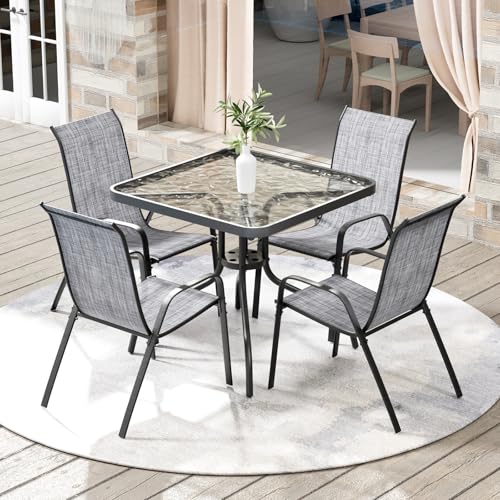
Glass Patio Table and Chairs with Umbrella: The Complete Buying Guide
A glass-top patio dining set with a coordinated umbrella blends open-air dining with reliable shade. This guide explains glass types, frame construction, umbrella compatibility, sizing, and long-term care so you can choose a set that fits your space and climate.
Jump to Buying ChecklistWhy Homeowners Choose a Glass Patio Table with Chairs and Umbrella
A glass patio table and chairs with umbrella appeals to buyers who want an airy, open dining area that does not visually crowd a deck or patio. A transparent top reflects light, keeps sightlines to the landscaping, and pairs naturally with a shade canopy mounted through a central hole. For compact spaces, this combination delivers three functions at once: a dining surface, seating for four to six, and sun protection without a permanent structure.
Compared with solid stone or heavy cast tops, a glass top is lighter to move and easier to wipe down after meals. The trade-off is that glass demands a properly tempered panel and a frame that flexes little under load. Buyers researching outdoor dining options often compare glass sets against wood and metal builds; our overview of garden table and chairs for a small garden is a useful cross-reference if your patio footprint is limited.
Who this set suits best: households with four to six diners, a patio with at least partial sun exposure, and a storage plan for the umbrella canopy during high-wind seasons. Households in hail-prone or heavy-freeze regions should review the weather section before committing.
Anatomy of a Glass Patio Dining Set with Umbrella
Every set in this category has five interacting parts. Weakness in any one of them shortens the life of the whole. Understanding how they connect helps you evaluate listings with more confidence.
1. The Glass Tabletop
Tempered glass panels are typically 5 mm to 10 mm thick. Thicker panels reduce flex and feel more substantial under hand pressure. Edge finishing matters: a polished or beveled edge resists chipping better than a rough cut. The umbrella hole is usually reinforced with a metal or plastic grommet to prevent stress cracks from the pole.
2. The Table Frame and Rim
The rim supports the glass and transfers load to the legs. Powder-coated aluminum, steel, and occasionally resin are common. A wide rim with rubber or silicone pads underneath the glass reduces rattle and distributes pressure. If you are weighing frame philosophies across the wider patio category, our guide to heavy-duty patio tables with umbrella holes explains how load ratings are usually expressed.
3. The Legs and Base
Leg design determines stability and how much floor space the set occupies. Splayed legs spread weight outward but take up more room. Straight legs are tidier on small balconies. Cross-bracing or a lower shelf noticeably improves rigidity on rectangular models.
4. The Chairs
Chairs in matched sets share frame material and finish with the table. Stackable chairs save space when the umbrella is packed away. Cushioned seats improve comfort but require fabric rated for outdoor exposure.
5. The Umbrella and Base
The umbrella passes through the table hole but is anchored by a separate weighted base. Canopy fabric, pole diameter, and tilt mechanism all affect how usable the shade is at different times of day. The base is the safety component most often underweighted by first-time buyers.
Glass Types and Safety: What to Confirm Before Buying
Not all glass on outdoor furniture is equivalent. Three specifications matter most.
- Tempered vs. annealed: Tempered glass is heat-treated and breaks into small granular pieces rather than long shards. It is the baseline expectation for patio tabletops. Annealed glass should be avoided outdoors.
- Thickness: 5 mm to 6 mm is common on entry-level sets; 8 mm to 10 mm appears on mid-range and premium builds and feels noticeably more stable.
- Edge treatment: Flat-polished or beveled edges resist chipping. Exposed sharp edges are a red flag for both safety and manufacturing quality.
Some manufacturers apply a tint or a subtle texture to hide smudges and water spots. Clear glass shows fingerprints more readily but keeps the surface visually open. Frosted or textured surfaces are easier to maintain in pollen-heavy regions.
| Glass Specification | Typical Tier | Best For |
|---|---|---|
| 5–6 mm tempered, flat-polished edge | Entry-level | Covered patios, seasonal use, lighter dining loads |
| 8 mm tempered, beveled edge, grommet hole | Mid-range | Year-round covered use, families with four to six diners |
| 10 mm tempered, textured or tinted, reinforced hole | Premium to high-end tier | Exposed patios, high-traffic entertaining, windy sites |
If your table will sit on an exposed deck, also review glass table tops with umbrella holes for reinforcement details and how the cutout is sealed.
Frame Materials Compared
The frame decides how long the set survives and how much maintenance it demands. Four materials dominate the market.
Powder-Coated Aluminum
The most common choice for glass-top sets. Aluminum does not rust, is light enough for one person to reposition, and holds a powder coat well. Mid-range and premium aluminum frames use thicker tube walls and welded joints rather than self-tapping screws. This is the balanced default for most households.
Steel
Steel frames feel heavier and resist tipping in wind, but require intact coatings. Any chip that exposes bare metal becomes a rust point. Steel is often found on entry-level sets, where the coating quality is the variable to inspect closely.
Wicker and Rattan over Metal
Woven synthetic wicker wrapped over an aluminum or steel frame softens the look of a glass top. The weave adds texture and hides minor scuffs, but debris can collect in the weave. HDPE wicker is the most weather-stable option; our overview of HDPE outdoor furniture explains why.
Wood and Composite
Solid wood frames around glass tops are less common outdoors because wood expands and contracts against a rigid panel. Composite and recycled plastic frames avoid that problem and are increasingly used on heavy-duty sets. For broader context on frame durability across categories, see garden furniture that can be left outside all year.
| Frame Material | Tier | Best For |
|---|---|---|
| Powder-coated aluminum, welded joints | Mid-range to premium | Most patios; low maintenance; easy repositioning |
| Powder-coated steel | Entry-level to mid-tier | Wind-exposed sites where frame weight helps stability |
| Synthetic wicker over aluminum | Mid-range | Softened visual style; covered patios and porches |
| Composite or recycled plastic | Premium to commercial-grade | High-traffic dining, coastal exposure, heavy use |
Umbrella Fit, Coverage, and Wind Behavior
The umbrella is where most buyers underestimate complexity. Three measurements determine whether the shade actually works.
Hole Diameter and Pole Fit
Most glass patio tables have a hole between 1.5 and 2 inches. Measure the opening and match it to the umbrella pole. A pole that is too loose will wobble and stress the glass edge; a pole that is too tight will not seat fully. Some premium sets include a reducing ring to accommodate different pole sizes.
Canopy Size and Table Coverage
As a rule of thumb, the canopy should extend about 24 to 36 inches beyond the table edge on each side to shade the seated diners. A four-seat rectangular table usually pairs with a 9-foot canopy. A six-seat table benefits from 10 feet. Larger canopies catch more wind and demand a heavier base.
Base Weight and Anchoring
The table hole stabilizes the pole but does not anchor it. A weighted base rated for the canopy size is mandatory. Cantilever umbrellas do not use the table hole at all and require their own offset base. For windy sites, review heavy-duty wind-resistant patio umbrellas and pair them with a base rated above the canopy's wind load.
Tilt and Rotation
A tilt mechanism lets you angle shade as the sun moves. Crank-and-tilt systems are standard on mid-range models. Collar-tilt systems are simpler but require manual adjustment. Rotation is a cantilever feature, not a through-table feature.
Practical tip: If your patio receives afternoon sun from one direction only, a fixed through-table umbrella is sufficient. If sun direction shifts across the day, a tilt mechanism saves you from repeatedly moving the base.
Sizing the Set to Your Space
Measure the patio first, then choose the table. Allow 24 to 30 inches of clearance between the table edge and any wall, railing, or planter so chairs can pull out comfortably.
- Four-seat round or square glass table: typically 36 to 42 inches across. Good for balconies and compact patios.
- Four-seat rectangular glass table: commonly around 60 by 36 inches. Fits narrow patios and seats four without crowding.
- Six-seat rectangular glass table: commonly around 66 by 40 inches. Needs a patio depth of roughly 8 feet including chair pull-out.
- Hexagonal glass table: seats six around a central umbrella with efficient use of floor area.
If your space is tight, the comparison in glass-top patio dining table 66 x 40 shows how a six-seat rectangle fits relative to chair clearance. For smaller layouts, glass-top patio table and 4 chairs covers the four-seat configuration.
Chair Pairing and Comfort
Matched sets remove most compatibility risk. If you buy chairs separately, confirm seat height, arm clearance, and frame finish match the table.
- Stackable chairs: best for seasonal use and small storage areas.
- Sling chairs: quick-drying, low maintenance, good for rainy climates.
- Cushioned chairs: most comfortable for long meals; require outdoor-rated foam and fabric.
- Swivel or rocking chairs: add comfort but increase the footprint and reduce how many chairs fit per side.
Chair arms should not overhang the glass edge, which concentrates impact stress. For a broader comparison of chair builds, see garden chairs and garden seats.
Weather, Wind, and Seasonal Handling
Glass-top sets handle normal rain and sun well. Two conditions require planning.
Wind
An open umbrella acts like a sail. During high-wind forecasts, lower the umbrella, remove the canopy, or move the set to a sheltered area. A heavy base reduces tipping but does not eliminate canopy stress. If your site is consistently windy, prioritize a steel or composite frame for weight and a base rated above your canopy size.
Freezing and Hail
Freeze-thaw cycles stress glass edges and frame joints. In cold climates, store the glass top indoors or use a fitted cover that does not trap moisture. Hail can crack tempered glass; a cover during hail season is a sensible precaution. Our guide to heavy-duty waterproof patio furniture covers explains fit and ventilation.
Coastal Exposure
Salt air attacks steel quickly. Aluminum, composite, and HDPE frames are the safer choices near the coast. Rinse frames monthly with fresh water to slow corrosion on hardware.
Care and Maintenance
Glass-top sets are low maintenance when cleaned regularly and stored sensibly.
Routine Cleaning
- Wipe the glass with a soft microfiber cloth and mild soap solution.
- Avoid abrasive pads, powdered cleansers, and ammonia-heavy sprays that dull the surface.
- Rinse and dry to prevent water spots, especially in hard-water areas.
- Clean the umbrella hole grommet to prevent debris buildup that stresses the cutout.
Seasonal Checks
- Tighten frame bolts at the start and end of the season.
- Inspect the glass edge for chips; a chipped edge can propagate into a crack.
- Check the umbrella base for cracks and confirm the weight rating is still appropriate.
- Store cushions and canopy fabric dry to prevent mildew.
For broader maintenance routines that apply across patio furniture, see garden furniture you can leave out all year.
Buying Checklist
Use this list when comparing listings. Each item maps to a specification you can verify in the product description or by asking the seller.
- Glass is tempered and at least 8 mm thick for year-round use.
- Edge is polished or beveled, not rough-cut.
- Umbrella hole has a grommet and matches your pole diameter.
- Frame is powder-coated aluminum or composite for low maintenance.
- Joints are welded or bolted with locking hardware, not self-tapping screws alone.
- Glass sits on rubber or silicone pads to reduce rattle and stress.
- Chairs match the table in seat height, arm clearance, and finish.
- Umbrella base is rated for the canopy size and local wind conditions.
- Set fits your patio with 24 to 30 inches of chair pull-out clearance.
- Storage plan exists for the canopy and cushions during off-season.
Comparative shopping note: Sets in the mid-range tier generally offer thicker glass, welded frames, and better grommet reinforcement than entry-level sets. Premium and high-end tiers add heavier tube walls, textured glass, and larger canopies. Compare features within a tier rather than across tiers to keep the evaluation fair.
Frequently Asked Questions
Is a glass patio table durable enough for year-round outdoor use?
Tempered glass is the standard for outdoor tables and is significantly stronger than standard glass. A well-built glass patio table with a powder-coated or rust-resistant frame handles normal weather well, though in regions with extreme hail or freezing cycles a protective cover or seasonal storage is recommended. Always confirm the glass is tempered rather than annealed.
What size umbrella fits a glass patio table with an umbrella hole?
The hole diameter on most glass patio tables is 1.5 to 2 inches. Match your umbrella pole to that opening and choose a canopy that is roughly 24 to 36 inches wider than the table on each side. For a four-seat rectangular table, a 9-foot umbrella is a common fit; for a six-seat table, 10 feet gives better coverage.
How do I clean a glass patio table without scratching it?
Use a soft microfiber cloth and a mild soap-and-water solution. Avoid abrasive pads, powdered cleansers, and ammonia-heavy products that can dull the surface. Rinse thoroughly and dry with a clean cloth to prevent water spots.
Do I need an umbrella base with a glass patio table set?
Yes. A table hole only stabilizes the pole; it does not anchor the umbrella. Use a weighted base rated for your umbrella canopy size and your local wind conditions. Cantilever umbrellas require their own dedicated base and do not rely on the table.
Can glass patio chairs be used with a glass-top table?
Yes, as long as both pieces belong to a matched set or share compatible frame materials and seat heights. Avoid mixing chair arms that extend over the glass edge, which can cause impact stress. Matched sets from the same manufacturer usually have the best fit and finish.