Patio Umbrella Stand for 11 Foot Umbrella: The Complete Buying Guide
An 11 foot umbrella delivers generous shade for dining tables, loungers, and deep seating, but that larger canopy also catches more wind. The stand you pair with it is the single most important stability decision you will make. This guide explains base weight, footprint, pole compatibility, and material choices so you can buy with confidence.
Who this guide is for: You already know you want an 11 foot umbrella. You are now researching the base that will hold it safely through summer afternoons and gusty evenings. Below you will find the practical criteria that matter most, organized so you can compare options quickly and make a well-informed purchase.
Why an 11 Foot Umbrella Needs a Different Stand
An 11 foot canopy is roughly 20 to 30 percent wider than a common 8 or 9 foot model. That extra diameter adds surface area, and surface area is what wind pushes against. The result is more leverage on the pole and more rotational force at the base. A stand that feels perfectly stable under a smaller umbrella can feel marginal under an 11 foot canopy, especially in open yards, rooftop terraces, or coastal settings.
Manufacturers account for this by specifying minimum base weights and recommended pole diameters for each canopy size. Treat those specifications as a floor, not a target. When your patio is exposed, choosing a base above the stated minimum gives you a safer margin. If you are still deciding on the umbrella itself, our guide to heavy-duty patio umbrellas pairs naturally with this base research.
Base Types for 11 Foot Umbrellas
There are three main stand families, and each suits a different patio layout. The right choice depends on whether you need the pole directly under the canopy or offset to the side.
1. Traditional Center-Pole Bases
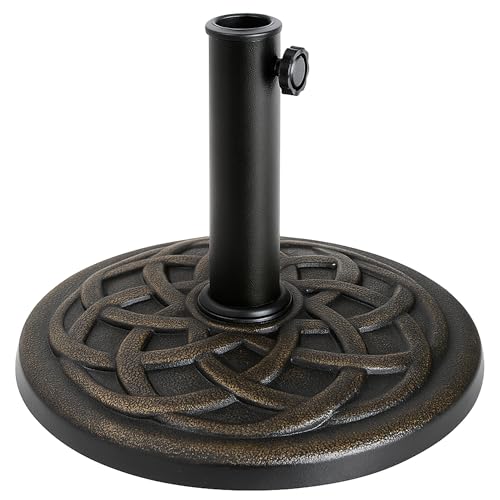
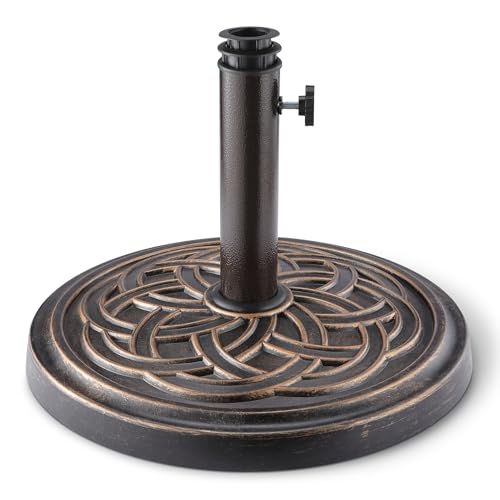
The pole passes through the table and into a base on the ground. These are the most common and the simplest to set up. For an 11 foot umbrella, look for a base with a wide, flat footprint and enough weight to match the canopy. Center-pole bases work best when your table has a properly sized umbrella hole, such as a patio table with a 2 inch umbrella hole. If your table lacks a hole, a free-standing base placed beside the table can work, though the pole will occupy floor space.
2. Cantilever and Offset Bases
Cantilever umbrellas rotate the canopy away from the base so the space underneath stays clear. This is a favorite for deep seating and lounge areas. The trade-off is that the base must be substantially heavier and wider because it carries the canopy on an arm. For 11 foot cantilever umbrellas, buy a base rated for that canopy size and follow the assembly instructions precisely. Offset bases pair well with patio side tables and lounger arrangements where a center pole would be in the way.
3. Weighted Plate and Panel Bases
Many heavy-duty stands use a plate or panel design that accepts removable weights, such as paving stones or water-filled sections. This is convenient for seasonal setups and for patios where a single very heavy base would be hard to move. The key is to fill the weights completely and check them periodically, since partially filled panels reduce stability. Plate-style bases are also easier to store in winter.
How to Match the Base to Your Umbrella
Before comparing models, gather three measurements from your umbrella: pole diameter, canopy size, and the manufacturer's recommended minimum base weight. These three numbers narrow the field immediately.
| Tier | Best For | Typical Characteristics |
|---|---|---|
| Essential tier | Sheltered patios and light use | Compact footprint, lighter fill, best with smaller canopies and protected locations |
| Balanced tier | Everyday residential use with an 11 foot canopy | Wider footprint, reinforced collar, accepts added weights, good all-around stability |
| Heavy-duty tier | Exposed yards, windy sites, large canopies | Substantial mass, broad base plate, rust-resistant finish, often anchor-ready |
| Commercial-grade | Hospitality and high-wind environments | Maximum stability, robust hardware, designed for frequent repositioning and anchoring |
Use these tiers as a relative comparison rather than an absolute ranking. A balanced-tier base from a well-engineered brand can outperform a heavy-duty-tier base with a narrow footprint. The point is to match the base's design intent to your canopy size and site conditions. Our overview of patio umbrella bases covers additional form factors if you want to compare across styles.
Pole Compatibility: The Detail Buyers Miss
An 11 foot umbrella stand is only as good as its collar fit. A loose collar lets the pole wobble, which accelerates wear and undermines stability. Measure your pole diameter with a caliper or a firm tape measure, and check whether the base includes adapter sleeves for multiple sizes. Many stands ship with a primary collar plus one or two adapters, which adds flexibility if you later change umbrellas.
If your pole is on the thicker side, confirm the base is explicitly rated for it. Forcing a pole into an undersized collar can crack the housing or strip the tightening mechanism. If you are pairing a base with a table, make sure the table's umbrella hole is large enough to clear the pole and any adapter. Our guide to patio tables with chairs and an umbrella shows how hole sizing affects the overall setup.
Materials and Weather Resistance
Outdoor bases live in sun, rain, and temperature swings. The materials you choose determine how the base looks and performs over several seasons.
- Powder-coated steel: Dense and stable, with a finish that resists rust when intact. Inspect for scratches and touch up as needed.
- Cast iron and cast aluminum: Heavy and stable, often used in premium and heavy-duty tiers. Aluminum versions are easier to reposition.
- Resin and polypropylene: Lightweight and weather-tolerant, often used in fillable designs. Stability depends on proper weighting.
- Concrete-filled housings: Very stable and low-maintenance, though heavy to move once filled.
Look for a weather-resistant coating, rust-proof hardware, and a base plate that sits flat on your patio surface. On stone or paver patios, a flat plate with a protective pad prevents scratching. If your patio is paved with pavers, check that the base does not wobble across joints; a slightly larger plate usually bridges gaps better.
Stability and Wind Considerations
Wind is the primary reason umbrella stands fail. An 11 foot canopy acts like a sail, and a sudden gust can tip a marginal base. The practical steps are straightforward: choose a base above the manufacturer's minimum, place it on level ground, and close the umbrella when wind picks up.
If your patio is exposed, consider a base that can be anchored or one with a very wide footprint. Avoid placing the umbrella where wind channels between a house and a fence. For patios that need maximum hold, our article on patio umbrellas that won't blow over explains how canopy shape and venting interact with base stability. Pairing a vented canopy with a heavy-duty base is one of the most effective combinations.
Also think about the surface under the base. A base on loose gravel or soft turf settles unevenly. On a stone patio or a retaining wall edge, confirm the base sits fully supported and does not overhang an edge.
Placement: Table, Side Table, or Freestanding
Where the base sits shapes how you use the space. Through-table setups keep the floor clear and center the shade over dining. Freestanding setups offer flexibility but consume floor area. A common compromise is a base positioned beside a side table with an umbrella hole, which keeps drinks close while preserving the dining surface.
For dining arrangements, a base that fits under the table is convenient but must still meet the weight recommendation. Check clearance between the base and chair legs so guests do not stub toes. If you are still assembling the dining area, our guides to tables with six chairs and an umbrella and table and chair sets with an umbrella show how base placement affects seating comfort.
Setup and Maintenance Checklist
- Unbox the base on a flat surface and confirm all hardware and adapters are present.
- Fill removable weights completely, then recheck tightness after the first week.
- Seat the pole fully into the collar and tighten the locking mechanism firmly.
- Check stability by gently rocking the pole; there should be minimal movement.
- Inspect the finish and hardware each season and touch up scratches to prevent corrosion.
- Store removable weights indoors during freezing weather if the manufacturer recommends it.
- Close the umbrella during storms and when the patio is unattended for long periods.
Common Mistakes to Avoid
The most frequent error is using a base intended for a smaller canopy. The second is under-filling a weightable base. The third is ignoring pole diameter and forcing an ill-fitting collar. Each of these shortens the life of the umbrella and increases the risk of tipping. A fourth mistake is placing the base on an uneven surface, which lets the pole lean and stresses the collar.
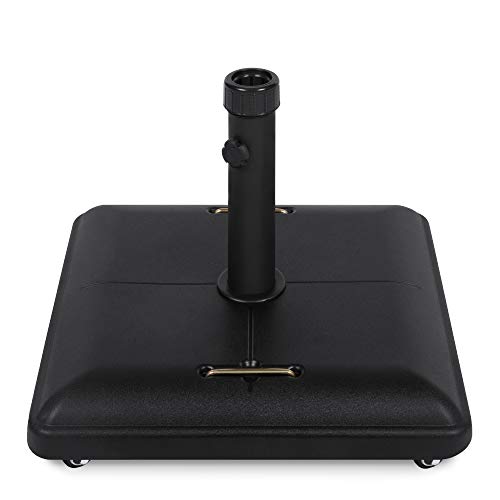
Finally, do not overlook how the base interacts with the rest of your outdoor setup. A heavy base can be difficult to move on a patio store display floor but is easy to slide on smooth pavers. Test the base on your actual patio surface before committing to a permanent position. If you plan to reconfigure often, consider a base with a handle or wheels in the balanced or heavy-duty tier.
Frequently Asked Questions
How heavy should a base be for an 11 foot patio umbrella?
Follow the umbrella manufacturer's stated minimum, and choose a base above that minimum for exposed sites. An 11 foot canopy needs substantially more mass than a 7 to 9 foot canopy, so a heavy-duty tier base is the safer default.
Can a standard base hold an 11 foot umbrella?
A standard entry-level base is generally too light. Larger canopies catch more wind, so a balanced or heavy-duty tier base with a wider footprint is the better fit.
What pole diameter does an 11 foot umbrella stand need?
Measure your pole before buying. Common sizes include 1.5 inch and 2 inch diameters, and many bases include adapter collars. Confirm the base is rated for your pole size rather than forcing a fit.
Are cantilever bases better for 11 foot umbrellas?
Cantilever bases free up the space under the canopy and suit lounge layouts. They require a heavy, wide base rated for the canopy size. Follow the offset and anchoring guidance in the manual.
How do I keep an 11 foot umbrella from tipping in wind?
Use a heavy-duty base, confirm it is fully weighted, place it on level ground, and close the umbrella during strong gusts. Anchoring the base where permitted adds an extra layer of security.
Ready to compare options? Use the recommended products below to review heavy-duty bases and compatible stands for 11 foot umbrellas. Check pole diameter, base footprint, and material finish against the criteria in this guide before you decide.