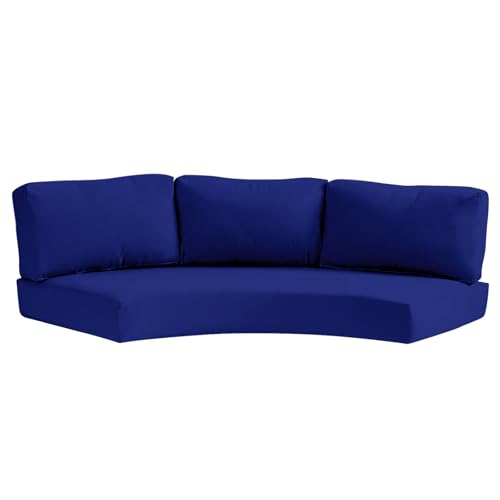
Replacement Curved Cushions for Outdoor Furniture
Curved patio seating looks elegant, but finding cushions that follow the contour can feel like a puzzle. This guide walks you through measurement, material choices, shape matching, and fitting so you can refresh your set with confidence.
Why this page matters: If you already own a curved outdoor sofa, round daybed, or barrel-style lounge chair, you are likely in the research stage — you know a replacement is needed, but you want to get the fit right the first time. Curved cushions are not one-size-fits-all, and a poorly matched cushion can slide, bunch, or wear out early.
Below you will find a practical framework for choosing replacement curved cushions, from tracing your seat shape to comparing cover fabrics and foam cores. If your furniture is a different style, you can also explore broader guides such as replacement cushions for outdoor furniture or replacement cushion sets for outdoor furniture.
1. Understand What Makes Curved Cushions Different
Curved outdoor furniture — whether a half-moon sofa, a rounded sectional, or a barrel chair — uses cushions that follow a bent frame. Unlike flat rectangular cushions, a curved cushion must match the radius of the seat, the depth of the backrest, and any taper toward the arms. Getting this right affects comfort, appearance, and how long the cushion lasts.
There are two common approaches:
- Curved-specific cushions: Pre-shaped cushions designed for round, arc, or barrel seating. These are the best fit for pronounced curves.
- Flexible rectangular cushions: Some gently curved seats accept a slightly oversized flat cushion that bends into place. This works best on shallow curves and soft foam.
If your furniture is a sectional or L-shaped piece, the same principles apply but with more segments — see replacement cushions for outdoor sectional furniture for a segmented approach.
2. Measure Your Curved Seating Correctly
Accurate measurement is the single most important step. A tape measure alone is not enough for curved frames — you need a template of the seat shape.
Step-by-step measuring method
- Trace the seat: Lay kraft paper or cardboard over the seat and press along the frame edges. Cut the template to match the curve exactly.
- Record key dimensions: Widest width, front-to-back depth at the center, depth at the sides, back height, and seat height.
- Note the radius: For round daybeds or arc sofas, measure the inner curve radius. This helps when ordering custom cushions.
- Check arm and back clearances: Cushions should not press against armrests or block reclining mechanisms.
- Measure the old cushion: If the original cushion still exists, measure it flat and note any compression or sag.
For round and deep-curve pieces, replacement cushions for outdoor round daybed and replacement cushions for curved outdoor sofa pages cover shape-specific measurement details.
3. Choose the Right Foam Core and Thickness
The foam determines comfort and how well the cushion holds its shape over time. Curved cushions benefit from a foam that flexes without collapsing at the curve.
| Tier | Foam Type | Best For | Notes |
|---|---|---|---|
| Entry-level | Standard polyurethane foam | Occasional seating, covered porches | Lighter and softer; may compress faster on curved seats. |
| Mid-range | High-density polyurethane or layered foam | Daily patio use | Balanced support and flex; good for gentle curves. |
| Premium | Quick-dry reticulated foam | Poolside and rainy climates | Water drains quickly; resists mildew and sagging. |
| Luxury | Memory foam or wrapped foam core | Deep lounge seating | Soft top layer with supportive base; excellent contour recovery. |
Thickness matters too. A 3-inch cushion suits dining and upright seating, while 5–6 inches is better for lounging. On a curved seat, overly thick foam can buckle — a mid-range high-density foam often holds the curve better than a very soft luxury foam.
4. Select Weather-Ready Cover Fabrics
The cover is what you see and touch, and it takes the brunt of sun and rain. For curved cushions, a slightly stretchy or well-tailored fabric helps the cushion wrap the frame cleanly.
- Solution-dyed acrylic: Excellent UV resistance and color retention; a top-tier choice for sunny patios.
- Olefin: Lightweight, moisture-resistant, and good for humid climates.
- Polyester blends: Entry-level to mid-range option; look for UV-treated versions.
- Performance weaves: Tightly woven fabrics resist pilling and are easier to clean.
Choose removable, zippered covers so you can wash and store them seasonally. If you are replacing only the covers, see replacement cushion covers for rattan furniture or replacement cushion covers for wicker furniture for fabric-specific guidance.
5. Match the Cushion to Your Furniture Material
Curved frames come in many materials, and each has slightly different cushion needs:
| Frame Material | What to Look For | Related Guide |
|---|---|---|
| Rattan / wicker | Non-abrasive ties, breathable covers, snug curve fit | Replacement cushions for rattan furniture |
| Wicker | Soft backing to protect weave, moisture-wicking foam | Replacement cushions for wicker furniture |
| Teak | Secure ties, quick-dry core for open slats | Replacement cushions for teak outdoor furniture |
| Wrought iron | Reinforced edges, anti-slip base | Replacement cushions for wrought iron patio furniture |
| PVC | Fade-resistant fabric, easy-clean covers | Replacement cushions for PVC patio furniture |
For vintage or older curved pieces, replacement cushions for vintage patio furniture explains how to adapt modern cushions to older frame shapes.
6. Fit, Fastening, and Anti-Slip Tips
Even a well-measured cushion can shift on a curved seat. Keep these fitting details in mind:
- Tie-downs: Look for reinforced straps or elastic loops that anchor to the frame.
- Non-slip underlay: A mesh or grip pad between foam and frame reduces sliding.
- Darted or piped edges: These help the cushion hold its curve instead of flattening.
- Zipper placement: A concealed zipper on the back edge looks cleaner on curved backs.
- Allow for compression: Foam settles slightly; a snug fit is better than a loose one.
7. Care and Seasonal Storage
Proper care extends the life of replacement cushions and keeps the curve intact:
- Brush off debris weekly and wipe spills promptly with mild soap and water.
- Let cushions air-dry fully before storing; standing them on edge helps water drain.
- Store covers and foam separately in a dry, ventilated space during off-season.
- Avoid stacking heavy items on curved cushions, which can flatten the foam.
- Rotate seat cushions periodically to distribute wear evenly.
If you are also refreshing other parts of your set, the replacement cushions for 3 piece outdoor patio furniture set guide covers multi-piece coordination.
Frequently Asked Questions
How do I measure curved outdoor furniture for replacement cushions?
Measure the widest point of the seat and the deepest point from front to back, then trace the curve onto paper or cardboard to create a template. Note the back height and any armrest cutouts so the new cushions follow the same contour.
Can I use standard rectangular cushions on curved outdoor furniture?
Rectangular cushions can work on gently curved seats, but they may buckle or leave gaps along the front edge. For pronounced curves, a custom or curved-specific cushion gives a cleaner fit and better comfort.
What materials are best for curved outdoor cushions?
Look for solution-dyed acrylic or olefin covers with UV resistance, plus a quick-dry foam core that resists mildew. Removable, zippered covers make cleaning and seasonal storage easier.
How often should curved outdoor cushions be replaced?
Most outdoor cushions last several seasons with proper care. Replace them when the foam loses loft, covers fade or tear, or moisture no longer drains quickly after rain.
Ready to Refresh Your Curved Seating?
Use the measurements and material notes above to narrow your options. When you are ready, browse recommended curved cushion options below and compare features, fabrics, and fit details.